![PortStrategy[GreenPort]](https://www.portstrategy.com/wp-content/uploads/2026/09/PortStrategyGreenPort.svg)





Moving targets
Comparing apples with apples is mission near-impossible when it comes to reachstacker emissions, as Alex Hughes finds out
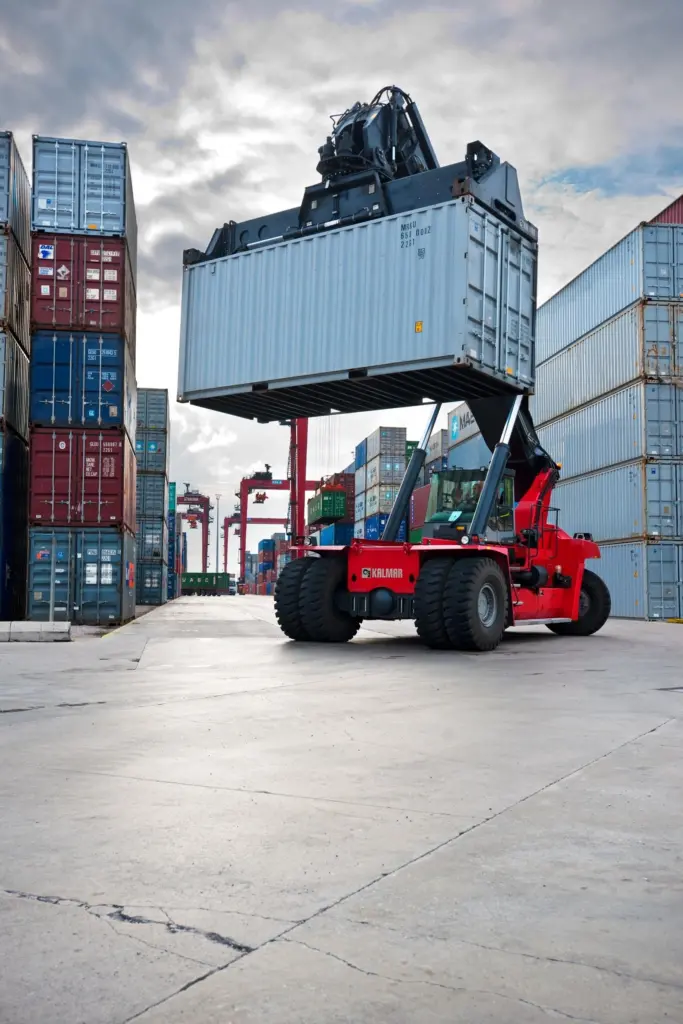
Determining which reachstackers are the least polluting and which are the most environmentally friendly is not a task for the fainthearted.
The problem is best summed up by Anders Sjöstrand, chief designer at Konecranes. “It is not easy to estimate number of particulates per g/kWh and rate of NOX per g/kWh since there are so many parameters to consider in order to get reliable figures. For example, estimated fuel consumption for one of our 4531 reachstacker is 15-18 litres per hour, but this also depends on different parameters and perhaps mostly on how the driver handles and manoeuvres the machine.”
Regardless of the difficulty of comparing like for like, Konecranes maintains that it is a world leader in reachstacker engine emissions levels. Mr Sjöstrand points out that a lot of investment is made in R&D to find ways of reducing these, examples being the Eco-drive and hydraulic load-sensing systems.
Similar claims are made by Cargotec, where Mikael Persson, vice president reachstackers and empty container handlers, notes that its 45-ton DRF450 reachstacker, which is equipped with a Tier IIIB engine, produces “less than” 0.025 particulates g/kWh and “less than” 2 NOX g/kWh, which are the current standards.
These emission levels – combined with optimised drivelines and state-of-the-art technology – place Cargotec very firmly in the vanguard of reachstacker development, he says.
Emission count
When asked to define emissions levels emitted by a similar Hyster reachstacker, Herman Klaus, the company’s product strategy manager, simply states: “We currently meet or exceed emissions levels as required by the Environmental Protection Agency.”
As for CVS Ferrari, export area manager Paolo Tavola observes that the company has only just started tests to determine exact levels and that no precise information yet exists. However, he stresses that emissions from all 3B engines that it uses have emissions levels in line with legislation.
Significantly, Mr Tavola claims that the company’s reachstackers offer the best fuel economy of all manufacturers operating in this sector.
“We have feedback from clients who have been able to reach 11 litres per hour. With the Euromot Step 4 stage we should be able to reduce fuel consumption further,” he says.
Clearly, in many cases, while conceding that many factors may influence emissions, manufacturers are accurately able to predict fuel economy, despite this being influenced by a whole host of external factors, too. This suggests that perhaps emissions are not uppermost in most customers’ minds.
Mr Sjöstrand says the importance Konecranes customers’ attach to exhaust emissions very much depends on the location of the terminal. In general, he says, operators don’t give priority to this area, although tend to do so if there is a legal or local demand for low emissions.
“Price is a consideration when buying a reachstacker, but if a customer is concerned about emissions this is often driven by fuel economy as much as anything else,” he says.
Different rules
Mr Persson points out that emissions levels vary considerably from country to country. In Europe, these are regulated by law to use the latest emission engines. However, as he points out: “You can find customers who market themselves as ‘green’ and buy reachstackers with the latest and best emission levels even if regulations in their country don’t require it. In this respect, emissions levels are considered more important than price.”
On the whole, he concedes that it is environmental requirements, in combination with fuel economy, rather than health and safety concerns, that have been behind the drive towards lower emissions in recent years.
Mr Klaus suggests that, at the present time, many of Hyster’s customers are still unaware of new emissions legislation and the impact that it will ultimately have on their buying decisions. Even those that are in the loop are hardly in a rush to adopt the new technology.
“Many terminal operators that do understand Tier 4 are not very interested in going there yet for a variety of reasons, including having to pay much higher up-front costs and the additional hassle involved in such aspects as urea, DPF and regeneration. They also have real concerns about the stability of the new technologies.”
Price tag
Asked where its customers consider emissions to be more important than price, Mr Klaus notes, “Tier 4 is the law of the land, so it will be more a question of compliance rather than price or emissions.”
In the short term, during the period of transition, most customers can still opt for either Tier 3 or Tier 4, although that choice is not available for all, since some ports or municipalities do require “best available technology” for reduced emissions. In other cases, there are financial or other incentives to utilise Tier 4 technologies as soon as possible.
“In the end, while there are many companies interested in low emissions, more are currently pursuing Tier 3 engines (for lower price and reduced hassle and maintenance),” says Mr Klaus.
Mr Tavola notes that different CVS customers also attach varying levels of importance to emissions, although in both Europe and the US terminals this is nowadays a “crucial issue”. However, he adds that price, performance, reliability and maintenance costs are also key factors, too.
As to whether emissions are ever considered more important than price, he says: “If a customer opts for a Tier 3B engine, this most likely means that they have already decided that emissions are more important. But most end users still opt for reachstackers equipped with the 3/A Euromot step engines, which help them save money.”
First moves
According to Mr Sjöstrand, “Konecranes is an ‘early adopter’ of new rules and regulations regarding emissions.” He points out that it was among the first suppliers to implement these in respect of stage IIIB engines, which use up to 7% less diesel fuel and are significantly quieter. “Needs and demands differ a lot depending on what part of the world that we are delivering to. For example, operators in Europe and North America mostly demand 3b/Tier4i engines; in Korea it is 3a engines. Other parts of the world are still happy about using machines with Tier 2 engines,” he says. However, he says that there is more to engine emissions than this, adding: “An awful lot depends on how the driver handles the machine, too.”
Mr Persson agrees, emphasising that Cargotec places emissions reductions high up the priority development list. However, he agrees that “there are more things to consider than just the engine to get lower emissions and better fuel economy”.
Mr Klaus says that Hyster has already been able to achieve significant fuel economy improvements with Tier 4 versus Tier 3 engines, but says that most other Tier 4 solutions do not result in improved fuel economy, especially when the cost of DEF (urea) is factored in.
“For the companies that are already moving forward with Tier 4, the desire to be greener and the health benefits associated with Tier 4 technology go hand-in-hand,” he says.“Nevertheless, for most users, the reduction of emissions has come at a high cost: higher purchase price, requirement of Diesel Exhaust Fluid (urea) and higher maintenance, but with no other benefits.”
Related Articles
 CONTAINER & CARGO HANDLING
 CONTAINER & CARGO HANDLING
 BULK HANDLING