![PortStrategy[GreenPort]](https://www.portstrategy.com/wp-content/uploads/2026/09/PortStrategyGreenPort.svg)






Multilift: for and against
Terminals pursuing growth want to maximise the productivity of every lift cycle. That is why the trend is towards twin-lifts from ship-to-shore and twin-lifts on the yard, says Bromma. But does it necessarily follow that a universal rush to multilift spreaders is justified? Felicity Landon reports.
Buying the equipment for multilifting containers is one thing – putting it into action is quite another and can bring a host of problems. According to Richard Clarke of civil engineering consultancy group Halcrow, the continuing drive towards twin, tandem or quad lifts is throwing up a series of issues for container terminal operators – the most serious being the increased load on quayside crane rails.
“The crane load on to the rails on the quay has jogged along at fairly normal loads for the past ten to 12 years, going up steadily as the crane got bigger – but not massively, ” he says. “But tandem lifts or quad lifts put the rail loads up quite dramatically.
“It has changed the design premises on new work and is causing some existing installations some pretty fair problems. Even if you just have to change a rail section on the quay it is very, very disruptive.
Because you have to put the rail down in quite long lengths, to change just the rail system on a typical 300m berth means a month’s shutdown and that is not good news. Depending on what sort of quay it is, if you actually have to strengthen the quay too, you are looking at several months.”
At a time when operators are looking at multilifts as a way of squeezing more volumes through an already tight situation, this is clearly disastrous.
Bromma was the first to market with its Tandem telescopic spreader, which is up and operating at Hutchison’s Yantian terminal.
The company has also received a second Tandem contract for Sahid Rajadee (Bandar Abbas) Iran.
As well as productivity, terminals want flexibility, says Bromma’s spokesman, Brian Lewis. “The container mix can change from year to year. Separating twins, and of course spreaders like Bromma’s Tandem, are quite versatile in what they can do.
“One of the benefits of Bromma’s approach to Tandem is that it can be used immediately on a terminal’s existing container cranes of a certain lift capacity, as opposed to the dual-hoist crane approach, ” he adds.
Crane spreader sales at Bromma rose by more than 35% in 2005 compared to 2004. In all, the company sold more than 800 telescopic crane spreaders. “To put 2005 in perspective, I believe this 800+ container crane spreader number likely exceeds the total sales of all of Bromma’s competitors combined. In 2005 growth was particularly dramatic in the ship-to-shore and yard spreader segments, ” he says.
He believes that Bromma’s spreader diagnostics and communications technology, SCSC, is a big part of its STS spreader story. STS45 separating twin-lift spreaders ordered in the last quarter 2005 included 22 for the European container terminal Euromax, nine for Panama Ports, seven for Sahid Rajadee and seven for Jurong Port.
Demand for STS45 twin-lift spreaders remains strong around the world, adds Lewis. In early 2006, orders have been particulary strong from Asia, where Bromma received contracts for 39 spreaders in January and February. Orders for the yard crane segment have also been strong.
At the end of 2005, Bromma took on three more engineers, bringing the total to 29, plus some consultants.
The single biggest focus of its R&D is design and technology to push spreaders to a higher level of reliability, says Lewis. As well as increased emphasis on diagnostics, part of this is simplified electrics, reducing wires and connection points so there is less that can go wrong.
The CANopen technology incorporated into its SCSC in 2005 enables Bromma to move the input-output points to where the actuators and sensors are located, rather than running the information on wire to the SCSC node. “This reduces wiring big-time;
from as many as 19 wires to two wires per box. The benefits are common sense; fewer wires equals fewer wiring problems.”
Bromma continues to pioneer all-electric spreaders, which have been successfully introduced in their hundreds on the yard side. The all-electric approach offers weight reduction and, therefore, energy savings. Bromma does have a simple single-lift all-electric ship-toshore crane spreader in its portfolio but has been reluctant to deliver all-electric twin-lift or separating twin-lift spreaders.
“Bearing in mind the large number of separating ship-to-shore spreaders that Bromma delivers every week, it is very careful and conservative when doing something like evaluating possible transition to all-electric twin-lift or separating twin-lift design, ” says Lewis.
“Further, Bromma extensively field tests any and every new spreader design at one of the terminals that serve as its test partners before it can be offered for general commercial sale.” By way of example, he says, Bromma was operating its prototype Tandem spreader at an APM terminal for more than a year before it was put on general sale.
TWINLIFT VS MULTILIFT VDL Smits Spreaders, which will be launching a complete new product range this year, is largely disregarding the possibility of lifting any more than two containers at a time.
“The normal twin-lift spreader is still a good spreader and that will be renewed, ” says Smits’ Frank van Laarhoven. “But as far as we can see now, we don’t have the intention of going very quickly into manufacturing something where we can pick up more than two containers.
“It is absolutely a nice market and product but for working with a tandem lift the capacity of the crane must be so high that the locations where this could be used are so small – and that is the way we see it. It is more of a marketing item than one that will work out as standard.”
He too highlights the issue of whether many quays and backyard areas are strong enough for the weight of a crane built to handle multilifts. “There are not so many places in the world where this could be used, ” he says.
And then, of, course, positioning and picking up four containers at once is quite difficult. “Probably doing two twin lifts is quicker anyway – and what if you want to pick up just one container or a 20 and a 40?
There are reasons for not going into this too quickly.”
This year will see the first major changes after the acquisition of Smits Spreaders by VDL at the back of 2004.
In the middle of last year, van Laarhoven joined VDL Smits from Elme, where he was sales manager; he arrived with two former Elme colleagues, clearly brought in to breathe new life into the Dutch operation.
This year Smits Spreaders production will move from the original Smits Brothers factory at Someren into a new purpose-built factory on the other side of Eindhoven, where it will share 10,000 sq m of manufacturing space, 2,000 sq m of offices and, by all accounts, quite a few synergies with a number of other VDL companies. The move will coincide with the launch of a completely redesigned product range which focuses on standardisation rather than the Smits tradition for specialisation.
“Smit was famous for its special products; if no one else could make it, then we could. We will keep making specials but we will also have, with a very good price, a standard product. That is what we are developing now and with that we will go into the market with a strategy of sharp prices and high quality, ” says van Laarhoven.
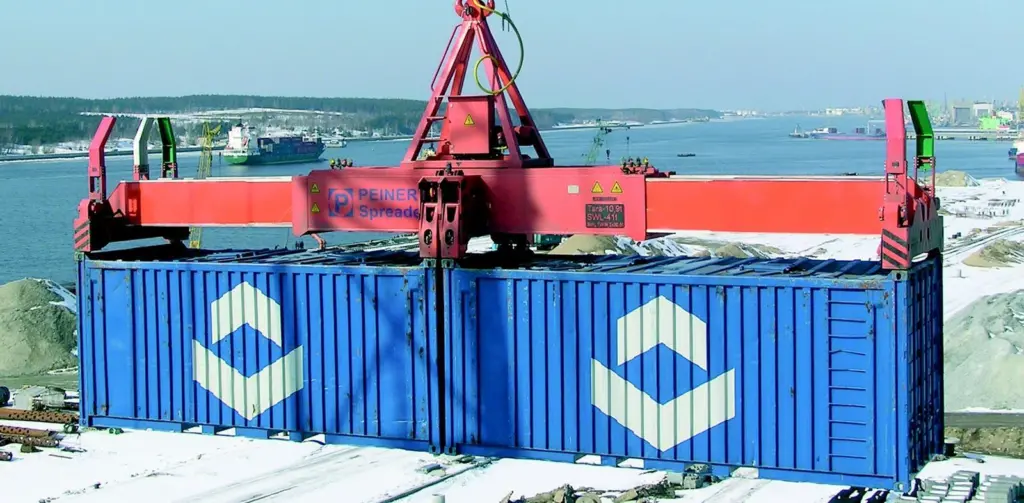
A relatively new – but also long-established – name in the market is Peiner Spreaders, which were relaunched by SMAG in 2001.
Peiner Spreaders’ sales manager Werner Meyer says the order situation looks very good and recent deliveries have included spreaders for mobile harbour cranes in Lithuania. “We just commissioned a twin spreader for these requirements and will also be commissioning spreaders in the UK. We are also just working on spreaders for low temperature requirements in Russia, ” says Meyer.
“Regarding the design work of our spreaders, we have changed lots of items regarding the old versions of Peiner Spreaders built by the former owner, Noell. The effect is an absolute excellent optimised and competitive product. Our spreaders are built in close cooperation with our customers. Not all of our competitors are able to show an interest in the customer’s wishes.”
Related Articles
 CONTAINER & CARGO HANDLING
 CONTAINER & CARGO HANDLING
 BULK HANDLING