![PortStrategy[GreenPort]](https://www.portstrategy.com/wp-content/uploads/2026/09/PortStrategyGreenPort.svg)





New dimensions
Inroads into 3D modelling technology are providing a new vision for port operators. John Bensalhia reports
Anything is possible. An established fact or misplaced optimism? While it’s difficult to get from A to B via teleport or for animals to talk in human language, advancements in technology have made the once impossible into something simple. It’s possible to fit a complete film or TV series on your shelf, thanks to the DVD miracle. When communicating, it’s possible to do so by video. And when it comes to 3D solutions, what was once regarded as the dream of the future has become reality.
Ashebir Jacob, senior port planner and engineer and simulation project principal at Moffatt & Nichol, says that computer technology development has made 3D modelling and visualisation more realistic and less computational intensive. “Civil engineers are using 3D modelling techniques to create photo-realistic images to visualise the bridges, buildings, roads, etc. on computer screens before they are constructed. In addition to static pictures, we can create animations to demonstrate and study operational processes.”
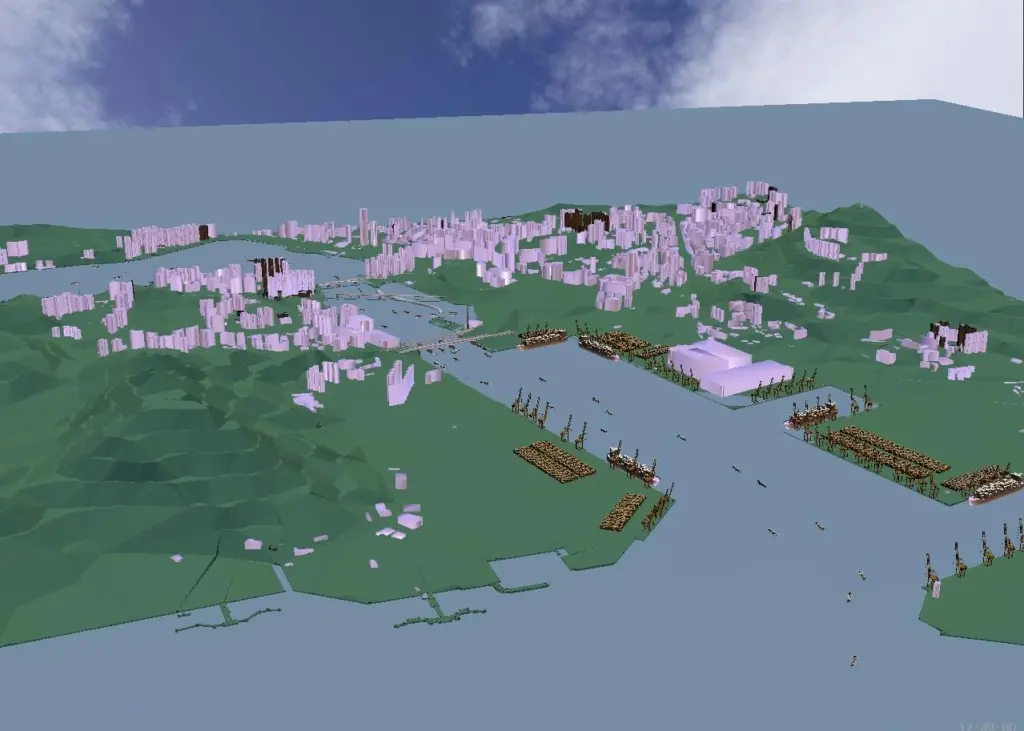
“If we’re looking at specific 3D modelling techniques with regard to port design and management, it’s essentially a case of being able to visualise what’s going in a busy port,” says Professor Ajit Shenoi of the University of Southampton. “You can represent the physical environment at any given moment and depict buildings, cranes, roads and ships, for example, very accurately in three dimensions.
“You can also represent movement in 3D in real time moving trucks, lorries and forklifts moving between ships and containers on the portside. And you can look at aspects such as access and logistics which can be anticipated and simulated as to where and how different items can be stored in different containers and buildings before they are moved on. You can simulate certain bottlenecks or problems and if you can anticipate their causes you can gauge their implications in advance and seek solutions in the early stages of development.”
Professor Shenoi says that applying 3D modelling for the sea allows the operator to consider the undersea terrain in and around a particular port. “You’re able to look more closely at the many approaches to that port and simulate the movement of the ships as they manoeuvre and come alongside a berth, particularly how much distance they require to stop and at what speeds. If there’s a new ship being built which is much bigger than what we’ve seen before that can be simulated in advance so that the shipping company and the master of that ship along with the port and the pilot can all see the same simulation and learn from it.”
Photo realism
Richard Colwill, managing director of BMT Asia Pacific, says that there are two main advantages. “When researching the ‘human element’ of navigation, 3D modelling better represents the environment so that more realistic decisions are made,” he explains. “This is important as ships get bigger as most navigation during its final stages within port basins is driven by pilots response to visual clues.”
“The other main advantage is that it permits 3D party decision makers to better recognise and understand constraints. This is increasingly called for given the proliferation of such 3D visualisation in computer games and engineering design software, such as BIM.”
Professor Shenoi says that a big benefit is safety. “If you use 3D modeling to simulate port conditions as possible you can begin to predict all of the factors that contribute to safety including the weather, peak time traffic, the logistical movement of Lorries, cranes and forklift trucks moving portside. Also, protecting the environment from spillages or emissions or accidental discharges can be anticipated, simulated and modelled so steps could put in place to mitigate these possibilities.”
Professor Shenoi adds that cost-wise, 3D modelling can help anticipate potential problems. “With 3D modelling, you are able to simulate how and where you want things using the computer. Otherwise you would have to construct and rectify any problems once you’ve completed the build. The more time you spend modelling, the less time you should have to spend fixing mistakes later. Time and cost are the main two benefits.”
With respect to financial considerations, a good rule of thumb is to assess existing solutions. Mr Colwill says: “When we look to bringing 3D into each aspect of port modelling the best tack is to ride on the back of existing developments in 3D for process system modelling where these companies are developing 3D into their standard products in order to meet customer expectations.” Mr Colwill says that this turns what used to be line process charts and ASCI data dumps into full 3D models with animations. “Port simulation can ride on the back of other people’s investment, so the additional financial cost is not high.”
Common user
Advances in technology have meant that it’s both easier and faster to work on 3D modelling projects. “Due to the recent development of computer hardware and software advances, simulation and 3D modelling can now be performed in shorter time frames using a regular desktop or laptop PC,” says Cornelis Versteegt, port automation specialist and simulation adviser at Moffatt & Nichol.
A key point in keeping costs low is reusability. Moffatt & Nichol’s FlexTerm software is a fully object-oriented simulation tool which offers full 3D modelling environments and 3D visualisation and animation. This allows for reusing model objects and parts of models in new simulation studies. “Multiple modelers can easily work on the same model through source control software tools by using the text-based XML file structure supported by FlexTerm,” says Mr Versteegt. “These features significantly reduce development and modeling costs. Such tools and functionalities have driven the cost of performing simulation significantly lower than before.”
Prior to these breakthroughs in the field, traditional simulation had typically been used in the design of larger ports and container terminals. But thanks to the reduction in costs of simulation and 3D modelling, smaller ports and container terminals are using these methods for design.
With technology evolving constantly, the future of 3D modelling will expand and play a greater role in port development. Mr Jacob says: “The development of 3D modelling and simulation is headed towards the direction of increased ease of use, more realistic visualisation, faster running speeds, faster modeling speeds, lower development costs and better and easier input and output analysis.”
Emulating success
Mr Jacob says that another innovation expected to be used in the future is that of emulation. “Emulation connects the simulated environment, a virtual world, with the real world control system to help terminal operators make smarter decisions and allow them to adjust strategies in real time. This allows port and terminal operators to test and optimise their control systems and software before the actual port or terminals have been built. It also shortens the development and testing time of the port and terminals.”
“Shipping companies are pretty sophisticated particularly when it comes to container trade and Ro-Ro,” concludes Professor Shenoi. “So when you’re shipping cars or shipping containers or managing cruise ships, these are all very sophisticated vessels travelling and arriving at ports which are just as sophisticated in terms of their operations on the ground.
“Modern ports are pretty sophisticated operations. Two that I’ve been to recently – Shanghai and Singapore – are very sophisticated and mostly computer controlled with minimal human intervention. The manipulation of the cranes is done optimally from a central control office. One person might be simultaneously operating seven containers at any given time.
“Shipping and port management are both highly competitive and you want to invest as much as you are able to get the right return.”
Related Articles
 CONTAINER & CARGO HANDLING
 CONTAINER & CARGO HANDLING
 BULK HANDLING