![PortStrategy[GreenPort]](https://www.portstrategy.com/wp-content/uploads/2026/09/PortStrategyGreenPort.svg)



Next generation automation
What’s in the design bank for the next wave of automated stacking cranes? Alex Hughes investigates
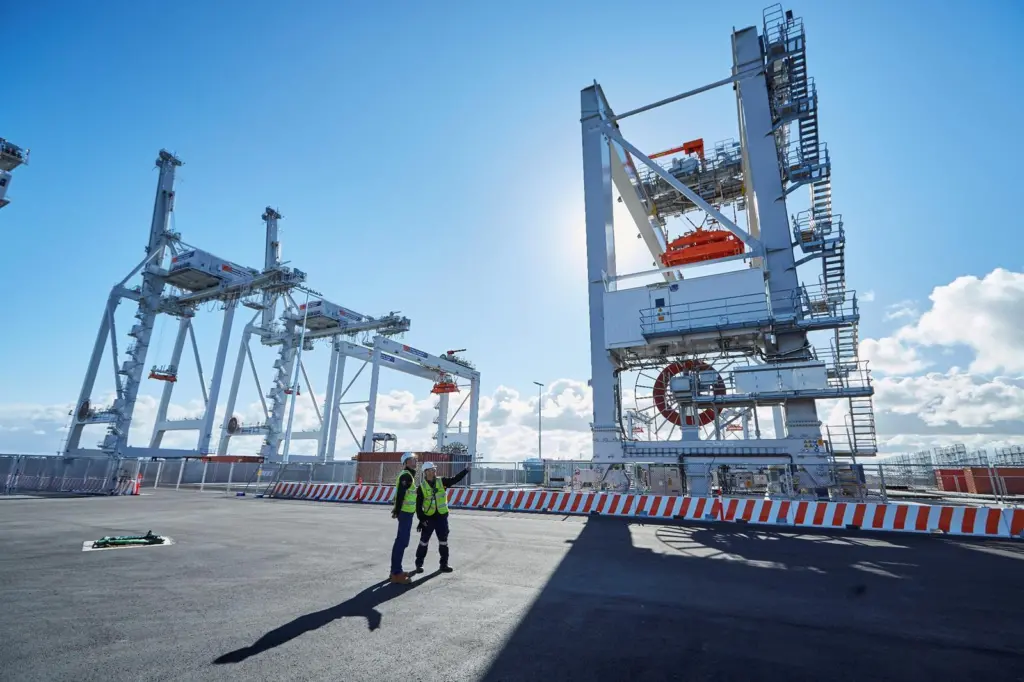
Automatic stacking cranes are no longer the preserve of a modern container terminal; employing well established technology and with prices ever-more competitive these robotised units are popping up all over the place. In line with the rising popularity, research and development on ASCs is stepping up to squeeze every last drop out of terminal productivity.
Two men at the cutting edge of this technology – Ville Mäkilaine, Kalmar Equipment Australia’s site manager at Victoria International Container Terminal, where ASCs are being introduced on behalf of owner ICTSI, and Svend Videbaek of Konecranes’ Port Solutions business area – tell Port Strategy what the improvements might be in the next generation of ASCs.
“At Kalmar, we are currently focusing on optimising the full system, looking at automation software, the cranes themselves and also how they are integrated,” says Mr Mäkilaine. Crane weight, though, is receiving particular attention, since this has an impact on so many levels.
He notes that there are a series of interesting ongoing developments with new materials and manufacturing processes, such as additive manufacturing.
“Lighter materials could potentially decrease energy consumption, maintenance work and so on, making operation cheaper. The maintenance and lifetime of the structures themselves must also be taken into consideration, as structural parts have their own inspection and maintenance requirements. This could decrease or increase the operational costs depending on the material and its requirements,” he says.
Nevertheless, the use of new materials or the adoption of different manufacturing processes to replace sheet and profile steel for main structures of an ASC are not on Kalmar’s radar for the near future.
Changing weight
If lighter ASCs were to become available, there would be a knock-on impact on terminal infrastructure design. And the weight of the ASC of the future is not the only aspect that could have a direct connection to infrastructure costs.
“Maximum wheel loads are not only affected by crane weight, but also by weight distribution, crane geometry and crane control,” says Mr Mäkilaine. “Optimising all of these can certainly lead to savings on infrastructure design.”
However, Konecranes’ Mr Videbaek points out that the cranes themselves are only part of the weight load borne by the yard; it is the container stacks that constitute the majority of the weight load.
A lighter ASC would also imply a cheaper manufacturing price since less material would be used, he adds. Lighter weight also enables savings to be made on drive mechanisms and on the electric system.
However, Mr Mäkilaine also has a warning: “If there were significant changes in materials and structural design, the manufacturing cost might even be higher. Having said that, the total cost of ownership could still be lower, if overall operational costs were lower.
Mr Videbaek adds that Konecranes is always looking into innovations in terms of equipment weight as part of its overall R&D programme.
“There are some interesting new material possibilities with respect to crane construction. We are investigating them, while keeping in mind the requirements for strength, durability and flexibility that must be fulfilled in crane construction,” he says.
Energy regeneration
Alternative energy is another area of interest for manufacturers and Mr Mäkilaine confirms that solar power is one area that Kalmar is investigating.
Even with available technology, it is possible to generate a significant amount of energy from solar panels. For example, given typical Australian solar radiation and a solar panel setup, auxiliary power consumption of the crane – controlling lighting, control equipment, cooling systems, and so on – can be covered, he says.
“However, even with an energy storage solution, such as batteries, it is not feasible today to make an ASC self-sufficient in power. The average power consumption is higher than what can be harvested with any practical solar panel setup. As technologies evolve this may change, but as solar radiation is highly variable, some backup power source is possibly needed anyway to ensure uninterrupted operation in all situations.”
According to Mr Videbaek, there are no easy solutions when it comes to generating power, storing power, or returning power to the grid using an automated container crane, or any kind of large piece of equipment that requires energy to make it work.
“Having said that, Konecranes is constantly working to make its cranes more efficient in terms of power consumption – and that includes automated yard cranes,” he says.
However, mounting solar cells on the ASCs would not be the prime location, he cautions: “Mounting solar cells in the container terminal at a stable location to be used as part of the terminal’s total power usage requirement would be a more useful deployment. It should be noted, at present, it would not be feasible to totally power an automated container crane, let alone a fleet of such cranes, with solar generated power alone. This is because the number of solar power cells needed would be huge, and therefore impractical.”
Battery power
That said, great strides have been made in efficient and affordable battery technology to recover all energy on hoisting and braking, Mr Videbaek notes. Konecranes, for example, is currently introducing new lithium-ion battery technology for use with its Automated Guided Vehicles.
“In the years ahead, if battery technology keeps advancing at its current pace, we can envision recovering most, if not all, of the energy created during hoisting and braking,” he says.
At Kalmar, its standard ASC solution includes energy recovery systems built in to the overall electrical system as a baseline feature. Kinematic energy is recovered by using electric motors for decelerating. The energy is then fed back to the grid with very high efficiency thanks to a state-of-the-art electric drive system.
“Adding batteries on board is not feasible for grid-connected ASCs as the energy is recovered without the need for the added weight and cost of a battery system. However, for equipment not connected to a mains power supply, batteries are a good option for decreasing total energy consumption.
“Kalmar already offers efficient and affordable battery and energy management technology, which also includes both hybrid and fully electric straddle carriers with batteries for energy storage,” says Mr Mäkilaine.
TAKING NOISE POLLUTION TO TASK
Noise reduction across all equipment is now becoming something of a holy grail in the industrial sector. But have we now reached the limit for the amount of noise reduction that it is possible to make on an ASC?
Kalmar’s Ville Mäkilaine comments that, given that the ASC concept is that of an electrically driven crane on rails, there is only limited optimisation possible in this area.
“However, if we look at the bigger picture, there is more that can be done. One of the interesting aspects Kalmar is looking at is optimising crane velocity, which has a big effect on noise level. For example, if there is a residential area near the terminal, cranes can be set to lower speeds during the night. Indeed, there are endless ways to optimise noise and also power consumption according to external interests and operational situations at the terminal,” he said.
Konecranes’ Svend Videbaek also sees scope for limiting noise generated by ASCs.
“Konecranes is working on noise reduction technology for all container cranes. A case in point are the STS cranes recently delivered to the Port of Oslo, which had extremely challenging noise reduction requirements that we were able to meet,” he says.
Finally, in respect of maintenance for ASCs, Mr Mäkilaine says that these are designed from the ground up for continuous unmanned operation and their maintenance regime is planned accordingly. Maintenance schedules are based on actual usage of each component separately, ensuring that no unnecessary maintenance is undertaken. Some calibration and adjustment tasks have also been automated.
There is further potential, he suggests, to automate maintenance for automation systems, particularly for calibration tasks and software updates.
Related Articles
 CONTAINER & CARGO HANDLING
 CONTAINER & CARGO HANDLING
 BULK HANDLING