![PortStrategy[GreenPort]](https://www.portstrategy.com/wp-content/uploads/2026/09/PortStrategyGreenPort.svg)




NO STOPPING AUTO-GATES
Container terminal gate automation is advancing in terms of take-up and system capabilities with further developments in the pipeline. John Bensalhia reviews progress.
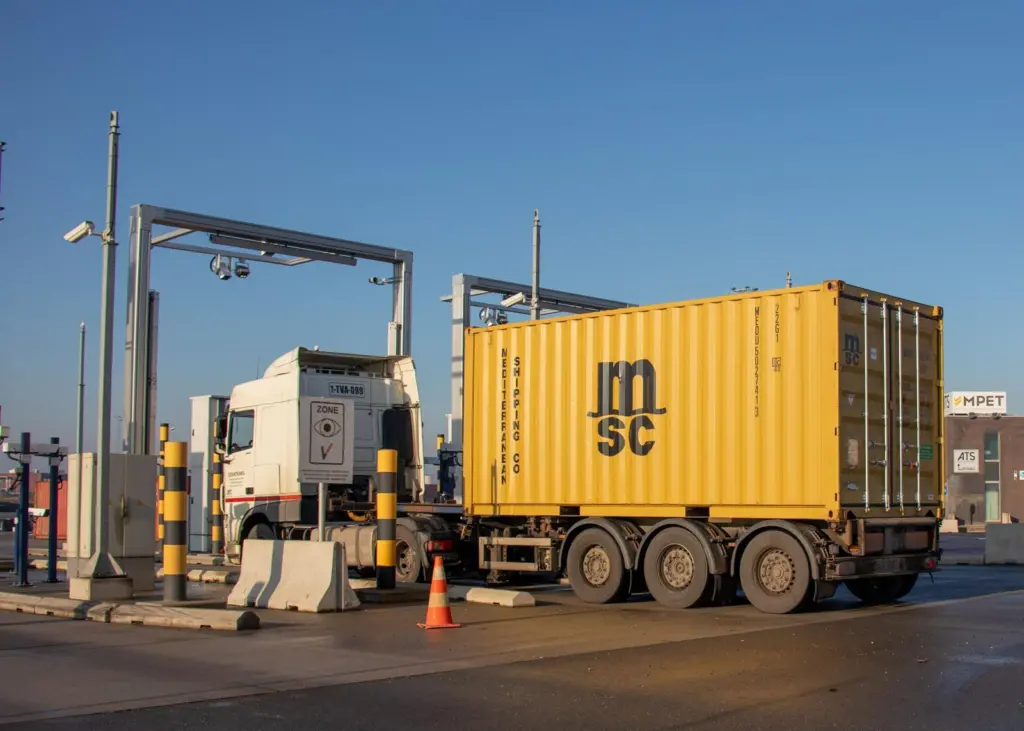
“Whether it’s by land, rail or water, the number of container transactions is growing every year,” says Chantal Mooij of CERTUS Automation. “More trucks at the gate. Bigger ships at the quay. Terminals need to be prepared for these increasing numbers.”
Gate automation is a case of cause and effect. With growing numbers of trucks entering, terminals must be able to process this increasing volume. “An automated gate reduces or even entirely eliminates data input and/or task confirmations, and thereby increases the accuracy and speed of the transactions,” explains Mooij. “This naturally results in higher throughput at the gate compared with a manual system.”
Gate automation is common practice today for ports. Jan Bossens, CEO, Camco Technologies, says that while, once upon a time, this was only affordable to +400,000TEU/yr terminals, today Camco sells systems to 50,000TEU/yr terminals.
“This is because of scale of economy. Thanks to a yearly production volume of more than 120 OCR portals, we could lower the price and even more importantly, the commissioning time. We learned,” he continues, “that costs (installation costs) made on location are difficult to budget as there are a lot of dependencies, decreasing installation time has an impact on costs.” An example of gate technology for managing increasing cargo levels is at the Port Authority of New York and New Jersey (PANYNJ), USA.
Container throughput at the PANYNJ rose for a consecutive ninth month to hit 18% above pre-COVID levels in April 2021, accounting for 712,799TEU in that month alone. Against this background, PANYNJ and APM Terminals will invest in key areas including outbound gate infrastructure, digitalisation and technology.
The automation of a conventional gate process is normally straightforward and not least because it offers possibilities for step-by-step implementation. Daniele Labate, DSP Team, explains that an automated gate needs pre-announcements, quality data and devices for detection and recognition.
For installation, he notes that: “There are evaluations that need to be taken prior to the switch over to automation.” And that: “More automation will require specialised maintenance and services and improved IT infrastructure.
ABOVE 95 PER CENT
Norbert Klettner, Managing Director, RBS EMEA, says that the level of real automation at the gate is driven by two key factors: the amount and quality of data available before the truck arrives at the gate and the reliability of the gate system including related Optical Character Reader (OCR) systems. “… you need,” he emphasises, “to reach way above 95% with a reliable process. This refers to the complete process of automation at the gate, not the OCR reading reliability of the cameras. If you are below that in your process, you will have too many manual handles and therefore, need to allocate too many resources.”
“Nowadays, container terminals are aiming more and more for safety, higher productivity and less congestion,” notes Labate. “Therefore, terminals are adopting automated solutions to meet higher and wider targets.”
Labate notes that in the past most of the gate process entailed human intervention for input, handling and monitoring. However, today: “The container terminal world is changing rapidly, introducing automation and remote monitoring and control for all different entry-points of the terminal facility as well as for yard handling and ancillary services.”
Safety is a key driver and as Labate further points out automated gate systems allow humans to stay away from risky areas and continuously monitor the process remotely, also reducing the possibility for the drivers to behave wrongly; any exception or wrong action being signalled.
“With more trucks visiting a container terminal, the risk of incidents is also growing,” highlights Mooij. “Cameras that capture every truck detail, contribute to a safer work environment. At an automated gate, truck drivers can identify themselves without having to leave their cab. Staff members no longer have to stand in the lanes between the trucks, risking collisions and being exposed to harmful idling.”
TODAY’S DESIGN TRENDS
Today’s trends in gate automation are progressive. Bossens says that some years ago, the hype in gate automation was about gateless gates, Bring Your Own Device (BYD), RFID seals and face recognition. This meant less hassle, no need for gate clerks with the main catalyst behind implementation being reduced costs.
Today, Bossens notes, the trend is away from the idea of gateless gates in accordance with heavier government regulations, stricter security and related entry and exit procedures in place. “Theft and drugs are the main drivers for intensified control, but we see also requests for Under Vehicle Scanners (UVS), mainly at country border located terminals,” he says.
Data accuracy is a primary benefit of gate automation. CERTUS’ Gate OCR system is said to capture every machine vision feature of each truck – licence plate registration, container codes, ISO codes, hazardous information and damages are claimed to be registered on a highly accurate basis. Lightweight gate solutions are also available and growing in number. These function as an app for a truck driver or a gate clerk that facilitate more automated data input to the gate process.
As Klettner explains: “This is certainly a good step to have more data pre-entered to the process and as an input to the Terminal Operating System (TOS), providing central control of the operations process.”
However, Klettner adds that a simple app does not facilitate a fully-fledged Gate Operating System (GOS) to comprehensively automate the process at the gate. “In case you have a big gate process with high numbers and also some pre-system delivering data such as a PCS, a full GOS solution is the better choice. If you have a lower volume and want to enable forwarders to do a bit more self-service at the gate, a mobile gate app is a good solution,” he states.
FUTURE DEVELOPMENT
In the near future, Camco will introduce a new OCR portal that can be installed and made fully operational in just one day by use of a cloud connection. Also forthcoming is a new kiosk concept based on Camco’s successful plug and play concept.
“We see a new hype around Automatic Damage Inspection (ADI)” says Jan Bossens. “It’s normal,” he postulates, “that vendors are in search of differentiation and customers are in search of increasing the ROI. Due to the increased possibilities of Artificial Intelligence (AI), a new battlefield opens. We are convinced there is a business case for ADI but we also inform our customers to stay realistic.”
Bossens considers that damage is a grey area. For example, there is an ISO classification system, but no objective metrics. So, with container terminals there is a focus on Structural Damage Detection (SDD), which immediately impacts operations and safety. “Other damage,” he elaborates, “like bumps, holes or dents are for post processing. The SDD technology we use is based on AI image recognition instead of laser scanners (which reduce the portal speed to 5km/hr due to their physical limitations.”
Klettner argues that going forward there has be more data connectivity between the gate related stakeholders from the forwarders to the truck drivers, ports and terminals as well as local government agencies. “The future of gate automation,” he states, “reaches further than the actual gate automation at the terminal level.”
Across the board, the consensus of opinion is that at a micro and macro level the standardisation of procedures necessitated by gate automation will progressively deliver clear benefits in terms of quality of terminal service, truck turnaround times and overall efficiency. As a corollary of this, the increasing adoption of container terminal gate automation is seen as a proven path to reducing the impact of human-related problems and/or disruption caused by third party events.
DCT GDANSK: TERMINAL 2b CASE STUDY
JLT Mobile Computers has been involved in several gate automation projects, providing rugged terminals for self-service driver kiosks. A recent example is a gate optimisation project at DCT Gdansk S.A., Poland which was a joint effort involving JLT; gate automation specialist Visy Oy; and Finnish digital learning provider Context.
As part of its Terminal 2b expansion plan, DCT Gdańsk has successfully implemented an OCR system at its gates. This involved the introduction of totally automated gates that use OCR cameras to note any containers arriving at the location. The process began in December 2017, but continued through to 2019, with extra adjustments and fine tuning made to the system. By December 2019, all container gate transactions were able to be carried out by the automated gates.
The introduction of the project has resulted in boosted safety and efficiency levels, as Jacek Grabowski, DCT Operations Director, explains: “The service is much faster. Before the implementation of the OCR system, the drivers spent around 12 minutes at the gate complex to file all the necessary documents before entering the terminal. Now, this is reduced to less than a minute per truck. Moreover, it is completed without the driver leaving the truck.”
Cameron Thorpe, CEO, DCT Gdansk summarises: “Our gate is now more efficient, provides our customers with a better service and crucially its safer as the driver no-longer has to get out of the vehicle, reducing pedestrians in this busy area.”
Related Articles
 CONTAINER & CARGO HANDLING
 CONTAINER & CARGO HANDLING
 BULK HANDLING