![PortStrategy[GreenPort]](https://www.portstrategy.com/wp-content/uploads/2026/09/PortStrategyGreenPort.svg)






Nuisance calls
Wildlife is coming to town, causing ports all kinds of problems. Stevie Knight reports
“Gulls didn’t start nesting on roofs till 1976, before that they kept to the coast and sea,” says John Dickson of NBC Pest Control. “But when they latched onto these nice wide, inviting spaces, they came in droves and now ports everywhere have really big problems with the birds.”
ABP Southampton in the UK recently made headlines with its ‘ecofriendly’ way of dealing with gulls: the port saw around 750,000 vehicles passing over the quayside during 2013, but gulls’ feeding habits of dropping seashells (and worse) from height posed a risk of damaging the ranks of new cars. So, ABP asked Rentokill for an answer: the solution was a hawk which would take to the air over the car terminal every few weeks and help scare the gulls away.
However gulls are tough old birds and likely to habituate to just one kind of deterrent. Mr Dickson says: “You need to put pressure on the birds to change their patterns, so it’s a mixture of predators, distress calls, rockets, and long term, reducing available food and nest sites to make sure the area can’t sustain the population.”
Further, while NBC also use hawks, “it’s got to be a trained bird, one that won’t just fly round… the cleverest of them know they are supposed to chase, but not commit to a kill”.
Roof trials
The roof nests are the biggest problem for many ports. “It’s not just the noise; large birds can attack people if they are nesting nearby and the chicks, while practicing shell-breaking with stones, often break skylights instead.”
There are other, related issues: the guano is acidic and can even eat into the structure of warehouses and other buildings. Further, the nests are loosely built, so bits of twig, shell, feathers and even dead chicks can block the drains. “We actually had one facility saying that their insurance was about to be withdrawn because of the number of times blocked drains had resulted in flood damage.”
The other issue is that gull’s feeding habits have changed too: “When you go up to look, it’s not just twigs and feathers but all stuff they have scavenged off the high street, like chicken bones from fast food outlets.” All of which adds to the biohazard.
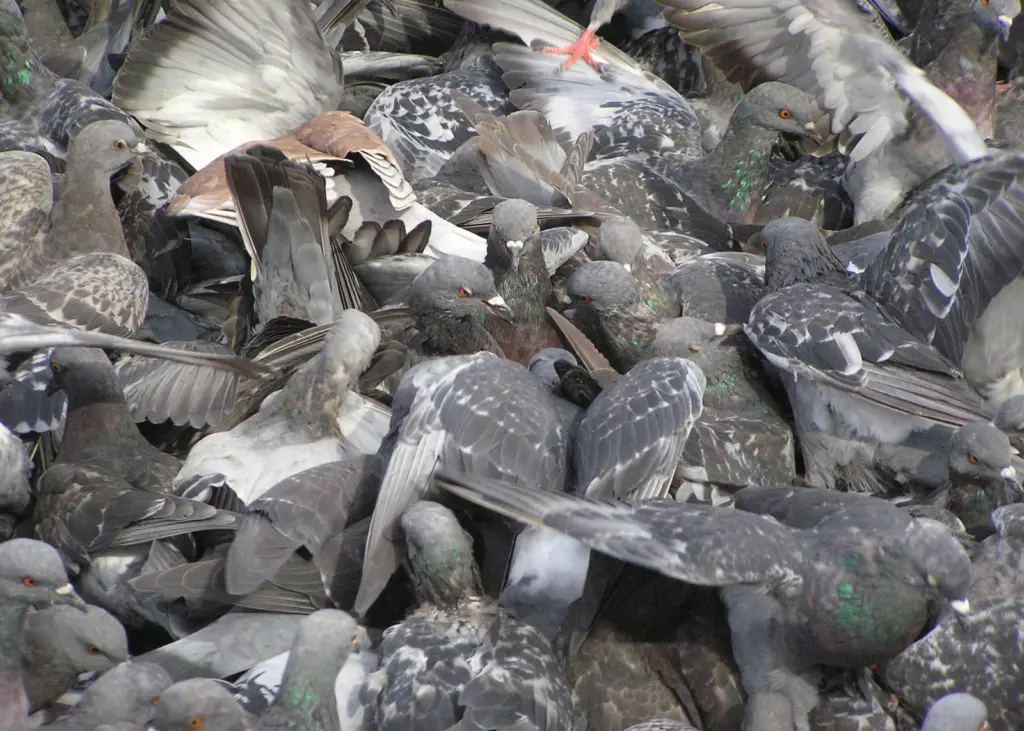
It’s not just gulls. Grain ports are also under attack from pigeons. “Obviously grain spills attract huge flocks of feral pigeons, sometimes thousands at a time,” says Mr Dickson. Because of the numbers involved, pigeons tend to create more of a mess than the gulls, and the slime underfoot can both be very nasty, cause damage to buildings and create a slip risk for the whole port. Further, pigeons and seagulls can displace tiles or coverings, causing leaks and contaminating goods stored inside.
Proper protection
But despite all this, what many ports don’t realise is that all birds, even the ones often thought of as pests, are actually legally safeguarded. “Under EU law, even birds like pigeons can only be culled if a port has explored all the non-lethal methods,” explains Mr Dickson, adding that most of the other common birds are far more protected. “The legal side is far more complex than you’d think.”
Further, nesting sites can stop building projects in their tracks: “It can be hugely frustrating, but if a tree has birds nesting in it, you can’t just chop it down.” So, a degree of foresight is often the best idea if a port has developments planned.
A project by the US Port of Tacoma to replace a coastal building was put in jeopardy by the nesting plans of gulls and cormorants, birds protected under the US Migratory Bird Treaty. Monofilament lines and rockets were deployed as deterrents, reducing the build’s delay. Likewise, when the UK’s Dover Hoverport outbuildings were facing demolition the large pigeon and gull population calling it home had to be dealt with: the scale meant rather than installing spikes and netting, a pigeon control programme of live falconry helped move the birds on.
High-flyers
It’s not just common birds that need attention: ABP Immingham needed to bird proof a 45 metre building with netting against, of all things, peregrine falcons so they could get on and demolish it. Further, Long Beach in California had black-crowned night herons using ornamental trees that now were in the way of the new container port. Digging up and replanting the trees with a few decoys perched in them, along with heron vocalisations, encouraged the birds to change nesting sites.
All things considered, ports had better be prepared for a long battle against the birds: As Mr Dickson explains: “A gull chick imprints on its own nest site and will usually return once mature to nest itself. So even if you could stop them this minute, the next four years’ worth are waiting to come back and breed.”
Related Articles
 CONTAINER & CARGO HANDLING
 CONTAINER & CARGO HANDLING
 BULK HANDLING