![PortStrategy[GreenPort]](https://www.portstrategy.com/wp-content/uploads/2026/09/PortStrategyGreenPort.svg)





On location
Positioning technology can be tailored to boost efficiency, safety and operations. Alex Hughes explains
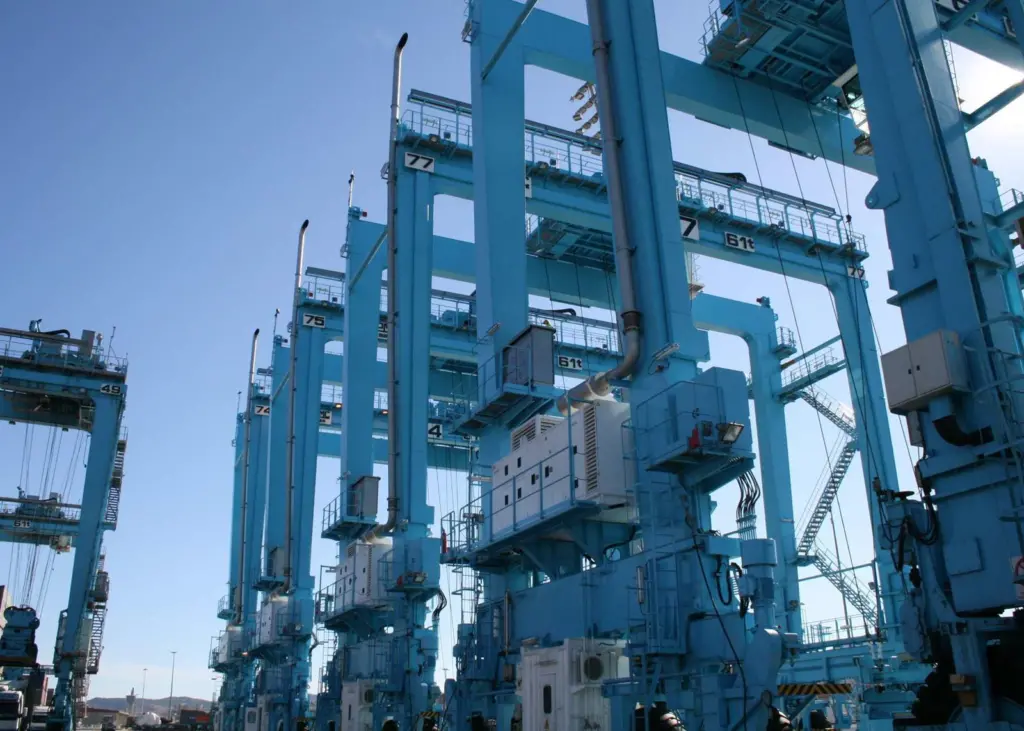
Major box terminals around the world have invested heavily in positioning technology to help improve terminal efficiency, marrying GPS with crane readers, autosteering modules and safety add-ons.
APM Terminals’ Algeciras hub’s first experience with positioning technology goes back almost 20 years, when UK-based International Terminal Solutions Ltd supplied transponders for use in the container yard. The same company was later responsible for introducing a GPS solution to locate equipment, with both yard and quay cranes also being fitted with magnetic readers and encoders that are able to provide the position of the spreaders throughout the container stacks.
Chief operating officer Laurids Uglvig explains that the GPS technology provides a two-dimensional image relating to the position of the equipment. This information is automatically merged with the data received from the encoders and magnetic readers, thereby allowing the exact position of the spreader and hence also of the box to be known in the stack.
This information is processed together with other data obtained from different sources on the machinery to paint a complete picture of the position and functional status of the equipment.
The Malaysian Port of Tanjung Pelepas (PTP) also leverages technology to improve efficiency. Its Kalmar Smartrail for rubber-tyred gantry cranes allows the RTGs to be steered using “virtual rails” programmed into the system’s database. According to a PTP spokesperson this leaves the RTG operators to visually focus on the surrounding areas of operations instead of having to concentrate on steering the RTGs manually.
“This reduces stress, helps avoid collision, improves crane availability and reduces operational costs,” says the operator.
As for DP World Southampton, for the last 10 years, it has operated Noell and Kalmar straddle carriers fitted with a PLC Interface and GPS system developed in-house. Among other things, the data collected helps provide real time and retrospective positioning of the straddle carriers, locate misplaced containers, manage an operational safety stop of straddle carriers and provide assistance with incident investigations.
“The use of GPS and the bespoke system are currently undergoing further development to utilise more interactive and proactive features in a development currently being trialled live across the site,” says Andy Kinnell, IT Services Director.
However, despite the advanced level of the positioning technology used by all three terminals, there are well known operational limitations when using this equipment.
Andy Kinnell identifies two main categories of problem.
Firstly, electrical noise from diesel/electric straddle carrier generators interferes with DGPS signals. At Southampton, this has been overcome by upgrading the GPS and thereby improving accuracy from the old units.
Secondly, there is invariably poor or unreliable positioning under quay cranes and around vessels. However, the system at the terminal has been designed to be flexible to allow for GPS inaccuracies without inhibiting the driver from working.
“Adding a local differential transmitter should improve the accuracy of the GPS when the view of the sky is limited or there are issues with multipath,” says Mr Kinnell.
Mr Uglvig acknowledges that Algeciras also used to experience location problems due to a clear “lack of satellites”, but nowadays, the covering range is good enough.
“Sometimes, it was difficult to get complete precision,” he concedes.
A similar observation comes from Malaysia, where PTP notes that best results are inevitably obtained when four satellites are available.
“As for what limitations are still inherent in positioning technology, the biggest challenge for GPS technology seems to be that of accurately calculating height,” says Mr Uglvig, adding that, overall, the experience at Algeciras suggests that GPS positioning technology is quite robust and reliable.
“Other technologies impacted by the so called “blend effect”, which is constantly present in our enormous machines, show a bigger predisposition towards breakdowns, calibration issues, data errors and general failures,” he says.
Mr Kinnell aqgrees. “Overall, we’ve been extremely impressed with the robustness of the equipment we have chosen. The hardware failure rate is extremely low, which, considering the harsh environment it is working in, is great.”
Nevertheless, he suggests that the most important limitation suppliers have yet to overcome is that of cost efficiency on unit production across the market.
At PTP, some operational limitations have been overcome by resetting the position of antennas in the yard. This has improved signals and increased accuracy, resulting in overall better results.
“Modern technology has definitely assisted us in reducing incidents of lost or misplaced containers. Even when containers are shuffled within the stack or when the operators place the containers in a position different from that proposed by the system, the technology allows the Yard Management System (YMS) to be automatically updated, meaning all containers in the yard can be accounted for and not much time is spent looking for them,” says the spokesperson.
Related Articles
 CONTAINER & CARGO HANDLING
 CONTAINER & CARGO HANDLING
 BULK HANDLING