![PortStrategy[GreenPort]](https://www.portstrategy.com/wp-content/uploads/2026/09/PortStrategyGreenPort.svg)






options on the move
New products offer added mobility and dust-free operation as their unique selling points. Mike King reports
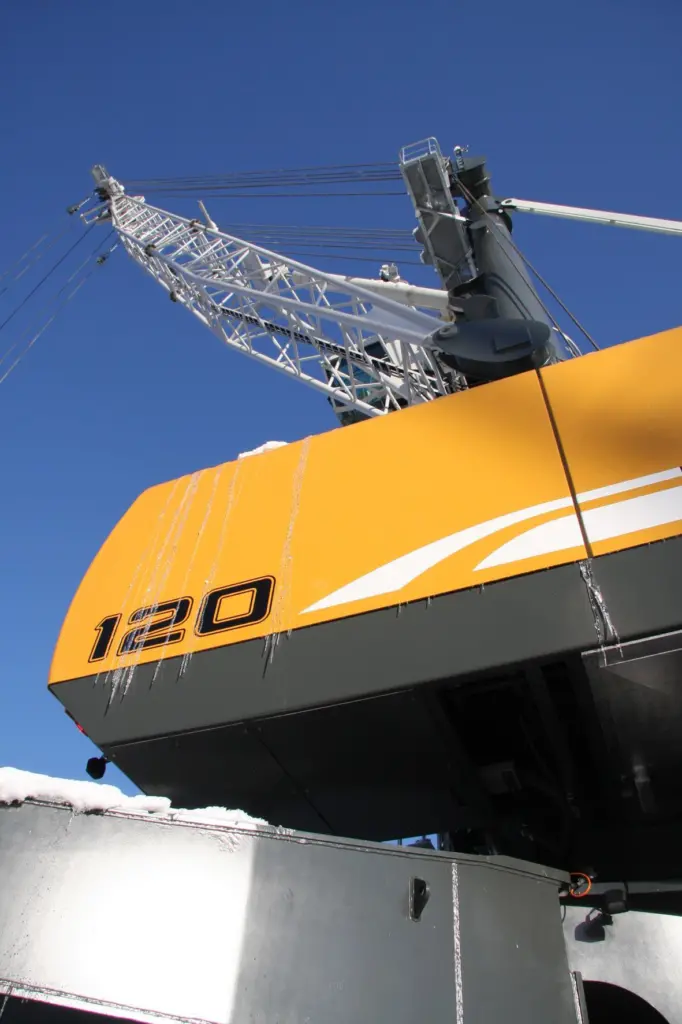
While a range of suppliers offer small mechanical and pneumatic mobile unloaders, generally designed for lower ranges or the flow characteristics of specific bulk cargoes, for ports seeking mobility, cargo flexibility and high capacity handling but unwilling to invest in dedicated equipment, mobile handling cranes (MHC) remain the preferred option.
The MHC market continues to be neatly divided up between two of the big beasts of the handling jungle in the shape of Austria’s Liebherr group and Gottwald of Germany.
Last year, Gottwald sold a total of 96 MHCs of which 19 units were delivered with four-rope grabs for bulk handling. The company has now delivered some 230 four-rope grab cranes to customers worldwide.
Liebherr’s delivery list for 2009 already includes six units in 4-rope configuration for dedicated bulk handling out of a total orderbook of 20.
At the larger end of the scale, the company’s LHM400 units continue to sell well. Two were commissioned this year for India’s Karaikal Port, each equipped with 2×70 tonne winches as well as a 35m³ grab for handling coal.
Portugal’s TCGL has also ordered an LHM400 unit equipped with a 33 m3 four-rope grab to handle grain.
Although the LHM 400 offers maximum lifting capacity of 104 tonnes and 48 m maximum outreach and is suitable for panamax bulk carriers, terminals after faster rates for handling heavy cargoes and capesize ships require MHCs such as the LHM 600, which offers 208 tonnes of lift, depending on the winch configuration, and 58 m maximum radius.
Liebherr has also been moving down the bulk handling scale to offer more lightweight designs suitable for handling cargoes at terminals receiving smaller carriers.
PT Pamapersada Nusantara and PT Mitra Bahtera Segarasejati, both based in Indonesia, have opted respectively for LHM 180 and LHM 280 models, designs that Liebherr only launched last year. Both will be equipped with 17m³ grabs for coal handling.
The LHM 180, with its maximum lifting capacity of 64 tonnes and 35 m outreach is generally deployed to handle smaller bulk carriers. The LHM 280, the next model up in the range, offers 84 tonnes capacity and a slightly more versatile 40 m maximum outreach.
Until this year, the two cranes were the smallest models in the Liebherr MHC range, but the manufacturer is increasingly eyeing the super-flexible end of the bulk handling market and this year launched the LHM 120.
Denmark’s Port of Korsør was the first to take the plunge for the new unit which it will use for unloading fertilizer as well as grain and feed stuffs from ship to hopper. The port handles around 350,000 tonnes each year, mostly consisting of bulk cargoes, and Liebherr says the unit, rated at 350-400 tonnes per hour and equipped with a 10.5 m3 grab, will help speed unloading rates by 75-100%.
“With this bigger capacity and reliability we expect that we can attract new customers and bigger cargoes to the port, and thus increase the total goods turnover, in spite of the financially critical times,” says Flemming Erichsen, harbour manager, Port of Korsør.
The LHM 120 is suitable for handling coastal bulk carriers and, depending on the grab fitted, is able to reach 13 m below the quay into the hold. With outreach of just 12 m the design delivers maximum lift of 42 tonnes with a hook, falling to 29.9 tonnes if a motor grab is in place and down to 24 tonnes with a traditional four-rope grab.
“The new LHM 120 delivers more turnover due to higher luffing, slewing and hoisting speeds while reducing running operating expenses with creative planning, innovative technology and experienced market ‘know how’,” insists Liebherr. “With a maximum lifting capacity of 42 tonnes and a maximum outreach of 30 meters this machine completes the new LHM lightweight range.”
Being able to move equipment from berth to berth, the prime advantage offered by MHCs, is not always the main priority. Instead some ports value the ability to safely and cleanly handle a wide variety of bulk cargoes without polluting the port and environs.
To that end, UK-based B&W Mechanical Handling, part of the Aumund Group and renowned for its mobile and flexible bulk port handling gear, launched the Eco-Hopper last month.
B&W claims the new model, unlike its predecessors of the 1990s which were built to accommodate 8-12 cubic metre grabs with flow rates of 300-600 tonnes per hour, offers a new degree of flexibility and mobility as well as dust-free unloading.
Rates of up to 2,000 tonnes per hour can be achieved subject to grab crane performance, while grab sizes of up to 40 cubic metres can be accommodated.
B&W promises rates of up to 5,000 tonnes per hour for self-discharging vessels.
The hoppers can be designed to suit the characteristics and flow properties of virtually any bulk material, from coal to clinker, sulphur to iron ore.
Unlike B&W’s previous generation of hoppers, which were built mainly to handle minerals and were mounted on existing port infrastructure, usually fixed rail tracks, the company’s new hoppers can be rail mounted on a fixed track or fitted onto pneumatic tyres. Or they can simply be bolted onto foundations.
The innovative new tyre-mounted option incorporates the ‘New Generation’ travel systems developed for the B&W Mobile Shiploader range. “In addition to the powered in-line and parallel travel offered on all machines this new system provides infinite combinations of wheel alignment,” says B&W. “This versatile system provides total flexibility and the potential to deploy the Eco-Hopper to unload a vessel and stow it away from the quay side after use. This is particularly useful on multi-use quays.”
The use of a combination of fixed and steering axles allows the Eco-Hopper to travel both parallel and at right angles to the quay with power sourced either via a cable reeling drum or, for full mobility, an on-board diesel generator/electric drive combination power pack.
At the heart of the B&W Eco-Hopper is a highly effective dust control system which minimises the escape of dust during the grab discharge cycle by using a Flex-Flap for dust retention to divide the upper and lower sections of the hopper. This works by employing an innovative pressure system to form a seal which prevents the escape of air, similar to a one-way valve. Integral reverse jet filters are positioned around the hopper inlet to extract and clean the dust laden air, and collected dust is then recycled into the main stream of material.
B&W believes ports wishing to upgrade existing systems, retrofit existing rail systems or seeking a new stand-alone bulk handling solution, will be able to benefit from the Eco-Hopper’s deployment, with its lower capital cost compared with fixed installations a further benefit.
By adding one or more hoppers, terminal throughput can be gradually increased provided the collecting belt conveyor and the subsequent handling equipment are designed for future capacity increases.
The total hopper weight can range from 40 to 200 tonnes with height variable depending on the ships size to be handled but usually between 10 to 15 metres for a panamax size ship.
By the end of this year, B&W says a fully working demonstrator will be operation at its base in Ely, UK, so customers can test particular materials pre-installation and final design.
Related Articles
 CONTAINER & CARGO HANDLING
 CONTAINER & CARGO HANDLING
 BULK HANDLING