![PortStrategy[GreenPort]](https://www.portstrategy.com/wp-content/uploads/2026/09/PortStrategyGreenPort.svg)





Phones Phoneys and Foresight
For a straddle carrier to achieve a ten-year life span, operators must establish predictive maintenance schedules, buy only spare parts from the OEM and maybe negate the need for drivers entirely – especially those with mobile phones. Patrik Wheater reports.
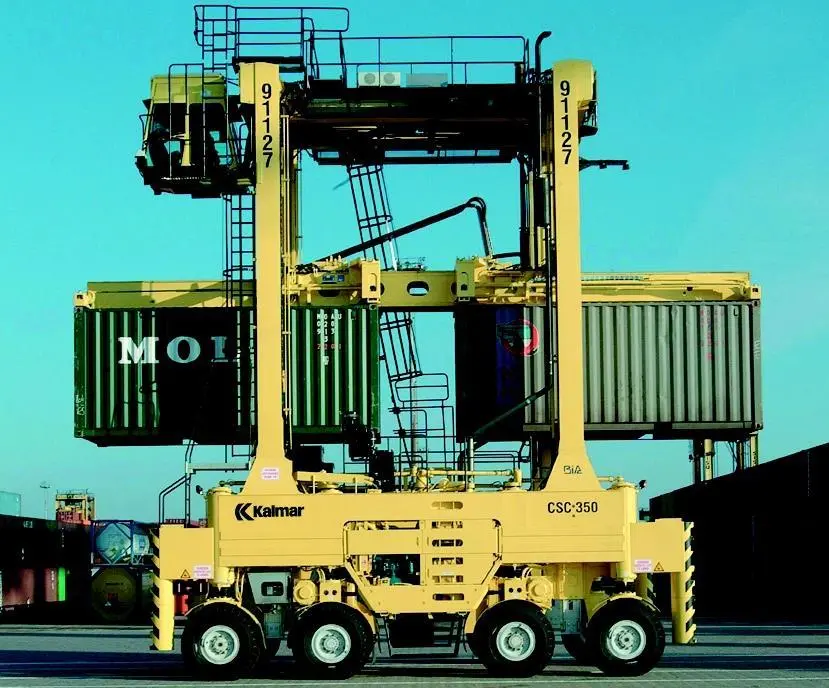
It’s banned on the byways and highways of most countries but using a mobile phone whilst driving a strad around a container terminal seems to have slipped the legislator’s net.
The TT Club has reported an increase in the number of claims arising from collisions involving straddle carriers, where the driver is thought to have been distracted by using a mobile phone in the cab; in one instance, a driver was composing a text message.
“The risks to operators have possibly been less recognised up to now, maybe because the drivers themselves are relatively isolated in cabs where they cannot be observed; maybe because these lumbering giants are not perceived to present the same kind of risk as a fastmoving car. Yet the dangers are real, and the consequences can be severe: in one case a straddle carrier toppled over as the result of a collision, seriously injuring the driver, ” says the Club.
Operator training becomes more important as increased throughput could lead to more physical and mental stress for the operators, which consequently increases the risk of accidental damage. “We place a lot of attention and care in creating an ergonomic workplace in order to relieve this pressure and to enable operators to stay concentrated on the task, ” says Noell.
Driver error, or more specifically negligence, is one of the most common causes of damage to straddle carriers and although the frame of these workhorses is designed to withstand a knock or two, the mechanical parts of the machines such as wheel forks, wheel yokes and, as a side effect, steering bars, are vulnerable and if the impact is severe enough damage can also occur to the upright columns, side frame and spreader.
LIGHTER UNITS COULD REDUCE OPERATOR ERROR Eric Ronco, development manager for Australian straddle carrier manufacturer Isoloader, believes lighter strads could prevent accidents caused by human error because “somehow the operators [tend] to be more gentle with these machines.” Isoloader has experienced a slow after-sales service market associated with its lighter units as damage is infrequent. Ronco also explains that his company attempts to get the same performance out of its lighter products as the heavier kind but at a lower cost in terms of fuel consumption and energy spent to drive or to lift.
The basic strad is designed for 50,000hours of operation – about ten years at a busy terminal. There are certain components, like a diesel engine, that require rebuild after 10 to 15,000 hours whilst transmissions and brakes are probably good for 8,000 hours before the need to undertake major overhaul work and the frame is good for about 50,000 hours.
Terry Derry, sales director, Africa, for Kalmar, along with other manufacturers PS spoke to, stresses that maintenance is the key issue and encourages operators to adhere to the maintenance schedules and daily checks that the manufacturers advise. And for early generation products Derry advises the inclusion of predictive maintenance regimes on the basis that major components are replaced or rebuilt before they fail.
PREDICTIVE MAINTENANCE A MUST “If customers have the ‘if it ain’t broke [sic] don’t fix it’ mentality, then when a component does break it is far more costly to repair or replace, resulting in longer downtime as they wait for spare parts.
Predictive maintenance allows the customer to properly plan when a component is due for rebuild or replacement and to schedule the machine for this work at the most convenient time, ” Derry says.
The proliferation of pirate parts onto the market – of which, it seems, the UK produces an abundance -vexes the manufacturers greatly, and although the reasons why they would like to see the back of them are plain, Derry does make a convincing argument against buying the cheaper brands – which can be as much as 30% cheaper – in favour of the more expensive OEM components: “In the early days we experimented with various compounds and finally got our nonasbestos brake liners to achieve 8,000 running hours [before they needed replacing].
“The problem is though, when the pirates copy the brake shoes they take a stab at what they think the compound material is and invariably get it wrong. So when operators re-line the brake shoes with the pirate liner, they just don’t get the lifetime.”
Re-lining a brake is quite a lengthy procedure: the shoe has to be adhered to the liner first, baked in an oven to ensure adhesion of the compound, and then riveted as a further safety measure. But some operators in South Africa have apparently sent a set of shoes to be re-lined with instruction for their return the same day. “You just can’t do that, ” says Derry. Indeed! Strads weigh 60 tons before they’ve even picked up a forty-foot container and if the brake liner gives way it could actually wreck the brake drum. “So it’s not just a matter of replacing the lining, you may need to replace the entire drum as well, ” warns Derry.
Noell says it only “co-operates with the most famous component makers for important parts for engines and brakes etc. The sum of reliability of the major components, our experience and quality in engineering and assembling?minimizes the cost of maintenance and maximises the value of our straddle carriers for our customers.”
However, Southampton Container Terminal’s (SCT) Cameron Waugh is sceptical about claims that non-OEM parts are less reliable than their OEM counterparts and believes that “it’s more of a problem for the manufacturer than it is for [the terminal operators].”
RECENT GENERATIONS MORE RELIABLE Straddle carrier reliability has now developed to a higher level and Kalmar’s seventh generation unit launched last year is cited as being more user-friendly with proportional hydraulics to make maintenance easier, especially in climates of high humidity. Germany’s Noell Crane Systems and Kalmar both cite an ergonometric and modular design as optimising the accessibility to all areas of the strad to allow easy repair or replacement of components.
And most OEMs boast state-of-of-the-art diagnostics technology to enable effective troubleshooting for an immediate and detailed identification, location and origin of a straddle carrier’s malfunction.
Sophisticated automation of course features heavily in modern design and Kalmar’s fully automated unmanned units are gaining favour in Australia, where the new machines were first trialled in 2003. Unmanned systems are also being considered by SCT, which “may invest in these systems as it will decrease the risk.” Collisions caused by less than diligent operators can result – during a particularly bad month – in an 8-10% reduction to the SCT fleet of 90 straddle carriers.
Of course, if the industry does fully embrace the unmanned system, then the straddle carrier driver will be able to make optimum use of his mobile phone in the hunt for alternative employment.
There since the early days
In 1958, Malcolm Mclean develops a concept for taking box cars off their bogies and sets up Sea-Land Service Inc. Container shipping is born In the same year, Matson Lines, in an effort to save time, begins to stack one container on top of one another using a prototype stacker called the “Van Carrier” US government proposes to standardise the size of a shipping container
In the 1960s Swedish spreader manufacturer Bromma Smides AB patents its twistlock design which is still widely used to this day Clark Equipment’s Model 620 straddle carrier was developed to stack the increasingly common 20′ unit three-high. Later, the 830L, designed to handle 40 footers, becomes the company’s most popular model
In the 1970s the straddle carrier suffers a reputation for unreliability and a number of ports begin to favour RTGs
In 1976 Valmet (same family as Kalmar) launches the “Container Stacker”; Noell (then Peiner) introduces its PPH top mounted single engine mechanically driven straddle carrier; and then Nellen a. k. a. Nelcon (now part of Kalmar), in collaboration with ECT, develops a diesel electric system. These ‘second generation’ designs put the straddle carrier firmly back on the map Japanese freight handling systems manufacturers enter the market
in the 1980s To further improve reliability Kalmar introduces the programmable logic controller to virtually eliminate any relays on the machine Kalmar, Sisu, and Noell develop four-high straddle carriers Lost containers become a thing of the past after integrated yard management system are developed, which utilise new GPS technology New shuttle/sprinter carrier concepts emerge to improve terminal productivity following the introduction of Post-Panamax containerships The first fully automated straddle carriers enter service at Brisbane, Australia, in 2003.
Related Articles
 CONTAINER & CARGO HANDLING
 CONTAINER & CARGO HANDLING
 BULK HANDLING