![PortStrategy[GreenPort]](https://www.portstrategy.com/wp-content/uploads/2026/09/PortStrategyGreenPort.svg)





Port Profile
Chinas Pearl River Delta has effortlessly lifted the crown for the most densely port-populated region in the world, as Wing Kah-goh reports
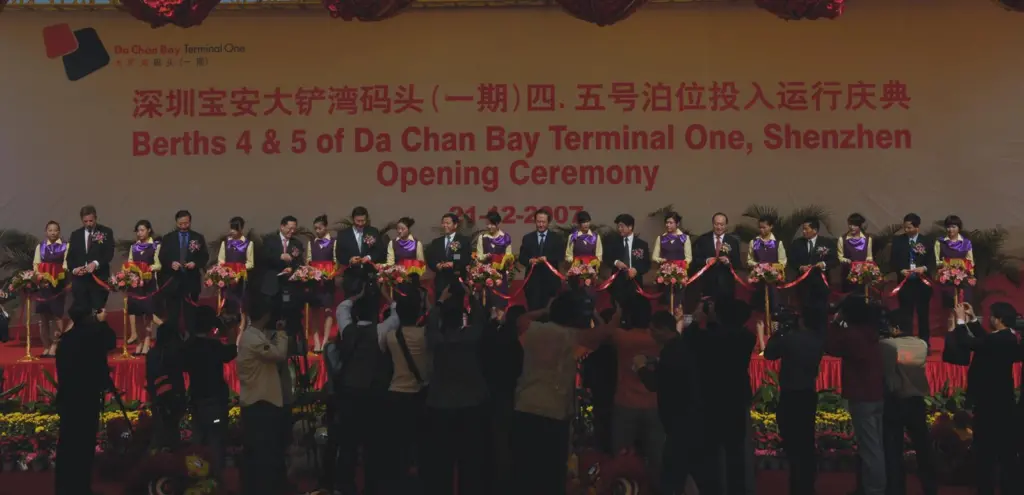
The opening in December of the first phase of yet another western Shenzhen terminal, the two-berth Modern Terminals-operated Dachan Bay, brought further bewildering choice to shipping lines calling at the Pearl River Delta. APM Terminals, meanwhile, has already begun work on its next big port, a near-$1bn joint venture in the second phase of Dachan Bay that will begin operations in 2009. The cluster of container ports would now rank as the densest in the world. Why? First, Guangdong province remains the leading export engine of China for the time being and secondly, unlike in the Yangtze Delta where Shanghai clearly calls the shots there is no overall port or body in charge – the ensuing free-for-all has added a dizzying amount of capacity since the turn of the century.
Under massive third phase expansion plans worth a combined RMB10bn ($1.4bn) by 2010, Yantian, the premier facility in the region, will have a total area of 344 ha with 15 deepwater container berths. Hutchison Port Holdings now essentially refers to Yantian as its flagship facility rather than its original stomping ground, Hong Kong. By 2005 on a per sq m basis, Yantian had surpassed the former British colony for efficiency and this year the port of Shenzhen will outstrip Hong Kong’s box figures for the first time. Politicians, think tanks and the public in Hong Kong are all discussing how the box business really is in Hong Kong – once the largest container port in the world until Singapore snatched its crown in 2005.
Other western Shenzhen port areas of Shekou and Chiwan are also expanding, while on the western side of the delta, HPH is developing a viable deepwater terminal at Zhuhai.
The Port of Zhanjiang in west Guangdong began phase one construction of Baoman Harbour on February 15. The Zhanjiang Port Group is investing RMB1.8bn ($252m) to set up two container berths of 50,000 tonnes each. The berths will start trial operation in the first half year of 2009 and finish construction completely in 2010. The harbour will build three container berths of 100,000 tonnes capacity each in phase two construction later.
Nansha, 54km south of Guangzhou, which only came into being in 2004, will grow 50% this year, authorities say, to 7m teu. So the cluster in the far smaller Pearl River Delta is far more dense than on the Yangtze.
Shanghai International Port Group (SIPG), via its sheer size and its clever investments up and down the Yangtze, has been able to ensure it, as the dragon’s head, gains the most volumes while the delta, which accounts for two thirds of its throughput, is more gradually coated with concrete and quay cranes than its southern counterpart. This year, Shanghai will likely surpass Singapore as the world’s largest container port. It is already the largest port overall with some 560m tonnes passing through its heaving docks last year. Yangshan, the flagship located on a pair of islands 34km southeast, saw throughput surpass 10m teu last year, phenomenal growth given that it only launched in November 2005 and serves as testament to the unflinching power of SIPG which goaded lines to its new facility either by ultimatum or serious price rises at its other main facilities at Waigaoqiao.
Still, other ports have prospered too.
“For foreign investors looking to expand operations away from the maturing markets of the coast, the development of the Yangtze River as a modern intermodal transport corridor may prove one of the most significant events of 21st Century China,” says “The Yangtze River Transport Corridor,” a report prepared by the China Services Group of Deloitte & Touche USA LLP.
Eight of the 10 busiest Yangtze container ports are in the eastern coastal province of Jiangsu, with the biggest, at the provincial capital of Nanjing in the Yangtze River delta, having 2005 throughput of 588,000 teu.
Containerised barge traffic quadrupled between 2000 and 2005. In 2006, approximately 3.8m teu was shipped along the Yangtze, up from just under 3m in 2005. The government estimates that 6.5m teu will be transported on the Yangtze by 2010. A big winner in the cargo bonanza flowing through the Yangtze delta has been Taicang Terminals, operated by Modern Terminals, which saw throughout surpass 1m teu last year.
Meanwhile, it can be difficult getting out of the shadow of Shanghai, but Ningbo to the south in Zhejiang province continues to be one of the fastest growing ports in China: its link up with the neighbouring Zhoushan archipelago spawning a number of massive island container terminal projects and the prospect of a 10m teu colossus is very real in Ningbo, widely perceived to be China’s finest deepwater port.
Related Articles
 CONTAINER & CARGO HANDLING
 CONTAINER & CARGO HANDLING
 BULK HANDLING