![PortStrategy[GreenPort]](https://www.portstrategy.com/wp-content/uploads/2026/09/PortStrategyGreenPort.svg)






Power in small packages
Tractors offer a robust handling option that can be easily optimised finds John Bensalhia
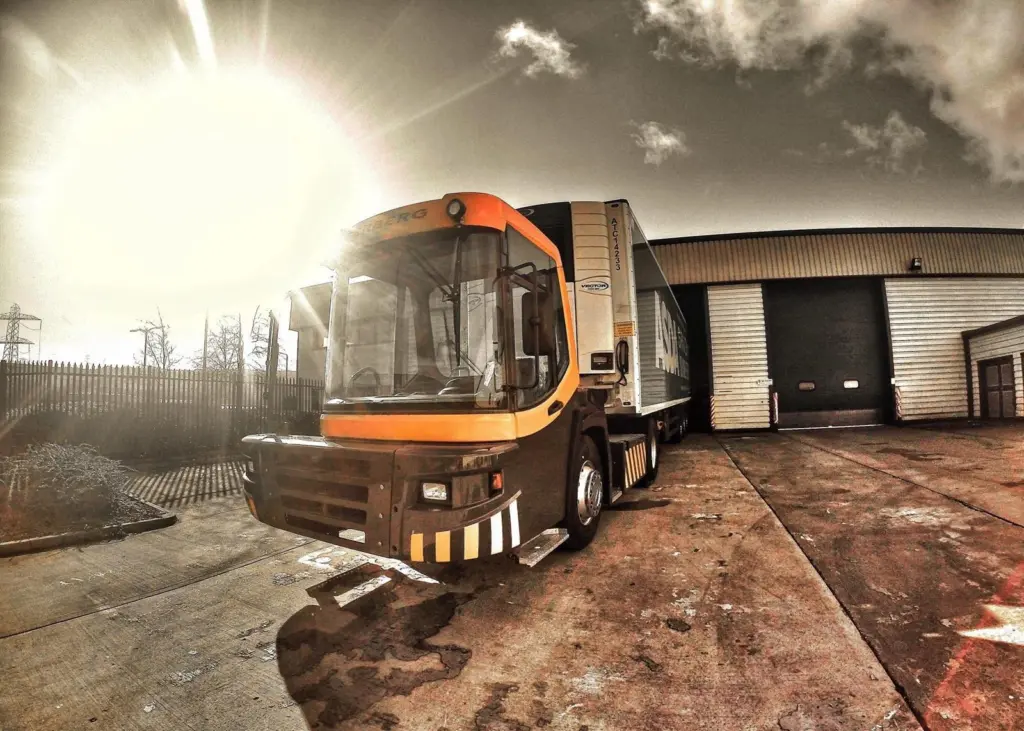
The tractor is by no means the exclusive province of farms and fields; many ports and terminals have found that the tractor is an invaluable tool in daily operations.
Originally invented in 1958 by Ottawa Trucks (the predecessor of Kalmar), the terminal tractor was devised as an efficient, cost-effective means of shunting freight and trucking company trailers around in a freight depot. Its popularity had spread by the late 1960s, by which time this type of smaller tractor was moving containers from ocean-going vessels to container stacks and vice-versa in European and North American ocean ports. Port operators soon latched on to their potential.
Chris Booth, vice president of Kalmar’s Terminal Tractors department, says that the chief benefits are that they provide easier manoeuvrability and operation, greater efficiency at a lower cost, simpler major and minor component maintenance and repairs, all of which results in faster, higher-yield operations.
Port tractor drivers are offered greater protection and a clear view of the area from the cabin. “The cabin has a perfect view around,” says Frank Oerlemans, export manager of Terberg. “A port environment is full of material and this view makes sure that the driver can avoid accidents much better than when he is using a normal road truck with all kind of blind spots. The cabin is also equipped with a ROPS/FOPS (Rolling Over and Falling Object Protection System) construction inside, therefore being extremely strong and a good protective tool for the driver.”
The ‘fifth wheel’ can be easily lifted, allowing for quick coupling and uncoupling of trailers. Furthermore, the tractors’ chassis and bumpers are much heavier and stronger compared with a normal road truck. “If a small accident happens, damage is in most cases limited to scratches,” says Mr Oerlemans.
Regional variances
Terminal tractors are experiencing different trends in different parts of the world. “Market requirements vary greatly between different world regions,” says Chris Booth. “For example, in Europe, driving comfort and ergonomics play a significant role, while in North America, basic simplicity, low acquisition and operating cost are paramount. However, common factors all over the world are reliability, safety and ready availability. Also quite important to many of the bigger port terminal clients are service support and spare parts availability.”
Environmental concerns are an important element of tractor design. The Terberg yard tractors’ automatic transmissions include a fuel reduction package which ensures the lowest possible fuel consumption. Frank Oerlemans says: “In this moment port tractor customers are paying attention a lot to fuel economy and in line with that greener solutions. It is there for that we have introduced several items in our tractors that do help to reduce the fuel consumption. Also we have introduced tractors that can run on LNG and CNG. These tractors do not have particles that are known to be carcinogenic in the exhaust gases.”
Before purchasing the tractor, port operators must ensure that they choose a model that meets their specific requirements. It’s worth asking a few questions, advises Frank Oerlemans: “What is the maximum load to be transported? The port must make sure that both tractor and trailer are suitable to handle this load. Ports must also consider the maximum gradient in the terminal: to handle heavy loads on gradients, more engine power is required and above a certain gradient the safety of the tractor has to be taken into consideration.”
Mr Oerlemans adds that ports should also consider ground surface: “For uneven grounds, a stronger chassis is required and the choice for the tyres becomes more important. Also a comfortable but stable rear axle suspension should be ordered.” He adds that ports must choose the right tyre in order to have the lowest cost per running hour/km. A good method to determine this is to test different types of tyre in the same conditions. In addition, the local tyre supplier can advise on the best course possible.
Robust units
Marc Vandenberghe of MOL says that the design of its port tractors ensures robust equipment for the application, in conjunction with easy maintenance and a safe environment for the operator. “We see that more and more operators in the ports pay more attention to safety and need a strong, robust, suitable tractor.
“In our port sector, we have some new tractors updated with a number of improvements in combination with the installation of stage-4 engines,” says Mr Vandenberghe. These include the Multi Trailer tractor TG280/4×4 equipped with the stage-4 Scania DC13 (400hp) and the RoRo tractor RM255/4×4 with redesigned chassis and new cabin, equipped with stage-4 Volvo 8-lit engines.
With the right manufacturer, maintenance isn’t a headache for ports. Kalmar, for example, offers a number of solutions for this area, including lease, rental and financing options; full service, maintenance and repair contracts; higher and closer spare parts availability in-country or in-region where feasible; plus trained, experienced maintenance and technical staff and solutions by authorised dealers or its own company branches wherever feasible.
“Most ports do maintenance in their own workshop,” says Frank Oerlemans. “The advantage is that you can direct the mechanics exactly to do that job you want to be done first. The disadvantage is that the mechanics have to be all round and are not specialised in one product. Also, they are not aware of the latest technology. Terberg does have a system, Partsonline, on which the latest service information can be found by the distributors and customers.
“Another solution is to outsource the maintenance and repairs to a local service provider. This also is happening partially to flatten out the peaks in the workload. We also see more and more that people go for rental of the equipment, including maintenance and repair. In that case, the port pays a fee per month or per running hour which covers all costs.”
Joshua Goldman, vice president business development, Transpower USA, says that all Transpower electric trucks include a remote diagnostics and data logging system allowing the company’s engineers to help field support staff to rapidly diagnose and repair any issues.
Advancements in design and innovation are making the tractor a sound proposition for ports. Taking factors such as accessibility, safety and environmental concerns into account, tractor manufacturers are ensuring that ports get the best possible results with the latest designs on the market.
Rock down to electric avenue
The electric tractor is becoming a highly popular option for ports. Terberg’s Frank Oerlemans predicts that there will be more electronics in the future to make the tractors safer and more ergonomic for the driver.
Joshua Goldman of Transpower USA, explains that electric tractors offer lower cost and higher throughput container and trailer movements on dock, near dock, and at distribution centres. “These also are typically faster, smoother, and quieter trucks than a diesel.
“From a propulsion technology perspective, TransPower’s zero emissions, battery electric port tractors are showing end users at the ports the viability of electric port tractors for diesel replacement propulsion.”
Advances in automation have allowed for speedier and valuable results at ports. Chris Booth says that a key benefit of a terminal tractor is its flexibility. For instance, it can be partly automated with the introduction of process automation solutions as represented in Kalmar’s SmartPort offering. “The Kalmar SmartPath solution, for example, allows terminal operators to gain consistent, valid and correct updates of terminal tractor positions in a terminal to optimise the dispatch process for vessel load and discharge, by providing timely automatic job status updates. It avoids manual job step information being entered too early or too late, making the dispatch more efficient.”
Mr Booth says that these process automation solutions represent an accessible, fast way to get immediate productivity improvements for a relatively small initial investment. “Even a partial adaptation of process automation increases productivity and equipment utilisation rate, improves safety and reduces the potential for manual errors.”
Related Articles
 CONTAINER & CARGO HANDLING
 CONTAINER & CARGO HANDLING
 BULK HANDLING