![PortStrategy[GreenPort]](https://www.portstrategy.com/wp-content/uploads/2026/09/PortStrategyGreenPort.svg)





Powerful Pulling
Manufacturers are responding to demands for enhanced productivity by introducing more cost-effective, environmentally friendly terminal tractors, as David Foxwell explains
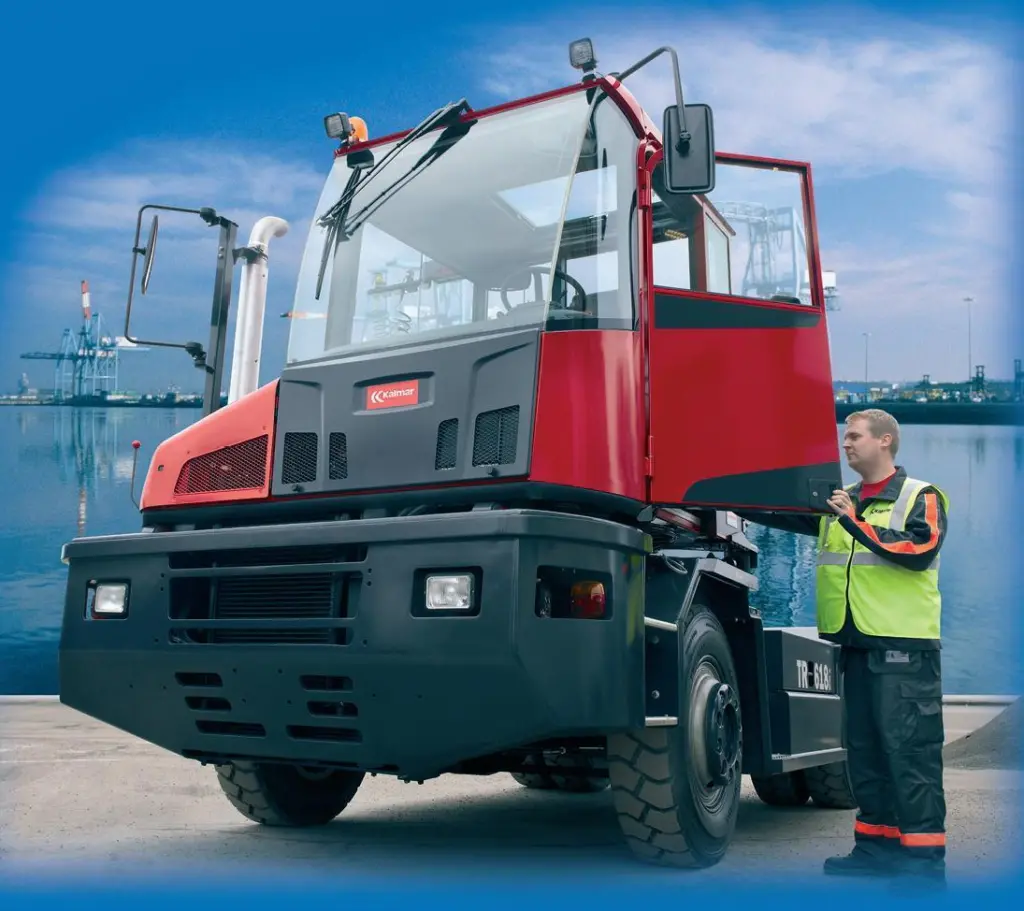
June saw the formal launch of Kalmar’s new generation terminal tractor, the icon series, which builds on the success of its innovative i-model range, introduced to the market in 2006.
Featuring a CAN-BUS control system of the type first introduced on Kalmar’s i-model range,the icon generation is characterised by superior operator comfort, enhanced performance and easy maintenance and service.
Developed in cooperation with drivers and ergonomics specialists, the operator cabin of the icon TT618i, TR618i and TRL618i models offers a significantly enhanced working environment, including improvements such as an asymmetrical rotating seat that is designed to be both flexible and adaptable, as well as a fully adjustable steering column, making it easier for drivers of different heights to access and work in the cabin.
A number of dimensional and layout upgrades provide more working space and better visibility, and the CAN-BUS control system – which integrates all functions in a single system and shows full operational and service data on one display panel – is designed to make operations faster, safer and simpler. Its diagnostic capabilities also assist in service and maintenance planning, saving time, effort and cost.
Speaking at the time that the icon series was unveiled, Timo Matikainen, general manager at Kalmar’s Trailer Logistics,noted that productivity is vital to port operations and the icon series is intended to help ports and terminals secure significant productivity enhancements via enhanced performance, cost efficiency and superior design.
“In operational terms, icon outperforms other terminal tractors thanks to the productivity and ease of maintenance afforded by its CAN-BUS system, combined with its excellent manoeuvrability and pulling power,”claims Mr Matikainen.
The icon range has also been designed with a small turning radius – which makes the tractor easy to operate in cramped spaces – and features the latest EU-stage engines, the Volvo TAD750VE and Sisu Diesel 74CTA,which provide greater torque,as well as the high pulling capacity required for heavy ramp driving. Automatic gear control ensures soft and smooth gear changes, while continuous traction is enabled by the new, stronger Dana RTE15822 transmission.
Pollution preventing hybrid
The icon series is not the only recent innovation from Kalmar, however, and with reducing pollution levels in ports in mind, Kalmar is also participating in a project which aims to reduce pollution by integrating hybrid propulsion technology into its terminal tractors.
The two-year project will be undertaken in cooperation with the US Environmental Protection Agency and the ports of Los Angeles and Long Beach, where hybrid terminal tractors will be operated and tested for six months. The green hybrid equipment is expected to reduce air emissions by 93%, which equates to 19 tonnes of nitrogen oxide and 200 pounds of particulate matter.
Kalmar’s role in the $1.2m venture is to assist with the selection of the hybrid system and to carry out the research and development associated with integrating the new system into the machines. The environmentally-friendly units will use either a hybridelectric system to combine the cleanest available diesel engine technology with an electric motor, or a hybrid-hydraulic system that combines the clean diesel engine technology with components that use hydraulic fluid compression to store energy. Stefan Johansson, vice president of Trailer Handling Product Development, tells Port Strategy that many port and distribution customers have recently shown interest in combining terminal tractors with a hybrid engine. He explains: “The new technology helps reduce fuel consumption, exhaust emissions and maintenance intervals.Strategically, it’s the right way to go.In the US, fuel is relatively cheap, but most people believe the cost will rise, increasing the need and urgency for alternative methods.”
The hybrid technology is expected to reduce – or even eliminate – emissions during idling, which can represent more than 50% of a terminal tractor’s duty cycle. Says Mr Johansson: “As it conserves the energy necessary for breaking, the hybrid system is ideal for a machine like the terminal tractor, which operates in a continuous stop-and-go fashion.”
Another advantage of the hybrid technology is that it allows customers to retain their existing operations and maintenance infrastructure.The system runs with a diesel engine so there is no need for another type of fuelling station.
Related Articles
 CONTAINER & CARGO HANDLING
 CONTAINER & CARGO HANDLING
 BULK HANDLING