![PortStrategy[GreenPort]](https://www.portstrategy.com/wp-content/uploads/2026/09/PortStrategyGreenPort.svg)





REACH PICKINGS OFFERED BY REACHSTACKERS
John Bensalhia talks to major reachstacker suppliers to discover current trends, innovations and assess the potential benefits for users.
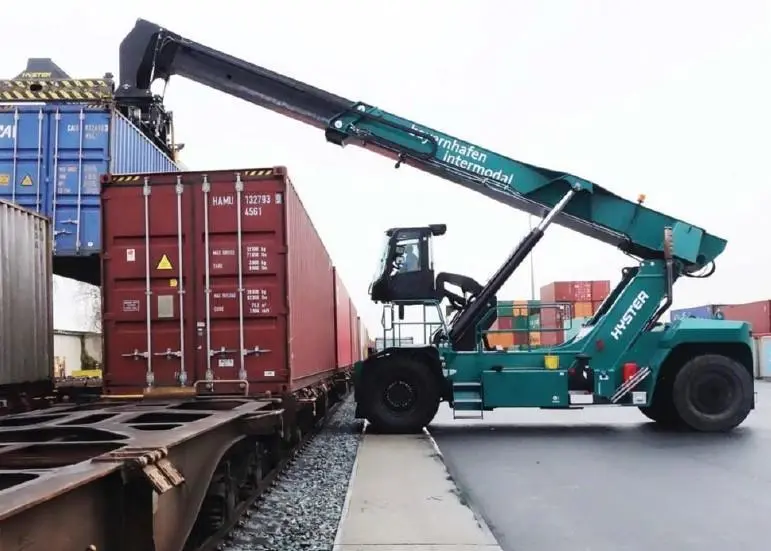
An over-riding trend of the modern reachstacker is, as Chris van de Werdt, Product Strategy Manager, EMEA Big Trucks, Hyster Company, observes, decentralisation. As boxes are moved inland, closer to the last mile of the journey, this reduces cost and CO2. This is then driving several other trends.
The first of these trends is Lowest Total Cost of Operation (TCO). “We are finding that more customers are focusing on productivity rather than the fuel savings they can achieve,” says Chris van de Werdt. “This is because fuel savings alone do not bring costs per container down – it is a combination of factors. We estimate that typically for the European and US market (excluding the tyre costs), just 16% of the total cost to run a reachstacker is the fuel cost, 20% is maintenance costs, 20% is depreciation and a full 44% is operational costs, including the driver.”
Hyster’s approach to fuel savings has always been about the best balance to support busy operations. Mr van de Werdt says that tests indicate that the Hyster reachstacker can be up to 12% more productive than a comparable product: “That’s 12% more containers moved per truck per hour, which quickly adds up.”
He further elaborates, “With telematics, terminal operators can also get better insight into their daily operation or maintenance. It is possible to use telematics such as the Hyster Tracker to get more productivity and move more boxes without increasing cost.”
The second and third notable trends of today’s reachstacker concentrate on the environment. In the case of noise reduction, this is particularly important for any terminal close to cities and residential areas.
“We are finding that more companies are willing to invest in reducing noise from both the machine and the spreader landing on the container (or when the container is put down),” says Chris van de Werdt. “Hyster Company ensures padding options for the spreader to dampen the noise, which work in unison with sensors that detect a container and automatically reduce the lowering speed just before contact.”
Peter Olsson, Director, Business Development, Counterbalanced Container Handlers at Kalmar, says that co-efficiency and sustainability is a major trend. “Especially CO2 emissions by optimising systems efficiency through increased digitalisation and interconnectivity between the terminal and the equipment. There is also resource efficiency, which can be accomplished by extending equipment lifetimes through service and maintenance, upgrades and recycling of parts.”
Many ports and terminals are keen to utilise electrification, with serious investigations underway about how to achieve this aim. Hyster has projects the Port of Los Angeles in the US and Valencia in Spain which have raised significant interest.
Chris van de Werdt explains that this interest is being driven by the ports themselves and with pressure from some governments. Yet he questions whether ports have the infrastructure to implement practical solutions. “Discussions are often about planning or re-planning the terminal and how the port needs to be laid out in the future, allowing for hydrogen fuel for example.”
Hyster zero-emission reachstackers incorporate electricity at high voltage as the main energy source to power fully electric motors. “The issue is usually about managing long working days in busy ports, which is where hydrogen fuel cells come in as a range extender.”
Meanwhile, the Hyster electric Container Handlers in development feature a large lithium-ion battery which is recharged by two onboard fuel cells during operation. “This approach suits the challenges of heavy-duty terminal operations, reducing planning complexity or charging issues,” says Mr van de Werdt. “It means that continuous operation is possible if hydrogen is available from the on-board hydrogen tanks.”
More ports and terminals are looking for flexibility to use reachstackers in more ways rather than just container handling. Hyster has, for example, developed quick change options so operations can swap to steel or coil handling or tubes and pipes.
“When one truck can do lots of things, the terminal is then able to adapt and offer additional services,” explains Chris van de Werdt. “Multiply that across a large fleet and operations could diversify and even reduce their fleet size. So, when ports are looking for new business, they can potentially get more from different customers by handling different materials.”
Terminal operators want to reduce damage and improve efficiency when handling containers on the second rail. Hyster recently developed a reachstacker with a new hinged elevating operator cabin which helps operators have direct visibility of the top corner pockets on the second rail containers, even when there is a high cube container on a railcar in the first rail position.
“Previously, the use of cameras or staff, known as spotters, to direct the operator had their limitations, putting extra time on the operation and increasing the cost per container moved,” says Mr van de Werdt.
With all these trends in play, ports are seeking a complete package with respect to the right reachstacker. Patrik Lundback, Director, Sales & Distribution, Konecranes, BU Lift Trucks, explains further. “Reachstackers are further increasing focus on safety, quality, uptime and environment, with great interest in electrification, hybrids and digitalisation.”
Mr Olsson explains that most of Kalmar’s customers are also looking for lower total cost of operation and ownership, maximised uptime and machine availability, lower emission levels as well as quieter and safer machines. The reachstacker is a multi-purpose truck and Kalmar has developed a reachstacker with an HVT transmission, which drastically reduces fuel consumption while offering improved productivity. “This provides lower operating costs and better total cost of ownership for the customer and a smaller carbon footprint for the environment.”
Growth in different quarters is also reflected in 2019 trends. “We are seeing a growth in vessel size,” says Patrik Lundback. “In addition, transhipment from these mega terminals to smaller ports will continue to grow. Inland cargo traffic is shifting from road to rail, barges and other modes of transport.”
One consideration for ports is to assess whether the reachstacker will need to block-stack higher and wider. This decision has met with mixed reactions for reachstacker manufacturers. Konecranes has, so far, had no requests to go higher than 6 for laden containers. “There are not really any limits for reachstacker operations if block stacking, but 5 is still the most common height for laden reachstackers,” says Patrik Lundback.
Chris van de Werdt says that container stacks are not necessarily going higher. “The problem applications have with going higher is that ‘selectability’ goes down, resulting in more dead picks, and with that comes higher productivity costs.”
In some cases, Kalmar has received requests to have machines with a capability to stack higher: “Therefore, we developed a machine that can stack 6-high vs. normal 5-high,” explains Peter Olsson. “However, not all customers are looking for this, since many of them have limitations on how high they can stack due to local requirements. With the mega trend of urbanisation and limited space for many existing terminals, we see a demand for higher stacking capabilities.”
Kalmar can offer up to 6-high for laden containers and 8-high for semi-laden containers (up to 12 tons). “These new high capacity types of reachstackers have been available for five to six years.”
Mr Olsson adds that another notable consideration is local restrictions. “At the same time, many inland terminals are in rural areas where a lot of space is available but also where local restrictions are considered regarding the stacking height up to 5-high. To get more containers in the same yard, the amount of block stacking tends to go from two or three rows deep to three or four rows deep (per aisle).”
The modern reachstacker has been designed to withstand wear and tear, and, the elements. Rain, wind or snow, the reachstacker can perform in all elements that are thrown at it. “Reachstackers are typically used 365 days a year and are asked to work in any weather conditions,” says Peter Olsson. “Therefore, a reachstacker must be designed to meet the harshest conditions, withstanding cold climates and the hottest weather.”
This is a view shared by Patrik Lundback. “Konecranes reachstackers are used to harsh weather and are prepared, with special heaters for extreme cold weather or for special coolers for extreme hot and/or humid climates.”
He sums up why the reachstacker is the most flexible container handling solution for small and medium sized terminals too. “For green field terminals, the entry ticket/investment needed is very attractive and could be started in a relatively short time-frame. Reachstacker operations could easily be converted in to RTG operations in the future.”
Related Articles
 CONTAINER & CARGO HANDLING
 CONTAINER & CARGO HANDLING
 BULK HANDLING