![PortStrategy[GreenPort]](https://www.portstrategy.com/wp-content/uploads/2026/09/PortStrategyGreenPort.svg)





Reach stackers
Training drivers to use reachstackers more efficiently is just one way to cost effectively improve productivity, as Alex Hughes reports
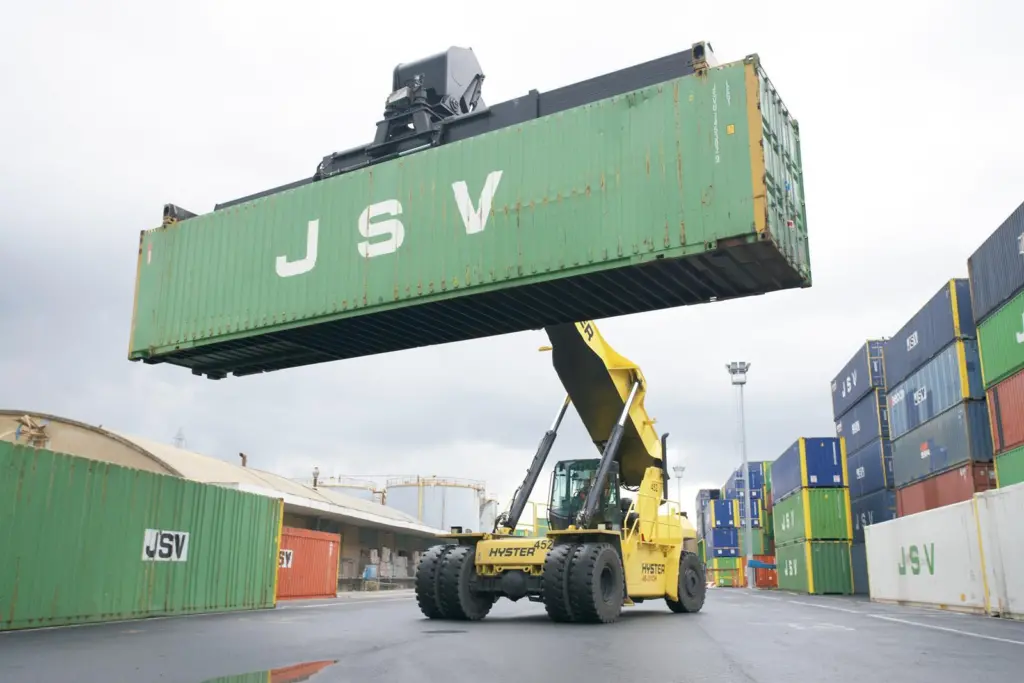
In today’s maritime terminal operating environment, there is very much an onus on manufacturers to provide more environmentally-friendly equipment. Reachstackers, which use large quantities of diesel fuel and emit high levels of emissions, are clearly one area where improvements can be made and that doesn’t have to be at the expense of productivity.
Specialist manufacturer Hyster says greener engines, automatic power shut down, better driving and locally available after sales provision are all part of the answer.
Antoon Cooijmans, product manager for Hyster Big Trucks, says that his company designs reachstackers to provide the optimum balance between power and low fuel consumption. The secret is the Cummins QSM 11 industrial diesel engine, which has charge-air cooling and generates low exhaust emissions that conform to the EC Tier 3 standard for Non-Road Mobile Machinery (NRMM). This engine’s maximum torque is at 1,000-1,400 rpm, providing excellent acceleration and lugging power, allied with low fuel consumption.
“There is no need to rev the engine up first when simultaneously lifting a container and accelerating at the same time. This characteristic is, I believe, the largest fuel saving aspect,” says Mr Cooijmans.
As for unnecessary fuel burnt during idling, he says that this can be overcome by fitting an optional engine shut-down feature, which will automatically turn the engine off either when no manoeuvres have been undertaken for a given period or once the operator has left their seat.
Asked about re-capturing energy lost during braking procedures, he observes that many electrically-powered warehouse products are now designed to re-capture energy. This technology has, however, not yet been developed for diesel engine-driven reachstackers. Instead, in the case of Hyster, energy can be restored by a proprietary two-speed system fitted to the hydraulics, which regenerates oil volume, resulting in energy savings without prejudicing high lift speeds.
“We can only do so much with the design of the reachstacker to ensure it is as energy efficient as possible. In reality, further savings can only be delivered by the driver, who has to operate the machine more efficiently. For example, high acceleration, heavy braking or irregular repositioning on the approach to a container will of course use up more energy and therefore make operations unnecessarily more expensive,” says Mr Cooijmans.
Furthermore, Hyster’s distribution partners’ training schools teach drivers how to maintain the right balance between productivity and fuel consumption, he adds.
“Driver training is a legal requirement and important to maintain safety in the ports and terminal. However, drivers are a key element, given that they can significantly help affect productivity and throughput of containers, fuel costs and equipment wear in demanding, time sensitive operations. It really is worth investing in them!”
Reachstacker manufacturers that sell equipment into the maritime field tend to have established a proven reputation for tough, reliable equipment. Nevertheless, Mr Cooijmans stresses that following routine maintenance schedules is critical to ensure that machines are able to provide optimum performance for the duration of their life span.
“Service schedules vary depending on hours used, but our reach stackers have a low cost of operation and are designed in such a way as to minimise and simplify service,” he says.
Port Strategy nevertheless continues to receive reports from disgruntled terminal operators across a broad range of equipment claiming that back-up from some manufacturers is simply not good enough and that response times to major incidents are too slow.
Mr Cooijmans acknowledges that port operations are extremely time sensitive, which is why Hyster’s global network of distribution partners is centred around locally-based companies that are able to respond quickly to any service-related issues. No other cost effective solution to after sales support should probably even be considered, he says.
“In terms of what terminals themselves could do to minimise problems brought about by the need to service equipment, a major issue is to find the most appropriate time to take the equipment out of operations so that maintenance can be undertaken. That means allocating this down time to off-peak times, which can also mean during the night or at the weekend. And when I mention the weekend, I also include Sundays in that.”
Related Articles
 CONTAINER & CARGO HANDLING
 CONTAINER & CARGO HANDLING
 BULK HANDLING