![PortStrategy[GreenPort]](https://www.portstrategy.com/wp-content/uploads/2026/09/PortStrategyGreenPort.svg)





Reorganisation: The Pay-Off
Southampton Container Terminal (SCT) has one of the worst imbalances of trade in Europe with empties accounting for over a quarter of throughput. Benedict Young finds how theyre combatting the problem.
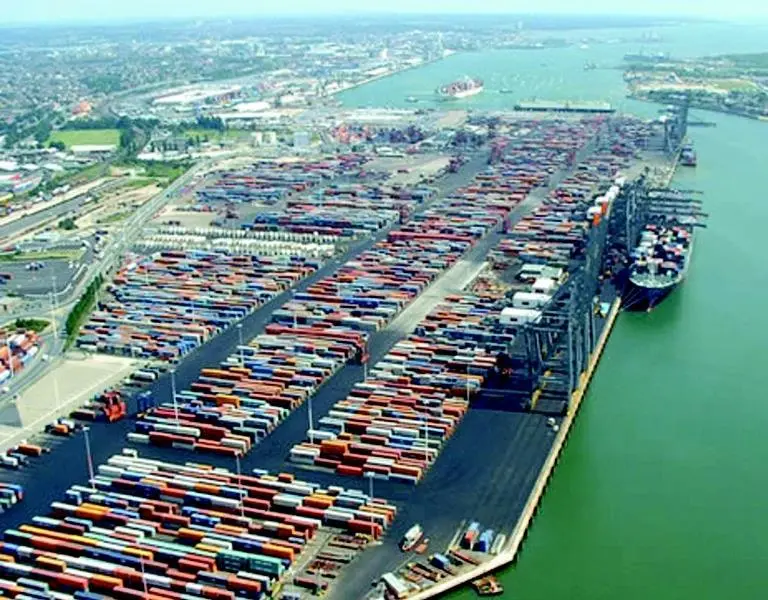
Due to imbalance of trade SCT has grappled with the problem of empties for many years. “Before 1998, everything was done with straddle carriers and empties were handled in two and sometimes three high rows which was not the best use of space, ” says Derek Smith, SCT’s business development manager.
SCT opened its new empty container park in January this year in the fourth location since 1998. Rather than situating it to serve the largest number of berths, it is located at the far west end of the terminal within 700 metres of the two deepwater berths which serve the China Express vessels.
“Over ten years the balance of trade has shifted with a reduction of full export containers of about half a percent per annum, ” explains Smith.
“26% of throughput is empty containers going back to the Far East.”
The empties yard utilises six FLTs capable of safely lifting two 40′ containers from the sixth tier. Empties handling has been fully integrated into the terminal management system with information flow between the machines. Each shipping line has a storage block of forty rows. When instructions are received to load a batch of export empties, the FLTs each peal off two boxes from the top of the appropriate stack and move them to the transfer point where they are stacked three high. As soon as the FLT has confirmed by twistlocks that the boxes are there, the information goes to the straddle carrier which transfers them to the ship. “It’s a very quick operation, ” says Smith.
FLOODED WITH EMPTIES In 2004, SCT was flooded with empties from elsewhere in the UK and ended up with 25,000 TEUs of empties in the terminal and the surrounding area. A reachstacker area was set up in early 2004 for receiving full exports. By September, half of it had to be turned over to handling empties stacking five high by reachstacker.
“We had to take strong control over what was received because if you bring in 200 boxes, the next 200 can’t come in until you’ve shipped the first batch, ” explains Smith. “That wasn’t well received but it was something we had to do to take control of the yard. The new empties park is double the size of the two combined areas last year. It occupies an area of eight acres which can hold 7,500 TEUs.
“If you take away the need to put an empty container under the straddle fleet, you have another option for unloading lorries. That is also a very smart operation as they queue up in taxi fashion and the empty handler comes along and off it goes. A percentage of trucks which are doing local shunts to depots are bringing empties in and taking nothing out and they’re gone in five minutes. They still have to book through the vehicle booking system but they get a fast-track through the pre-gate which chops off another few minutes.”
Due to the distance from the empties yard to the berth, some empties are still stacked in two and three high straddle rows adjacent to the ships but 75-80% of empties go to the new park.
“If we put 7,000 TEUs of empties in the main yard, they would require 3,500 ground slots, ” says Smith. “At 100 slots per acre, that would require 35 acres to store empties whereas we’re doing those in seven to eight acres now. For every 1,000TEUs we’ve taken out of the terminal’s straddle rows, we’ve gained 2,000TEUs of space elsewhere. Last year we were running straddle carriers an average of 1,100 metres and now it’s about 750 metres per move, so the yard reorganisation is paying off in terms of ship productivity and vehicle turnaround.”
Related Articles
 CONTAINER & CARGO HANDLING
 CONTAINER & CARGO HANDLING
 BULK HANDLING