![PortStrategy[GreenPort]](https://www.portstrategy.com/wp-content/uploads/2026/09/PortStrategyGreenPort.svg)






Ro Ro tugs
Its a tough job, but modern-day ro-ro tugs seem up to the challenge. Alex Hughes reports
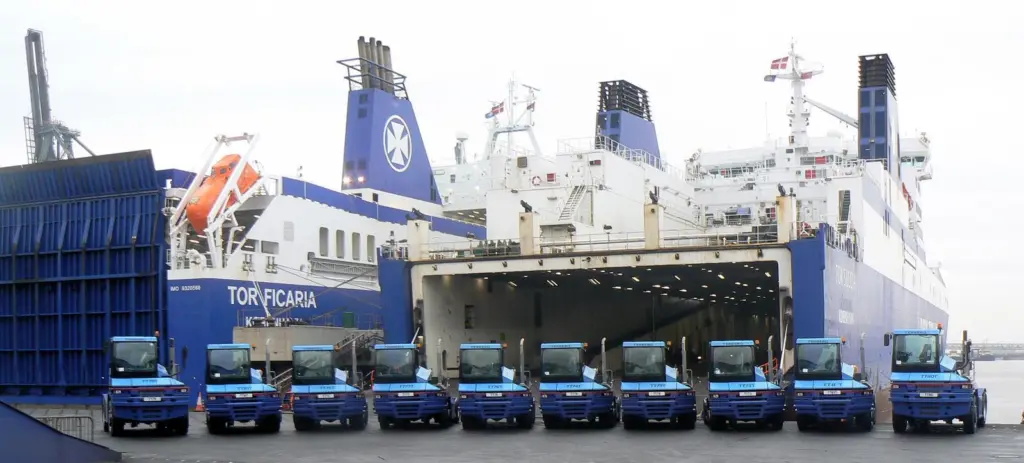
Ro-ro tugs have to work in one of the most difficult of all port terminal environments: shuttling trailers and merchandise on and off docked vessels.
Worse still for operators, assets have to be sweated while they are still young, since most tugs can only work reliably on the front line for just five years.
The DFDS Nordic Terminal at the east coast UK port of Immingham is one of the UK’s busiest in terms of ro-ro traffic. Here, a fleet of 56 Terberg tugs undertakes the brunt of the loading and discharge operations, as well as being heavily involved in yard shunting and the movement of industrial cargoes, using the Mafi roller trailer system.
“For most of these duties, there is no suitable substitute equipment,” operations director, Alistair Campbell says. “However, for some of the longer hauls, we use a couple of second hand road tractors, but that’s about it.”
Terberg, he explains, recommends operating tugs in front line situations for no more than 12,500 hours. Beyond 14,000, he says, they become significantly more expensive to run.
“Ideally, we would keep them for no longer than five years or 12,500 hours, whichever comes first.”
As a result, new tugs at DFDS Nordic Terminal are worked very hard, because they will have proven reliability, says Mr Campbell, making them ideal for front line duties. As they become older, they are re-deployed to less onerous tasks.
Further south in the UK, Peter Lavelle, director of the Wallenius Wilhelmsen Terminal in
Southampton, which handles new vehicles traffic, explains that operations on his terminal normally require the deployment of a single ro-ro tug, which is owned by the company, although extra machines can be hired in from stevedores working in the facility.
“Our tugs are used for both terminal and vessel work. However, some of our vessels calling at Southampton also carry FLTs with front end attachments, which are capable of carrying out some of the duties undertaken by our tractors,” says Mr Lavelle.
The various tugs deployed on the Southampton terminal were also supplied by Terberg, although there have been no recent purchases. Nevertheless, Mr Lavelle points out that when acquisitions are made, the main considerations when choosing between one supplier and another are capability, technology, running costs and driver comfort.
To date, the oldest machine operated in the Wallenius terminal is ten years old, but it does not work continuously every day. To ensure it continues to operate smoothly, the WWL terminal therefore insists on a twice-yearly service.
Asked whether the relative sophistication of ro-ro tugs compared with conventional terminal tractors means that they are more prone to develop serious maintenance issues, DFDS’ Mr Campbell says that this is not the case. There are more things to go wrong, he concedes, but the Terberg tugs are very well put together, so this is not the case. The fact that onboard fault diagnostic systems monitor performance also helps keep tugs in service longer.
“The newest tugs we have are extremely reliable; they don’t break down very often,” he says, noting that there are invariably some teething problems early on, which Terberg is always quick to resolve. “If a company is producing bad product, word gets around the industry extremely quickly, because everybody in this business talks to one another.”
Terberg, he adds, is an extremely proactive organisation and sends a representative to the Nordic terminal on a monthly basis to gather feedback. Indeed, according to Mr Campbell, manufacturers he has dealt with across various types of port equipment in different ports have always shown themselves open to feedback from operators.
Wallenius’ Mr Lavelle agrees: “Ro-ro tugs have been improving greatly over the years and, when you consider the work they are doing, I think there is very little manufacturers could do to improve them dramatically,” he says.
Nevertheless, he stresses that these tugs are not bought as off-the-shelf machines, as each user has individual requirements that have to be catered for in the overall design. Lead times therefore tend to be in the region of six months.
Meanwhile, Mr Lavelle notes the second hand market for ro-ro tugs, but would be extremely cautious about entering it. “The risk is that you have no knowledge as to how the tractor has been treated and maintained in the past, so you could never be exactly certain what you were buying,” he says.
Adds Mr Campbell: “A unit that has been on the terminal for six to seven years will have done anything between 13,500 hours and 17,500 hours. There are dealers that will then take them off your hands and sell them on, although the second hand market at the moment has been negatively affected by the economic downturn.”
Nordic, itself, has never bought second hand. If it does require a short term infusion of tugs, either manufacturers or dealers are invariably able to provide some nearly new vehicles at short notice. Getting brand new units, even in the recession, implies a lead time of at least six months.
Although the Immingham terminal operates only Terberg units, the company’s facility in Esbjerg has Kalmar-Sisu tugs, while that in Rotterdam favours Terbergs.
“We have a good close working relationship with Terberg in Immingham. So, as long as they come up with the right equipment at the right price, we will continue to buy from them. However, we always go out to international tender for new units and other companies do bid. If somebody came up with a better price, we would consider them,” says Mr Campbell, nevertheless conceding that the fact of currently operating a uniform fleet has to be seen as a substantial barrier to entry.
Those tugs deployed on the terminal are not, however, standard units, since they are modified by Terberg before delivery to meet Nordic terminal’s specific requirements. These modifications have been developed in partnership with the manufacturer over several years of close cooperation.
“In today’s environment, where we have a real focus on costs, we are looking for value for money. When we issue a tender, we are therefore looking at a bid that balances the initial price, whole life costs and technology,” says Mr Campbell.
The company has assembled a significant database of each tug on the terminal, which allows him to have a good idea of the lifespan of components such as engines, transmissions and running gear. If, however, Terberg up-rates engines, it will inform the terminal as to expected fuel consumption, so that additional costs can be monitored.
Mr Campbell insists that he knows the running cost per hour of every tug in the fleet and is aware of most of individual characteristics of each, which in turn helps him optimise deployment and, crucially, keep a lid on costs.
“Calculating return on investment on a tug is very difficult, the problem with our Imminghan operation is that it is a multi-functional terminal, which means that a tug might be working on a vessel one day and pulling conventional steel plates the next day.
“Of course, there is a different value to each product and it would be impractical to allocate profit generated to individual tugs. Instead, we invest in tugs to ensure that we have sufficient of them to handle particular types of cargo. In fact, last year, we invested in some RT382s because we had a specific commodity we wanted them to work with.”
Back in Southampton, apart from the already mentioned fork-lift trucks, there is no other mix of handling equipment in the WWL terminal, since the ro-ro tugs provide everything needed, which Mr Lavelle lists as four-wheel drive, better suspension than conventional tugs, and an enhanced fifth-wheel capability.
Related Articles
 CONTAINER & CARGO HANDLING
 CONTAINER & CARGO HANDLING
 BULK HANDLING