![PortStrategy[GreenPort]](https://www.portstrategy.com/wp-content/uploads/2026/09/PortStrategyGreenPort.svg)






Rough riders
For tough, challenging surfaces, ports need to look to rough terrain handlers, as John Bensalhia explains
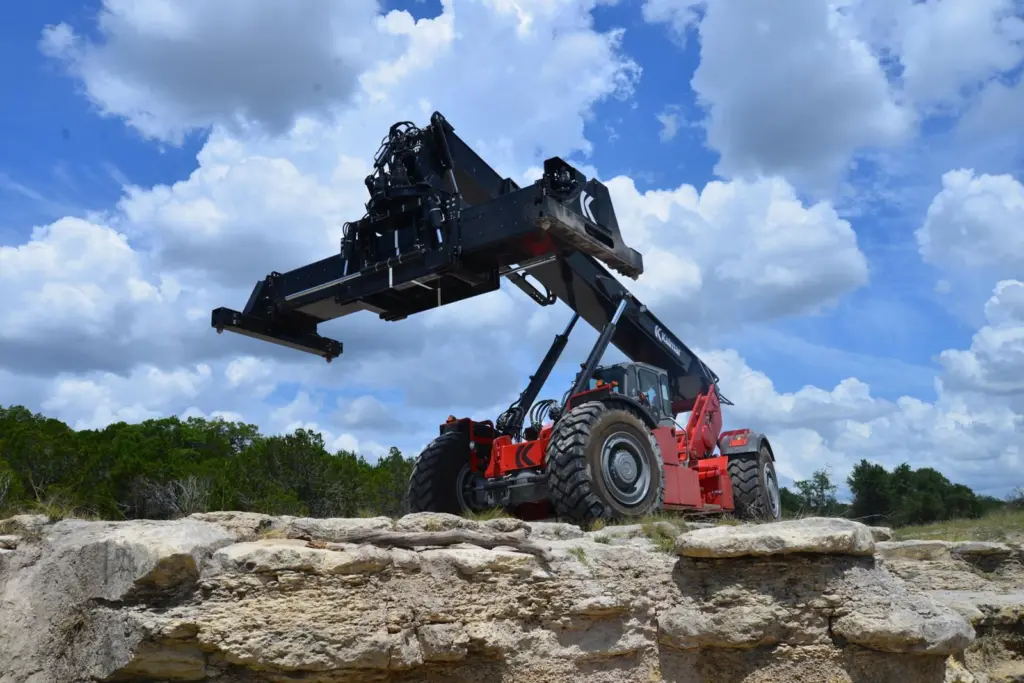
In the Northern hemisphere, we’re moving towards summer and as the sun puts his hat on, that means more carefree car trips: whether it’s a relaxing drive along a country road, a trip to the coast or braving a camping holiday.
One thing that will almost certainly put a dampener on the journey is navigating rough terrain. Some of the roads will be pot-holed; parking around a busy beach may require some creative moving around a clump of hilly sand dunes; and then there are those tricky minor roads leading to the final holiday destination. All of which may leave your car in need of its own holiday.
Rough terrains don’t just make life challenging for the average holiday. Port operators must somehow manage the problem of rough or uneven ground, whether it’s for picking up or transporting cargo to and from its destination, container handling or maintenance. Finding the right choice of rough terrain handler depends on a number of factors such as mobility, strength, and stability. A good rough terrain handler will need to stand up to the task of negotiating challenging ground at ports.
Kalmar is one manufacturer that provides rough terrain handlers for those trickier surfaces. Vehicles such as the RT240 reachstacker and the Kalmar RT022 forklift have been designed to endure the toughest ground surfaces to allow port operators to carry out their operation in smooth, efficient fashion. The RT022 forklift, for example, offers the advantage of being compact enough to drive into a container while at the same boasting a lifting capacity of up to 5,000 pounds. When it comes to negotiating the toughest of surfaces to move around on, the RT022 uses two-wheel, four-wheel and crab steering modes to allow for high performance manoeuvrability.
“A primary trend in rough terrain container handling is use of specialised attachments requiring longer load centres and incremental capacity,” says Robert Schafer, sales director of Kalmar Rough Terrain Handlers. “With Kalmar’s many attachments, the RT240 can supplement and even can handle different types of loads. With its universal tool carrier, the RT240 is well suited to work with numerous attachments, such as a tire handler, cylinder clamp and pipe handler.”
Steering group
Like the RT022 forklift, the RT240 has the three different steering modes to allow for good movement on challenging surfaces. With the ability to traverse any type of terrain, the RT240 can unladen, drive up to 24 miles per hour on a paved surface.
Mr Schafer adds that another trend in container handling training is improvement in safety. “The RT240 has passed the most rigorous military standards for rough terrain and can safely operate in off road conditions, even where there is mud, sand or snow. It’s the only choice for off road and unimproved ground conditions, giving you the reassurance that your operators are safe.”
Mr Schafer explains that the rough terrain container handlers have the ability to work “off pad” away from traditional concrete or improved surfaces where the typical reachstacker operates. He adds that specific instances of rough terrain may require alternative solutions that may save the port money. “In certain cases, it may be less expensive to utilise a rough container handler in lieu of surface improvements.”
“As containerisation becomes more prevalent in the Americas, demand for mobility will continue to increase over time. In addition to being cost efficient, there is less prep time for operations to begin.”
Terex has also noted a number of notable trends when it comes to the rough terrain crane sector. Strong markets for rough terrain cranes are North America, particularly the US and Canada, and the Middle East. There is also a growing demand in Southeast Asia.
Damien Bizjak of Terex Cranes’ global marketing department explains that models are tailored for particular markets while trying to maintain a common platform where possible. He adds that environmental considerations have also been taken on board: “Emission regulations are a big consideration at the moment as models are upgraded to conform with Tier 4F and EuroMot4. In addition, we offer Tier3 / EuroMot3a for regions that do not have access to ultra low sulphur diesel.”
Capacity increase
The most popular classes are middle and high capacity. “They had significant growth over the past few years,” says Mr Bizjak. “There does seem to be a trend in increasing capacity particularly in the Middle East and North America and in applications like petrochemical and prefabricated steel and concrete fabrications.”
Several of Terex’s rough terrain cranes feature the new Terex family cab including the RT 670 and RT 780. Mr Bizjak comments: “This adds to the lineup of the Quadstar 1065, Quadstar 1075, Quadstar 1075L and Quadstar 1100 that already feature the new Terex look and feel with the family cab, which sets a new standard for operator environment. Benefits include clear view of the load with hinged, tinted all glass skylight and tiltable cab, interior designed for operator comfort, and easy to use, simplistic drive controls.” The latest Terex model, for example, is a 65 tonne capacity crane, the Quadstar 1065. The crane is rated at 65 tonnes at 3m with a maximum main boom length of 32.4m.
Mr Bizjak says that the main advantages are the versatility for lifting requirements and site conditions, manoeuvrability, ability to pick and carry, and ease of operation. “RTs are robust machines that can operate in tough site conditions and are versatile in terms of lifts they can handle. On the site they can pick and carry a load and manoeuvre easily around the terrain thanks to multiple steering modes. RTs are designed with intuitive and easy controls which makes them ideal for bare rentals, as they often have non-dedicated operators.”
For ports wishing for the right rough terrain solution with respect to platform workspace, that wish can come true thanks to Genie, a member of the Terex group. Genie’s rough terrain scissor lifts work on the principles of increased efficiency and productivity thanks to facilities such as competitive lift speed and large platforms. The Genie rough terrain scissor lifts also offer strong levels of speed, traction and gradeability, managing to deal with difficult ground surfaces.
Need for speed
Speed shift is a focal point of the Manotti Rough Terrain Cranes. The two Manotti cranes are characterised by the type of speed shift used. The hydrostatic crane is designed with the engine mounted on the superstructure so that it can rotate full circle. In addition, it can also hydraulically power each sub-assembly, for example the gear shift that controls travel speed. Meanwhile, for the mechanical crane, the engine is normally located in the strong steel frame, with the speed shift (which is directly flanged to the engine) controlling the travel.
A key selling point of Manitowoc Grove’s rough terrain crane is the Crane Control System, a user-friendly initiative that makes operation simpler and the required work faster to carry out. At last year’s CONEXPO, Manitowoc Grove showcased its new RT540 rough terrain crane. This rough terrain crane is an upgraded version of the previous RT540E crane with all new features including new controls, new cab and an improved swing system.
Working alongside the CCS is the new swing system, which allows the operator tighter control and ease of use – for example, there is less time lag between the movement and the slewing motion of the crane. Four steering modes and strong pick-and-carry abilities cap off this new rough terrain offering from Grove.
While the ground below may cause a bumpy ride for rough terrain handlers, fortunately the latest innovations and developments available mean that this product area is a comparatively smooth one for ports.
Small cranes can benefit from lifting plan
The popularity of rough terrain cranes means that manufacturers need to come up with new innovations to ensure easy, accessible service for customers.
Ports then benefit from these new innovations. Terex, for example, has developed an online lift planning tool, Terex Lift Plan. This can be used to plan a lift in advance, but also on-site on an ad hoc basis.
“This is particularly useful for the crane driver should conditions change,” says Terex’s Damien Bizjak. “The driver simply enters the new information and the system automatically does the rest. Historically, only customers with big machines and complicated lifts have used lift planning tools. As the new tool is easy to handle, it is also applicable for lifts with smaller capacity cranes. Nearly all Terex RT cranes can be found in the Terex Lift Plan.”
The company has also introduced a new regional structure. “We are building a dedicated Sales and Service organisation for every region in order to be easier to do business with,” says Mr Bizjak. “We are also increasing our product support presence in the regional markets. One example is the newly opened Service Station in Singapore. Others will follow.”
Related Articles
 CONTAINER & CARGO HANDLING
 CONTAINER & CARGO HANDLING
 BULK HANDLING