![PortStrategy[GreenPort]](https://www.portstrategy.com/wp-content/uploads/2026/09/PortStrategyGreenPort.svg)





RTGs-R-US
Fazilette Khan casts an eye over the automation of the RTG, its perceived limitations and advantages.
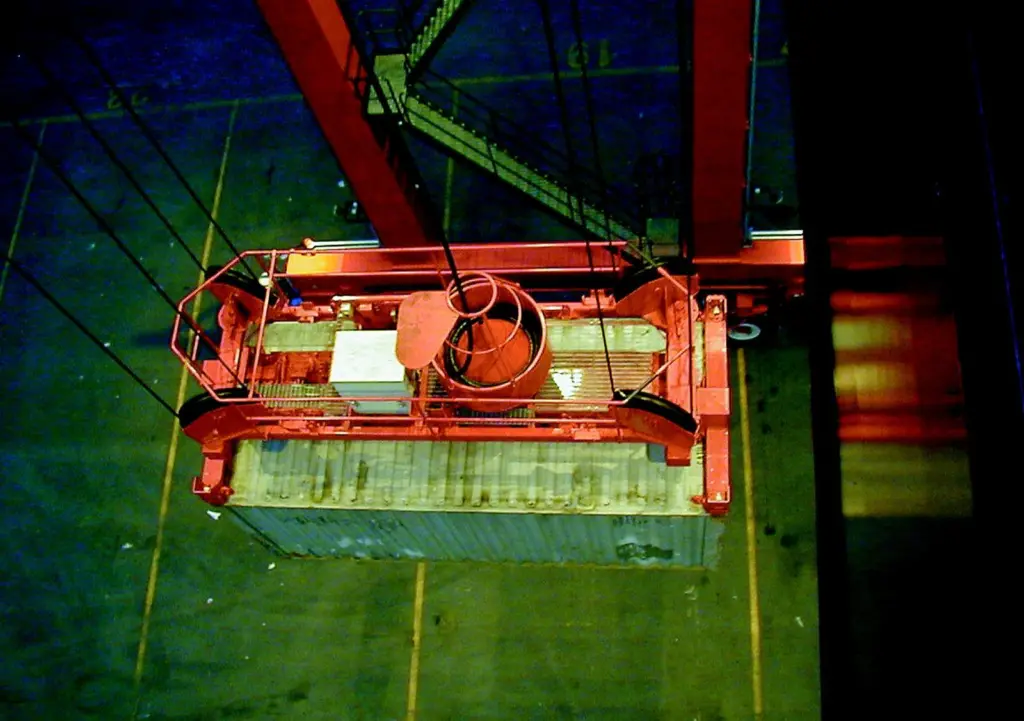
Five years ago, both manufacturers and terminals were predicting fully automated Rubber Tyred Gantries (RTG’s) as the future. Ground-based systems like distance counting, buried wires and transponders were heralded as the key to the cybernetic domination of these massive machines. So why didn’t the prophecies of the crystal ball gazers of that time come true?
The answer is simple – safety. Mixing automated RTG’s with trucks, tractors and trailers driven by humans is a scenario that is not even contemplated these days – the risk of the impact as a result of an accident just too great.
“The technology is there, but it is not realizable with current RTG yard practices. Any automated RTG operation would have to run under conditions similar to an automatic stacking crane exclusion area, ” explains Pat O’Leary, director at Liebherr Container Cranes.
Kalmar Industries too is shying away from taking the final steps towards unmanned RTG operations. “There are a few operational and technical obstacles down that road that have to be overcome. For safety reasons, loading and unloading containers on or from manned vehicles in vehicle lanes is not the most desired aspect of container handling automation, ” says Keijo Parviainen, vice president, Yard Cranes, for the company.
Even if this holy grail was achievable, many ports remain sceptical and cite that RTG’s may anyway not be the bottleneck in their operations. Therefore improving productivity of the RTG by means of automation alone may not improve the overall operational productivity at all. One port insider summed up the opinion of many: “We will continue to evaluate uses of automation but will only recommend making the investment when we are convinced the benefit provided warrants the expenditure.”
Instead, when full automation is the desired objective, terminals, especially new ones, are paying the extra premium to install rails and have automated stacking cranes or RMG’s. These machines have the capability of picking up containers using 3-stack co-ordinates such as its position along the stack length, the width of the row and the depth of the stack. By using high-speed radio or optical fibre links, bidirectional information can reliably be transmitted to a central computer which monitors the container positions in stacks while automatically operating the crane motions, all without the need for driver intervention.
Hardly surprising then, that RTG’s have thus far only achieved partial automation. This has taken the form of container identification and gantry steering. With automated steering, the driver does not need to manually operate the RTG. Instead the crane is navigated by a differential global positioning system (DGPS) along a pre-determined path. “Keeping a 35-36 metre wide machine within 3-4 cm of a set path saves on both fuel and time. It also cuts out the possibility of minor accidents, ” says O’Leary. “It leaves the driver free to concentrate on other tasks such as of picking and setting down containers as well as visually identifying and confirming container numbers.”
Liebherr’s GPS steering system can, with customer preference, be operated with either electrical or hydraulic control. The automated guidance system is based on the ‘cm’ resolution principle using real time kinematics calculations. A single or twin antenna arrangement is available. When two GPS antennae are fitted, no rotational correction is required as the antennae define a line rather than a point. The less expensive option of the single antenna system requires more complex algorithms and is unsuitable on certain sites.
Repeaters located throughout the terminal ensure the integrity of the signals to the base GPS receiver which calculates the location of the vehicle from signals received from several satellites. “Our autoguidance system has two modes of operation – electrical (differential) steering and hydraulic. The electrical steering operates on the basis of the GPS signals controlling the relative drive speed of each side of the RTG, whereas in hydraulic mode the wheel angles are controlled independent of speed in order to maintain the defined path, ” explains O’Leary.
Smartrail is Kalmar’s version of automated steering. It too is based on a DGPS system. According to the company once the system is activated by the RTG operator a pre-determined path can be followed which has an accuracy of within +/-5cm. Additionally, the container verification system feature allows the terminal operators to locate the exact yard position of each existing container. Based on GPS, it automatically sends in real time an updated message to the container terminal’s yard management system each time a container is either picked up or placed in the yard.
But not all agree that yard management systems incorporating individual machines can give optimal efficiency. As one industry insider puts it: “If you have to know the location of every moved container, how can you achieve that by integrating RTG’s only. Each and every piece of yard equipment must be a part of the container handling management process.”
Elsewhere, Konecranes has made strides in improving the overall efficiency of its RTG’s. The company’s orders for close to 200 newgeneration RTG’s already delivered or under delivery, have no hydraulic systems even for gantry wheel turning. The patented load control and bogie wheel turning solutions of these AC drive, diesel electric gantries promise better reliability, low maintenance and fewer spare parts.
The Port of Oslo however went one stage further in its demands for the Ormsund Terminal. Due to its proximity to nearby residential areas the port wanted all the machines operating within its perimeters to be both noise and pollution free, in fact to have zero emissions. Kalmar provided four electrically operated RTG’s to the port. The 9+1 span and 1 over 4 high machines have no diesel engines, instead, the machines are fed by a high-voltage cable. In order to follow the cable ducts extremely precisely, the RTG’s have been fitted with Kalmar’s Smartrail.
While the case of the Port of Oslo has thus far proved to be a unique order catering to the demands of a particular client, the current trend in the RTG market has seen some changes. The 1-over5 high RTG with 16 wheels seems to be on the increase as is the demand for twin-lift operations with a capacity of 50-65 tonnes under the spreader. “RTG’s are continuing to gain ground from straddle carriers, reach stackers and intermodal RMG’s. Customers value the efficiency and flexibility of RTG’s, ” confirms Thomas Saastamoinen, sales manager, Container Handling at Konecranes.
To illustrate the point, the Israel Ports Authority (IPA) has placed an order for 24 new generation RTGs with Konecranes. The 16-wheel RTGs have a lifting height of 50 feet and a span of 74 feet. The cranes will be 1-over-4 containers high and six-plus-truck lanes wide.
Handling efficiency will be achieved by high hoist, trolley traverse and gantry speeds. Additionally, the RTGs will be fully equipped with a GPS based container positioning system, autosteering, sway prevention and fine positioning systems.
IPA has also reserved an option to buy 15 additional RTGs. The order (excluding the option) is worth around E29m and deliveries are expected to start this April. The order for the 24 RTGs is part of a huge port expansion programme that will extend and modernise existing ports and reduce ship-waiting times. The RTGs have been ordered for the new Hayovel project, which is now well underway at Ashdod port.
The IPA which owns, operates and manages Israel’s commercial seaports at Haifa, Ashdod and Eilat, envisages annual cargo growth of 6% in the coming years and total investments by IPA from 2003-2007 will amount to $900m.
Related Articles
 CONTAINER & CARGO HANDLING
 CONTAINER & CARGO HANDLING
 BULK HANDLING