![PortStrategy[GreenPort]](https://www.portstrategy.com/wp-content/uploads/2026/09/PortStrategyGreenPort.svg)






Safety stance
How are fork-lift truck manufacturers helping to raise health and safety levels in their products? What add-ons are available to cement safety levels? What can port operators do to ensure that their fork-lift truck operators know all the ins and outs of safety? John Bensalhia investigates…
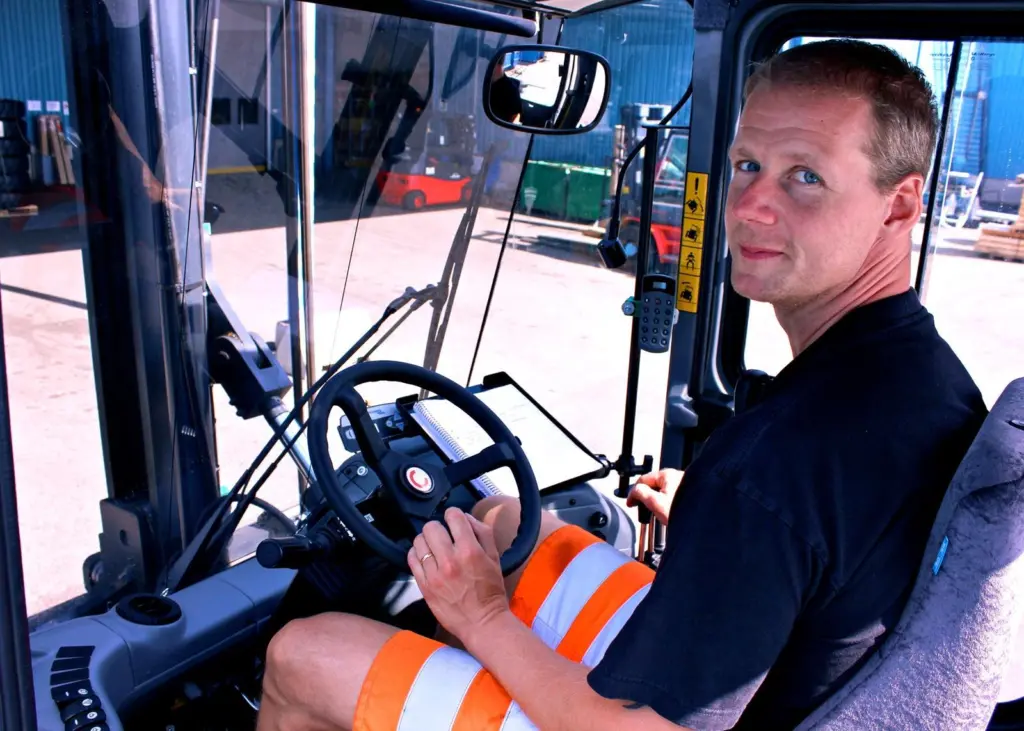
What are the watchwords that roll off the tongue when it comes to discussing fork-lift trucks? Versatility. Flexibility. Good value for money. The sort of words that any port operator likes to hear. But by far the most important watchwords are health and safety.
While a good fork-lift truck can perform tasks economically and efficiently, it still requires large amounts of training in order to avoid accidents or fatalities. It’s a regulation that’s stipulated all over the world – fork-lift truck operators must be properly trained and certified.
A recent report compiled by the Fork Lift Truck Association found that, on average, between 2001 and 2010, there had been a 28% improvement in safety levels for fork-lift truck usage. However, it’s not just training standards that are helping to make fork-lift truck operation safer in ports, improvements in technology on the part of the manufacturers are also playing an important role.
Take Cargotec’s Kalmar G-Generation fork-lift truck. This recent model has been devised with a spacious cabin. One of the main benefits of this model is that it can get rid of blind spots with the aid of solid safety cage construction and profiled beams.
Another health and safety issue is that of overpowering noise levels – Cargotec’s DCG90-180 lift trucks overcome this problem via variable speed pumps and a temperature-controlled cooling fan that is run only when necessary.
Safe solutions
Konecranes also takes the issue of health and safety seriously when developing new products. “Konecranes invests significantly in R&D to be the first to offer new technologies that improve performance and safety,” say Lotta Tagesson, marketing specialist and Patrik Lundbäck, sales and marketing manager. “We also ensure that our forklifts are fully compliant with current emissions, regulations, anticipating their evolution as a normal part of our product development process.”
Konecranes makes health and safety top priority, having increased spending in R&D. For example, Konecranes has introduced the award-winning NearGuard system, which is based on Radio Frequency Identification Detection (RFID) technology. “The system consists of two to four receivers mounted on the lift truck and RFID tags attached to obstacles and/or employees working in the lift truck’s operating area,” explains Konecranes. “When the lift truck is driven in close proximity to a tagged obstacle or employee, the driver sees a flashing warning indicator on the EMC control system’s colour display. Near Guard brings a powerful new dimension to lift truck safety and infrastructure protection.”
Konecranes’ fork-lift trucks include a host of crucial elements that allow the operator safe, efficient usage. Increased visibility is a key factor of safe operation, and Konecranes have taken this issue on board in two key ways – one is the implementation of various cameras – a camera supervision system can be mounted as a reversing camera on the rear of the lift truck, or as a forward camera mounted on the mast. The other is the ‘slope’ design of its counterweight that will not obstruct the rear view. In addition, Konecranes trucks include fire alarm and suppression systems, and parking distance controls with sensors for reverse driving. The driver of the truck can be alerted if he or she is not wearing a seatbelt, thanks to a special lamp, and there is also a breath analyser – an alcohol test unit that requires the driver to perform a breath test before use.
Another key element of the Konecranes range of fork-lift trucks is the ErgoCab: “The ErgoCab is truly spacious and with remarkable visibility. It can be customised precisely as you need, and is designed for optimal ergonomic for the drivers,” says the manuacturer. “Our controls inside the cabin are designed for the best possible ergonomic for the operation and with low noise level inside the cabin. We are also offering various climate features depending of the location of the machine.”
Alarm bells
In addition to fork-lift truck manufacturers, other companies are helping to make the trucks as safe as possible with the aid of state-of-the-art equipment. Transmon Engineering, for example, manufactures and supplies a range of systems that allow for greater safety in fork-lift trucks, such as a Pedestrian Alert System to help tackle the problem of blind spots during operation. The Pedestrian Alert System uses RFID technology through special tags that are worn by on-site workers at all times. These tags emit a signal that activates the system when entering the proximity of the detecting field (around seven metres from a fork-lift truck). Therefore, the truck operator is warned of any nearby pedestrians through the clear sign of a beacon, buzzer or LED. Paul Sercombe of Transmon says that the Pedestrian Alert System “helps reduce the risk of a forklift and pedestrian collision in any operation, particularly when visitors are on-site, such as visiting lorry drivers or during busy times when temporary staff are employed.”
Transmon’s Active Zone Reversing System can also be added to any fork-lift truck – these devices provide an alarm, which can be heard and seen. The alarm will activate if it gets too near to a person, object or structure. Distance limits can be changed with warnings that begin from up to seven metres. The alarms will increase in volume and in colour from green to amber to red alert.
However, Mr Sercombe cautions: “These safety add-ons should enhance awareness of the potential dangers, but should be considered the last line of defence against accidents. All Transmon systems are designed to be used in addition to, not instead of, the correct driver and pedestrian training and should not be considered a replacement for operation supervision or responsible driving.”
Education drive
Both training and supervision are key to safe fork-lift truck operation, although as Lotta Tagesson and Patrik Lundbäck of Konecranes explain, these shouldn’t be exclusive to the drivers: “Training is imperative, but not just for the operators. Equally important is that all people that works in the vicinity of the forklifts have received safety training as well as training for how to best use the functionality of the lift truck.
“We as a company do operator training that emphasises best practice on how to work in a safe manner. We all have a duty to make sure our colleagues and customers are coming safe home after their duty.”
FLT operators should be trained by a fully qualified instructor in a clear, open space before moving to the actual area of work. They need to learn the basic knowledge and skills required for operating and driving the truck, from manoeuvring techniques through to working switches and levers in the cabin. Beyond these basic principles, the operator needs to know about all safety aspects and potential hazards: for example, dangerous misuse (if someone else is on board the truck or if someone is standing on the truck fork or pallet) or the right safety loads. Once the tutor is satisfied, he or she should provide written authorisation for the qualified fork-lift truck operator to work. However, port operators should ensure that regular checks and training recaps are provided.
The most notable area of the Fork Lift Truck Association report was the storage and warehousing industry, which went from 308 injuries in 2001/2002 down to just 71 by 2009/2010. It’s a good indicator that more fork-lift truck manufacturers and associated companies have found the right technology and methodology to help lower injury and fatality rates – ports can benefit from both these developments and also through the right training programmes which allow truck operators the right amounts of knowledge and expertise to carry out efficient, detailed and above all, safe work.
Related Articles
 CONTAINER & CARGO HANDLING
 CONTAINER & CARGO HANDLING
 BULK HANDLING