![PortStrategy[GreenPort]](https://www.portstrategy.com/wp-content/uploads/2026/09/PortStrategyGreenPort.svg)





The Point of Contact
Arguably, of all container handling equipment, spreaders come in for the heaviest punishment since theyre the principal point of contact with the box. Nick Elliott talks to manufacturers and summarises a recent conference presentation on spreader performance.
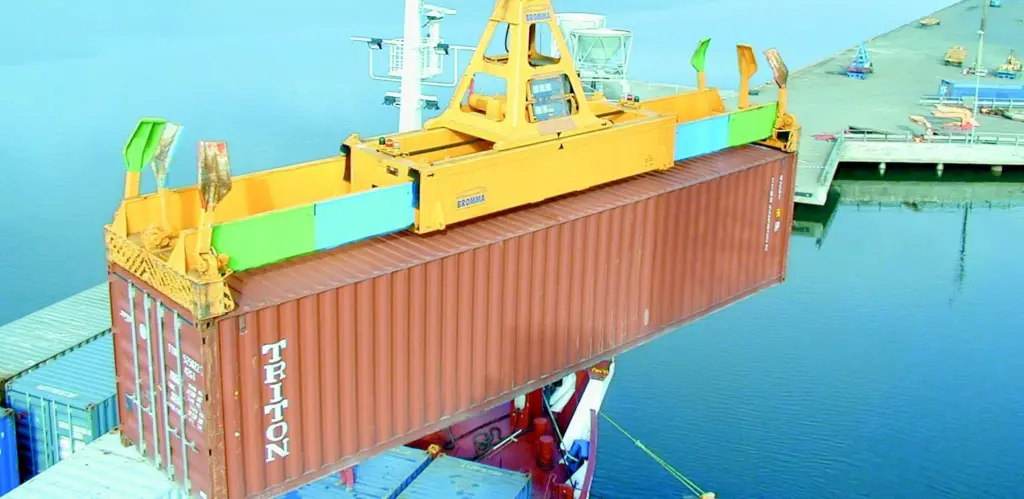
Sometimes that contact can be more forceful than intended.
As Elme’s Lars Svantesson points out: “It is so important to ensure the crane’s brakes are working, to ensure you have a soft stop before landing the spreader on the container. But this is not always the case. For example, if you get stuck with the spreader down in the ship’s hold and time is running, you may need to do desperate things such as cut the whole thing out and send it back to us for repair. This can be the easiest way to unload it, and the most economically viable solution.
Dick van Soest of VDL Smits Spreader Systems agrees: “The spreader is definitely vulnerable. Just imagine the crane operator sometimes doesn’t even break and allowing the spreader to fall onto the container from 60 to 70 metres. It is the part that has to do all the work, it gets all the hits and it’s not allowed to cost a single penny, it’s not allowed to be taken out for maintenance or preventive maintenance, and it’s certainly not allowed to break down.”
Van Soest believes the crane driver plays a crucial role in a spreader’s performance. “They can save you money and it is very much to do with the skills of these guys. The majority are really top of the bill.”
He also urges close attention to preventive maintenance programmes. “The spreader is no different from a car. It needs servicing regularly and if you increase the service intervals you might run into problems because certain parts haven’t been looked at.”
Van Soest also takes issue with the premise that the lighter the spreader the less energy it consumes. “Of course this is true but the heavier spreader might last 10 or 12 years instead of eight years. So you must look at it from an investment point of view. And it is very important that you have a thoroughly designed spreader. Our spreaders are a little heavier than others but we do not have structural problems.”
Van Soest concedes that diagnostics are a blessing. “Of course it is useful if you can make contact with the spreader by phone to see how it is operating. We had a case where one of the pumps (we have two pumps and two motors on each of our spreaders) was out of service. We talked to the customer and he asked what we were coming to do? We said we are coming to fix one motor – it’s not running. He hadn’t even noticed.
“Of course these monitoring systems lead to faster problemsolving, ” he adds, “because the history is locked inside the memory of the PLC. If for example, the same corner does not lock for five times because the sensor is not correctly adjusted, then we can just go down and adjust the sensor.”
MEASURING PERFORMANCE At the recent TOC conference in Hong Kong, Bromma’s Kok Choong Hwa tackled the subject of spreader performance asking what norms might be used to define “success.” As he points out, in other industries there are clear performance norms, key performance indicators for staff; out-performance based on return on shareholder equity, return on invested capital; or more industry-specific indicators such as cost per mile flown. Such yardsticks are rare in the field of terminal operation however.
Usefully, Kok Choong Hwa went on to propose some industry norms for performance. These focus on productivity – using the metrics of speed (lift cycles per hour) and cycle efficiency (overall TEU productivity per crane); downtime; and environmental efficiency.
“Unplanned downtime – when a spreader stops working while a crane is operating – can be very costly, ” Kok Choong Hwa reminds us.
“Even more costly is when a spreader cannot be diagnosed or fixed quickly and has to be changed out. Planned downtime – taking a spreader out of service for routine maintenance – though less costly, is also measurable. The more your spreader is out of service for routine maintenance, the more capital a terminal has to tie up in spare spreaders.
“In terms of monitoring and evaluating unplanned downtime, ” he says, “metrics for spreader fleet evaluation might be:
MMBF: Mean moves between failure [inherent spreader reliability] MTDR: Mean time for diagnosis/repair [troubleshooting speed;
return to service] ISA: Inherent spreader availability COPS: [Unscheduled] spreader change-outs per hour of service “Again, performance in these categories varies quite a bit from terminal to terminal. One of our customers has shared with us, in terms of MMBF, that they average some 44,000 moves between failure. Their MTDR speed of response – their mean time for spreader diagnosis and repair – was 18 minutes. And, their inherent spreader availability was 96%.
“One of the keys to reducing downtime events – to increasing MMBF – is to document where spreader problems occur. This is an interesting subject, because reporting varies widely.
For example, at one terminal mechanical problems represent 82% of downtime events, while at another terminal it is 5%. At one terminal electrical problems generates 57% of the downtime events, while at another it is 14%. At one terminal the downtime log indicates that driver errors produced 63% of downtime events, whereas at others driver error is not even listed as a cause of downtime.
Terminals classify downtime in different ways. Still, if we can identify where a weak link is, we have a better chance of addressing it.”
He points out that in this area of mean time for diagnosis and repair, significant improvements are being realized by the use of diagnostics technology. Over 400 major event, spreader-related messages are incorporated into Bromma’s SCS2 diagnostics giving technicians very specific information. “Faster problem identification leads to faster problem-solving. Faster problem-solving leads to fewer spreader change-outs.”
For planned downtime he proposes two metrics:
MHBS: Mean hours between service TTPS: Total hours for preventive service “Clearly, if you can lengthen the time between normal service cycles, you gain several advantages in terms of operational efficiency.
First, you can sometimes reduce capital investment in your spreader fleet. Reducing the time that a spreader must be off the crane for routine service can perhaps allow you to trim one or two spreaders from the overall size of your spreader fleet.
Second, spreaders that need to be serviced less generate cost savings in technician labour. Less routine maintenance service may mean fewer maintenance technicians. Third, spreaders that need to be serviced less usually generate lower spare parts expense. For example, we recently learned that one of our UK customers with a large Bromma low maintenance all-electric spreader fleet is averaging just US$750 per year per spreader in routine maintenance costs.
“If a hydraulic spreader takes more time to service than an allelectric spreader, and if a hydraulic spreader has more frequent service cycles than an all-electric spreader [and you have quite a few yard crane spreaders in your fleet], then the cost savings by going all electric may be significant. As we know, time is money.”
Every hour of unscheduled downtime costs money as crane drivers sit idle says Kok. “Every hour of routine maintenance that can be eliminated saves money. Every lift cycle that is more productive, every spreader fault that is diagnosed more quickly ? all of these issues are important, because they all impact profitability.”
Related Articles
 CONTAINER & CARGO HANDLING
 CONTAINER & CARGO HANDLING
 BULK HANDLING