![PortStrategy[GreenPort]](https://www.portstrategy.com/wp-content/uploads/2026/09/PortStrategyGreenPort.svg)






THE SHARP END
Prolific innovation is helping to maintain strong competition between spreader manufacturers. Benedict Young explores the latest product developments which promise to enhance terminal operations.
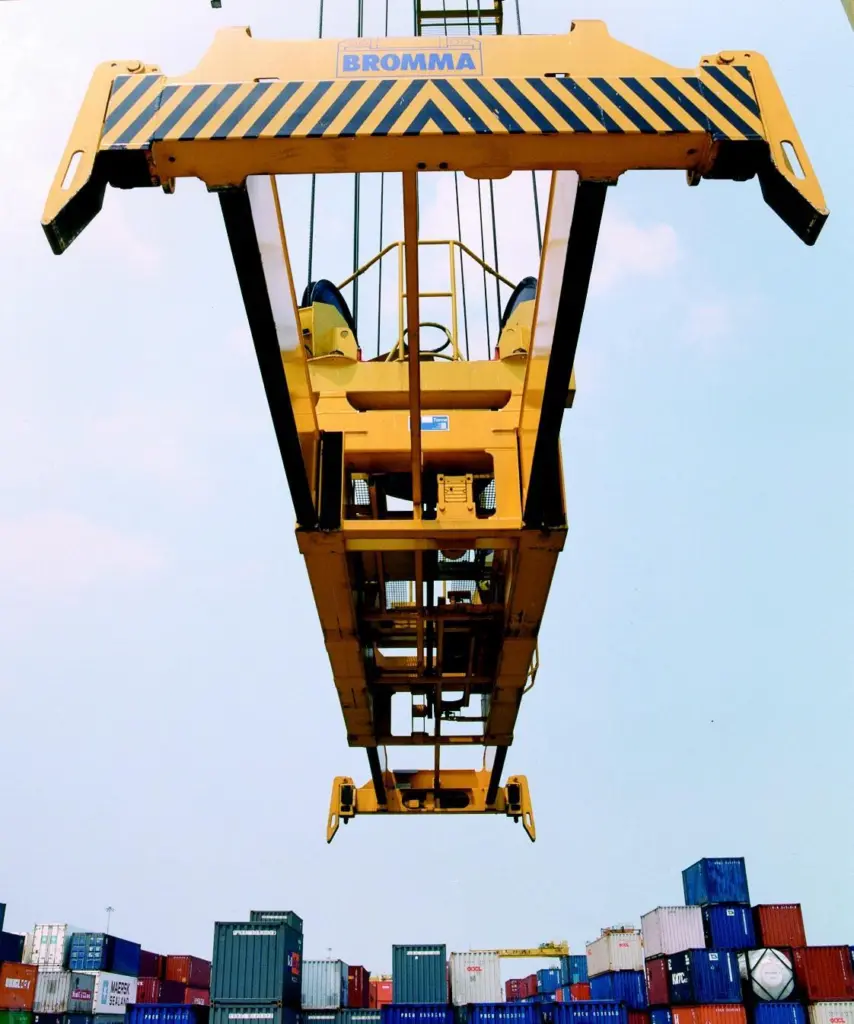
In the container stevedoring industry, spreaders really are at the sharp end of the process, taking punishment throughout day-today operations. They are the interface with every container and their ability to operate efficiently and reliably is crucial to terminal operators.
Spreader manufacturers are well aware of the unique importance of their equipment and they are serving an increasingly demanding market of terminal operating companies. From simple steel beam and frame designs, spreaders have evolved into state-of-the-art machines.
But not every spreader application is the same and operators have a variety of differing needs. The global container industry is now mature and terminal operators have learnt to demand more imaginative spreader solutions. As a result, there is strong competition between manufacturers to come up with ever more innovative product ideas.
RAM Spreaders recently launched a new telescopic container spreader design for mobile harbour cranes. Weight saving is a key feature of the new RAM 1770 unit which can handle 20ft and 40ft boxes on single lift with a maximum capacity of 35 tonnes eccentrically loaded.The single beam design offers a robust platform with less inertia when rotating unladen, while fast and accurate container location is achieved with six hydraulically operated flipper arms.
A post connection between the spreader and crane provides a centre of gravity adjustment system for safer, faster handling. The post pivots left or right of centre for gravity point adjustment and is powered by two hydraulic cylinders. A pin connection at the top of the post provides a fixing location for the mobile harbour crane rotator and ram-shorn hook.
A hydraulic reservoir is integral to the post, helping to ensure ideal weight distribution. The innovative use of a post connection makes it easier to transport, assemble and commission the RAM spreader on site, as the post can be stored horizontally during transport.
The first new 1770 unit was commissioned in summer 2004 on a Gottwald 280 mobile harbour crane, sold through Container Lift Port Equipment for the Manchester Ship Canal Company, in Salford.
Smits Spreaders has also been seeking innovative solutions for mobile harbour cranes and has installed what it describes as a “unique spreader” in the Finnish port of Rauma. The twin spreader (SWL 2x 25 tons) is believed to be the first spreader ever equipped with both longitudinal and transversal adjustment.
The transversal adjustment feature is useful for ro-ro ships with lolo capabilities on the upper deck and for the smaller feeder vessels. It facilitates the loading/unloading of containers when the ship lists. The crane driver can position the spreader and the containers at exactly the same angle as the ship deck or ship cells. It is possible to position containers at an angle, even immediately adjacent to each other.
Smits reports that several other stevedoring companies and ports have expressed an interest in this high tech spreader and the company expects to conclude more orders in the near future. The development of a heavier version of the design (SWL of 2x 32.5 tons) is also due to reach completion soon.
With more and more terminals encountering congested operating conditions, faster high-performance yard container handling is taking on even more urgent importance. For Bromma Group, recent innovation in the area of yard spreaders has resulted in the launch of the Bromma Marathon series. The range includes both all-electric and hydraulic units with the aim of high-productivity, low-downtime and low-maintenance in yard crane operations.
The single lift Marathon YSX40E and YSX45E spreaders, available in 40′ and 45′ versions, are all-electric units aimed at environmentally sensitive terminals. The risk of costly oil clean-ups is eliminated with all-electric units. The exclusion of the hydraulic power pack also offers lower spreader energy costs. Bromma estimates that its all-electric spreader will require only ten percent of the annual energy of a comparable hydraulic yard crane spreader.
In addition, the units are lightweight and can be four or more tonnes lighter than the spreaders they replace. Service intervals are lengthened and service duration shortened as there is no oil filter to change. The long running time of the YSX40E and YSX45E spreaders makes them ideal candidates for automated handing operations. To do their bit in reducing the pollution created by container ships idling at the dock and trucks idling outside the terminal, Bromma’s new Marathon range also includes the YTR40 and YTR45 heavy-duty twin lift (2 x 20ft containers) yard crane spreaders. These are designed to increase the overall speed of box handling operations. Both units include hydraulically operated telescoping and twistlock functions.
The newly redesigned YTS45 separating twin-lift can move two 20ft containers with a spacing of from 0-1000 mm, under full load, while they are suspended under the twistlocks. This movement can be performed at any point in the crane cycle, so there is no stopping time required to change the container spacing. The YTS45 features simplified RTG end beams and a simplified positioning system.
Crane OEM, ZPMC, recently ordered 36 Bromma YSX45E allelectric spreaders representing the single largest order to date for the new 45 ft units. These are due to be delivered to Dubai Port Authority (DPA) by the end of December 2004. This follows an order for DPA earlier in 2004 for 16 Bromma YTS45 units.
RAM Spreaders has also been focusing its attention on the container yard and this summer extended its CenterSpread series with new models (2950/2960) for RTGs and RMGs. The centre gap is adjustable up to a class-leading 800mm for handling two 20ft containers, and single lift operation with 20ft and 40ft containers with fixed guides.
RACE TO TWIN LIFT 40 FOOTERS Like the new 1770 spreader, the new yard crane spreaders benefit from RAM’s drive to reduce spreader weight. The company reports that more than 60 orders were received within the first few months of launching to selected clients.
For the largest terminals, the ability to turnaround the biggest ships fast is ever more important. The race to twin lift 40 ft containers is well underway and is presenting a new set of challenges.
Stinis Krimpen BV is developing its large capacity spreader along the lines of a conventional headblock split lengthways down the middle axis to give two mirror image half headblocks. One or two conventional spreaders can then be fitted under the headblocks. Although the design is a truly original and very promising concept, it is currently unclear when Stinis will be taking the project forward to field trials.
A crucial issue with any such large capacity spreader is the capacity of the gantry crane. Bromma reports that its telescopic twin 40 Tandem spreader – the latest evolution of its experimental Tandem Line spreader – is performing well in field trials at Maersk’s terminal in Algeciras. The spreader can lift two 20 ft containers, or two 40/45 ft containers, or a combination.
Crane capacity is again a key issue though when it comes to handling four 20 ft containers as the spreader weight alone is approximately 24 tonnes. Cycle times are reported to average between 60-80 seconds.
Although high-tech spreaders are an increasingly important part of terminal operations, simple fixed crane spreaders still have a place.
Even here though, innovation is not dead. Smits fixed crane top spreaders offer single point suspension for use with any type of crane, below which four cables connect to four lifting suspension points on the monobeam construction.
A specially designed mechanism on the crane hook – activated by the hoisting/lowering movement of the crane – automatically operates four twistlocks without the need for hydraulic or electric connections. By releasing the suspension slings by 10 cm, the mechanism is automatically loaded for the next locking/unlocking action. With every lift, the spring loaded mechanism cable activates the locking/unlocking action before lifting the spreader. The four twistlocks are linked with bars in series to prevent an individual locking/unlocking of the twistlocks.
In developing markets where sophisticated equipment is not necessarily important, such fixed spreaders offer a simple, safe and most importantly cheap means of handling laden containers. These units can also prove useful as spear spreaders or as ships gear.
Although Bromma group remains the market leader in crane spreaders, many other manufacturers report that demand for their spreaders is also at record levels. Bromma’s position is strengthened by shared production with its sister company Kalmar, both of which are owned by the Partek Group.
RAM Spreader’s parent company NatSteel Ltd recently announced a conditional agreement to sell its steel and related businesses to Tata Steel of India. The sale is expected to be completed in February 2005 and values NatSteel’s steel interests at $273m. Although the sale will not directly affect RAM Spreaders, the parent company has declared that it intends to apply part of the proceeds to the further development of its non-steel businesses.
This development bodes well for RAM and is a good sign for maintaining competition among spreader manufacturers. But it is clearly innovative spreader solutions that are really driving the market and terminal operators are now in a position to demand greater choice and flexibility than ever before.
Related Articles
 CONTAINER & CARGO HANDLING
 CONTAINER & CARGO HANDLING
 BULK HANDLING