![PortStrategy[GreenPort]](https://www.portstrategy.com/wp-content/uploads/2026/09/PortStrategyGreenPort.svg)





THE SHORTER THE VOYAGE THE MORE LIKELY THE VIABILITY
Its the familiar trickle-down effect. Trade grows. Ships get bigger to gain economies of scale. Hub ports order bigger quay cranes to work the bigger ships. Meanwhile smaller ports are growing and also have to accommodate bigger ships – either as feeders or direct callers – so they too need to replace their quay cranes. But where do they buy them and how do they get them home? Nick Elliott investigates.
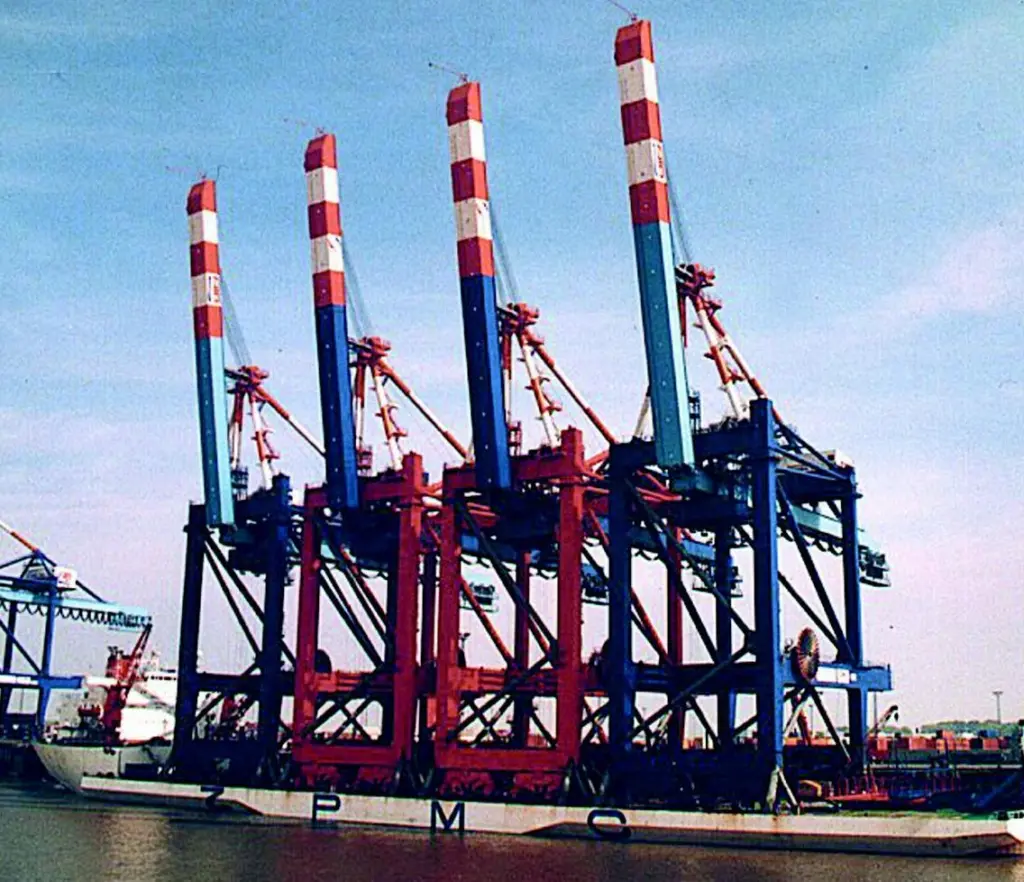
Such ports have two options: buy new or secondhand from the supply of the bigger ports’ cast-off. If they choose the latter, then the question of transport and erection must be addressed.
First though consider the pros and cons of the two alternatives.
Dirk Ramm of brokers, Cash Courier and Shipping Services (CCS) in Hamburg, explains: “There is a market for the movement of secondhand cranes to smaller ports but the transport and modification of these older cranes costs a lot of money, so the buyers must weigh up whether to buy a new crane or a modified secondhand one with perhaps just a five or 10 year lifespan left.” If soft financing is available then buying new might well make sense but often cost is the governing factor and that would favour buying secondhand.
But the longer the distance from the seller’s port to the buyer’s, the higher the transport costs – particularly if a Suez or Panama transit is involved – which will usually kill the deal before it gets off the ground. What all this boils down to is that for shorter distances, the economics often do stack up and so, unsurprisingly, most secondhand crane movements involve relatively short sea voyages.
WEATHER RESTRICTIONS FROM WARRANTY SURVEYOR A recent example was the transport of two secondhand quay cranes by German manufacturer Noell Crane Systems from Bremerhaven to Novorossiysk in the Black Sea. The tug FAIRPLAY XIV and barge AMT EXPLORER undertook the 3,670 mile voyage last winter. But even on this passage, things were not so straightforward. Having been delayed sheltering from or riding out bad weather, the barge had to be ballasted down by around two metres to get through the Bosporus. “Transit of the Bosporus Straits entailed careful planning due to the height of the crane structures and the clearance available under the Bosporus Bridge, the barge being temporarily ballasted down at this location, ” explains Geoffrey Potts of contractor Anchor Maritime Transportation (AMT).
As is usual in such cases, Noell handled the load-out and sea fastenings with AMT providing the tug, barge and ballast engineer to run the barge machinery. Since the job took place during winter, the cargo underwriters’ warranty surveyor, imposed a weather restriction across the Bay of Biscay requiring a 72-hour forecast with a limit of Force 6, which resulted in a delay in Falmouth Bay. A further two days were lost in the Aegean riding out bad weather. “It’s important to choose reliable tugs and tug masters and make sure they’re not just trying to push on when the weather conditions are unsuitable, ” comments Potts.
AMT is the UK’s biggest barge transport contractor but Potts is realistic about the market. It is well understood that it is impossible to compete on price with ZPMC’s fleet of converted bulk carriers.
Although ZPMC undertakes third-party work its criteria differ from those of independent third-party contractors since they are often using such jobs as positioning or repositioning voyages to fit in with deliveries of their own cranes. “ZPMC will consider the overall benefits of the whole transaction and throw the transportation in at cost, ” says Potts but adds: “Principally though, they are working in the Far East, so competition from them within Europe is not so great.”
Much of AMT’s work involves moving older cranes.
Potts observes that most new cranes, at least those being delivered in Europe, are shipped in knockdown form and erected on-site. “For their own reasons, manufacturers prefer to ship their cranes in sections whilst the older ones are generally shipped as complete units.” Besides the Novorossiysk job, AMT has transported secondhand cranes from Rotterdam to the Canaries, and from Israel to Spain.
MOST ENQUIRIES THROUGH BROKERS This is a specialist business and most of the enquiries come through brokers. Besides pure towage contractors like AMT, there are also several load-out contractors such as Mammoet and Abnormal Load Services, who may subcontract with the likes of AMT. The contracts are normally on a voyage charter basis with lumpsum freight payable, and on FIOS terms because of the specialist nature of the load-out and tie-down arrangements, which are normally contracted out by the shipper to specialist subcontractors. Sea fastenings are usually prefabricated in advance ready to be installed once the load-out is completed, whilst the barge arrives when all load-out arrangements are finished.
There is an ongoing debate surrounding the pros and cons of transporting erected container cranes over long distances, particularly if sea conditions are poor (PS March 2004). As AMT’s Potts explains: “The question of structural integrity is for the shipper or principal. Obviously with older cranes, there is a greater need for bracing to be installed to cover the sea passage. The longer the passage, the more this has to be looked into and the higher the costs involved.”
CCS’s Ramm makes a further point which is that cranes delivered in knockdown form can be erected in countries where labour is cheap, creating a further disincentive for buying secondhand. CCS fix the transport of new cranes, either fully erected or knockdown. “Knockdown cranes still have 60 to 70 metre long girders which need to be accommodated, usually on conventional vessels, ” he explains. “But they still require a floating crane at the port of destination. Where such facilities are available, a gearless vessel will be chartered, which is of course much cheaper than utilising a heavy-lift vessel. Typically, a container quay crane will measure around 8,000 cubic metres, with up to two cranes being carried in knockdown form per vessel.”
If there’s one company that knows the business it’s KCI Koneports (formerly Noell Konecranes). Dirk Groth says there is a huge demand for secondhand ship-to-shore cranes worldwide but the problem is often the availability of older cranes that match the specification needs of the new owner. “What is required are surplus Panamax types, but there are not so many owners wishing to sell their cranes.
On the other hand, where there is the demand to modify and modernise the crane to meet that specification, then we can offer the complete package.”
The decision as to whether to move a crane on a long sea passage may depend on cost but how to move it depends to a large extent on the weather conditions expected on passage says Groth. Although it requires more sea fastening arrangements, the tug/barge combination is cheaper than a specialist heavy-lift vessel, and there is a much higher availability of barges than of heavy-lift vessels from the likes of Dockwise or ZPMC. Furthermore, considerable care is necessary when transporting a secondhand crane in knockdown form:
“You have to cut the structure and re-cable the complete crane, then commission it, ” says Groth.
KCI Koneports has its own FLUIDTS heavy lift transportation system to load or unload cranes to or from a barge. FLUIDTS consists of hydraulic jacks moving on a cushion of air installed under the travelling system of the crane with special slideways laid under the crane and onto the barge. The crane is then moved on temporary rails onto the barge. The system is based on compressed air where no air pressure is allowed to escape by means of a special piston seal, and which enables the load to slide. The system comprises loadbearing modules with a bearing capacity of 250 tons each, slideways, a towing and positioning device as well as a hydraulic control system.
The load-bearing modules are linked to the cranes by special adapters.
The advantage of the system is that objects can be transported very smoothly and gently protecting both the load itself and the surface.
GENERALLY OVER SHORTER DISTANCES A glance at KCI Koneports’ recent reference list underscores the fact that secondhand crane transport is generally undertaken over shorter distances, and in their case, often involves modification as well. And Groth also confirms that movements within the same port, make up much of the workload:
Backslipping of a ship-to-shore crane with FLUIDTS system and then by-passing a damaged crane, removal of the ship-to-shore crane back to the rails in Durban Modification of 1 ship-to-shore crane at Patrick’s Webb Dock terminal by modification of HV transformer, HV cable and cable reel, sea-fastening for transportation on Big Lift vessel from Melbourne to Fremantle Loading/unloading 7 ship-to-shore cranes to/from a barge by means of FLUIDTS system at MTL, Hongkong Loading of a ship-to-shore crane by means of FLUIDTS system onto a barge in Jakarta and unloading in Pontianak.
Related Articles
 CONTAINER & CARGO HANDLING
 CONTAINER & CARGO HANDLING
 BULK HANDLING