![PortStrategy[GreenPort]](https://www.portstrategy.com/wp-content/uploads/2026/09/PortStrategyGreenPort.svg)






The tubeless wonder
Tubes will soon become old hat in the port environs, as John Bensalhia finds out
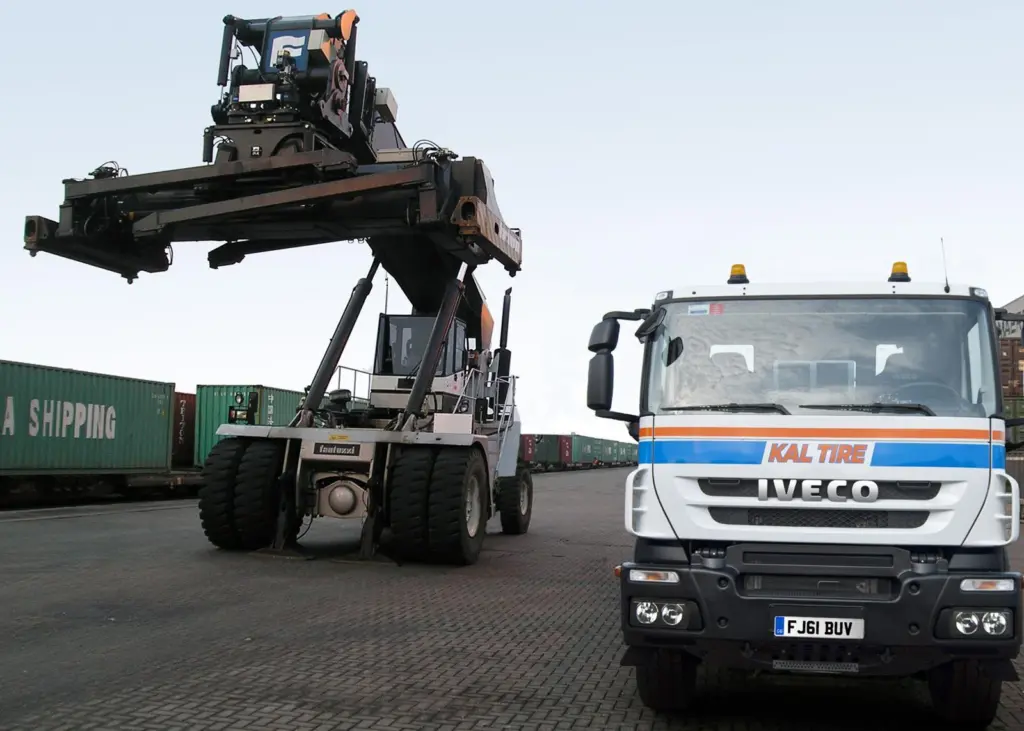
Remove the tube from the tyre equation and ports can look forward to fuel and money savings, and the all-important improvement on safety levels.
And the arrival of tubeless tyres on the dockside may not be far off, as Kishore Namburi, Michelin’s sales manager for ports and industrial tyres, based in Dubai, explains.
He says that tyre technology is fast advancing towards tubeless tyre solutions. “Tubeless tyres have proved to be more cost-efficient, safe, fuel-efficient with high levels of safety – this may become a future standard option in all ports very soon.”
There are a number of advantages to tubeless tyres. They allow for better ventilation and lower build-up of heat in the bead area because of the increased space between the tyre and the brake drum (lower heat levels also allow for longer tyre life). During usage, if a small object penetrates the casing, there will be no sudden pressure loss as no air can escape through the valve hole: in this case, the valve is fixed to the tubeless rim and not to the tube, as is the case with tube type tyres.
Tubeless tyres also allow for easier fitting and removal, fewer deflations, and improved safety levels.
But before that innovation hits the docks, equipment operations managers need to focus on today’s best fit tyre solutions. To that end, port operators need the right knowledge and advice. However, attaining even those simple goals can pose problems. Mr Namburi says that one problem in ports worldwide today, is lack of knowledge on the advantages of steel industrial radials suitable for port usage, compared with nylon tyres and highway pattern radial tyres.
Industrial tyres are strongly built to carry heavy loads, and to operate an average of up to 40kmph, which is the maximum speed obtainable in port operations. “Why use a highway pattern tyre designed to run at 120kmph when the need is less than 40kmph?” asks Mr Namburi.
“In most cases, ports are using normal highway pattern truck radial tyres for terminal tractors and trailers when they should be using industrial radial tyres which are available now by premium companies like Michelin (eg: X Terminal tyres) which have proved to be highly successful and cost-saving tyres in more than 70 ports in the world so far.
“Nylon tyres have been withdrawn from the market for passenger and truck segments in several advanced countries, and non-existent for more than a decade (for truck and passenger/SUV), but they are still available in the port sector in some countries.”
Mr Namburi argues that there needs to be more education on this aspect, with more data available to port operators on the advantages of steel industrial radials. “Radialisation has been prevalent since the late 1950s and it’s high time all the ports switched over to radials to take advantage of its merits and cost-saving potential, especially industrial radials.
“Tyres are one of the most expensive spare parts in any port and they should be selected on individual port analysis. The only way to achieve this is to keep a record of all performances of tyres and upgrade to industrial tyre solutions wherever available. Industrial tyre solutions (in steel radials) are the best options available today for ports to cut tyre costs and save up to 50% if they have good pressure maintenance and operating conditions.”
Ports are advised to take advantage of “Free Site Operation Studies and correct tyre recommendations” by technical experts of companies such as Michelin. Mr Namburi suggests that global operators should encourage more importance in selecting the right tyre solutions by creating a global database used by worldwide ports and analysing available industrial tyre solutions in more depth – this solution can cut tyre expenses heavily and save the environment by scrapping lesser tyres for a better way forward.
“A wrong tyre choice can lead to a number of problems,” says Mr Namburi. “Increased down time leading to loss of productivity due to premature failures and punctures; increased fuel consumption due to high rolling resistance – especially on solid tyres being used in some ports (mainly on port trailers), plus frequent punctures/damages on bias/nylon tyres, which can also affect port operations considerably.
“The wrong tyre choice can also affect the operational safety of the vehicle and increase overall tyre budgets tremendously.”
Mr Namburi adds that port operators must address some important questions. Is the tyre being used designed for port applications? Does it have load carrying capacity (on actual working loads)? Is the tyre heat-resistant (is it built with a cool running compound)? Does it have resistance to damage and tear (ie: with cut-resistant rubber compound)? Do the current tyres being used lead to loss of productivity due to premature damages/punctures?
It’s also important to consider the right speed rating of the tyres – if the speed rating is too high, and if the tyre is designed for highway use, then it may not work well for port applications.
“Selecting the cheapest tyre can turn out to be the most expensive tyre in the long run, especially cost per hour,” says Mr Namburi. “But when you select quality tyres, the considerations of performance, durability, productivity, and reduction of operational expenses in the long run should normally be the best choices. It’s always recommended to analyse test results of the industrial radial tyres available, vis-a-vis current ones being used, before making it your standard purchase option.”
Fortunately, help is available for port operators with their choice of purchase. Marko Muhonen of Nokian Heavy Tyres Ltd says that “the most effective tyre is a purpose-designed product – as we at Nokian have approached the question. We design the product according to the application.”
Kal Tire provides detailed tyre management that results in supplying the correct tyres for the job. “The suitability of tyres for tasks within the marine industry requires both an in-depth site survey prior to purchase/fitting, as well as an ongoing tyre management service – complete with use/wear data,” says Kal Tire’s Paul Aykroyd. “Kal Tire make educated tyre selections, based on a range of facts and statistics; such as hours, wear, rates and suitability for the sites individual needs.
“Although there are temptations to ‘spot buy’ from the market based simply on price, data continually proves that Kal Tire’s premium brand service, combined with the correct tyres for the application, provides the best results in the long-term running costs of the machines.”
Tyre selection for port operators is crucial. The age-old argument of cost is an ongoing problem, but the one message that comes through loud and clear is that going for the cheaper option will only cost more in the long run.
Choosing a more expensive tyre may seem more daunting, but as a long-term investment, it will save the need for spending more time and money on looking for another product so soon after the cheaper option has failed. A good quality tyre provides a long-term journey for the port operator rather than a prematurely brief trip.
Related Articles
 CONTAINER & CARGO HANDLING
 CONTAINER & CARGO HANDLING
 BULK HANDLING