![PortStrategy[GreenPort]](https://www.portstrategy.com/wp-content/uploads/2026/09/PortStrategyGreenPort.svg)





Time to take another look
Many ports are taking the opportunity of a lull in container volumes to review their gate technologies. Felicity Landon reports
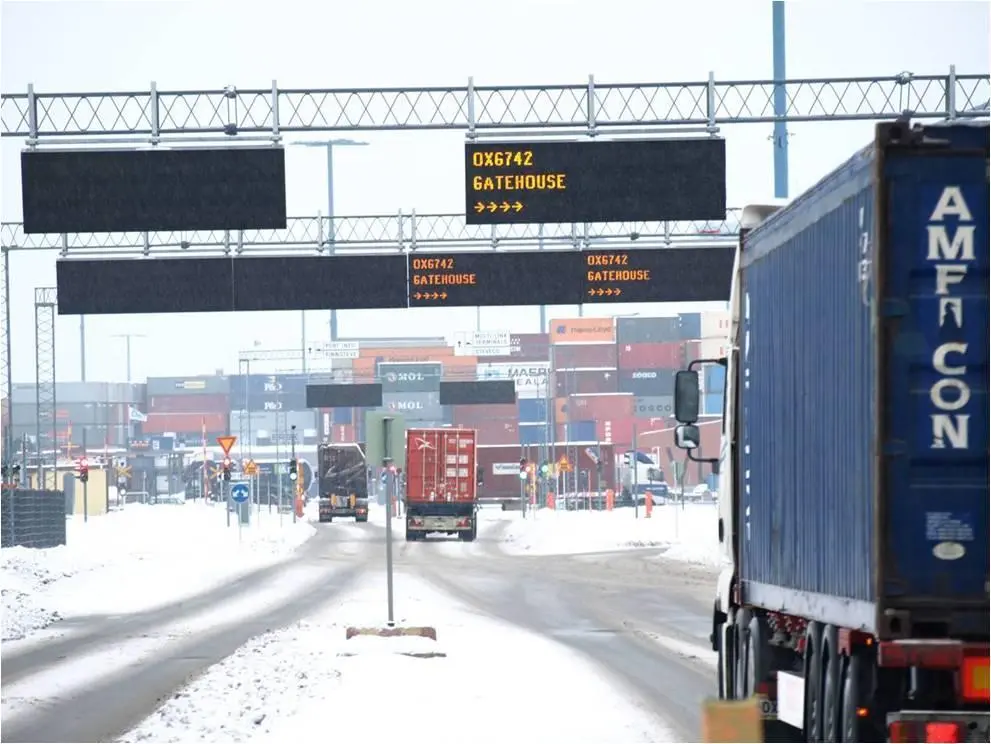
Now is the ideal time for port operators to focus on the implementation of new gate technologies, according to some of the companies providing such systems. Of course they would say that, wouldn’t they … but it appears to be sensible advice.
“It’s a great time for a port to reassess their operational procedures and look for ways to improve efficiency for the busier times ahead,” says John Lund, UK sales manager for Visy. “Volumes will increase in the future and I think that ports can put themselves in a strong position for that increase by auditing and reviewing during the lull.”
There is evidence that ports are indeed taking advantage of quieter times and looking at ways that they can make things more efficient, he says. “But on the investment side, whether they are actually willing to spend money is a different issue!”
Sean Pierce, vice president of business development and professional services with Tideworks, agrees: “With the distraction of staff and disruption to the terminal operation that typically occur during system implementations, these low-volume periods are an ideal time to implement a new system. Furthermore, when the economy does rebound, the terminal will be more efficient and better prepared to handle increased volume with the new gate system in place.
“In the meantime, the new gate system may in fact help the terminal grow its business by attracting new customers.”
What are ports looking for? Increased automation and integrated security features are the two key themes. But requirements vary from region to region, says Mr Pierce.
“Local labour costs and practices have a big influence on what can and should be automated. The operational culture and willingness to change is also a big factor. The gate system provider needs to be sensitive to these local requirements and have the ability to configure the solution to the port’s specific needs.”
Tideworks is seeing more and more terminal operators looking to address and integrate security concerns into the gate system design, says Mr Pierce. “In the US, for example, marine and intermodal terminal operators strive to ensure that the gate system will be compliant with the TWIC [Transport Workers Identification Credential] programme requirements. In other regions, ISPS identification cards have been introduced and must be supported by the gate system. Many terminals already have or are investigating the integration of face cameras, biometric readers and other security devices within the gate system design.”
Another interesting trend is that many of the gate systems seen at marine terminals are now starting to penetrate the intermodal terminal market, according to Tideworks.
The goal of any gate system is speed, efficiency, increased capacity and reduced costs, points out Mr Pierce. “A variety of software and hardware solutions can help ports achieve these objectives to varying degrees, depending on the efficiency goals and project budget.
“At minimum, a gate management system should effectively integrate the key components of the gate transaction into one user interface: voice communication, video information and the terminal operating system (TOS). With this type of system, users in a central office location or call centre can effortlessly collect all required transaction data from cameras strategically located in the lanes. Additional features, such as auto-focusing cameras and colour-coded key controls, can save valuable processing time and increase productivity.”
The next level of automation is to integrate the gate system with optical character recognition (OCR), to automatically capture container numbers and details of associated equipment, so that this data is automatically extended to the TOS. Licence plate recognition or RFID tags can complement OCR portals, allowing for automated truck identification – further streamlining the process and reducing data entry requirements.
When a terminal’s gate is fully automated, truck drivers do not need to speak to a clerk during processing and, in some cases, they don’t even need to stop.
Mr Pierce describes gate automation projects as “a delicate balance between concrete and software”. “More than just a software implementation, these projects typically include a large civil works component in order to properly build out a new gate complex or retrofit the existing gate infrastructure,” he says.
The latest developments in gate management are clearly around the idea of automation, says Visy’s John Lund, but one technology alone will not provide complete gate automation – several must be used together.
“The list of technologies is long and seems to be getting longer all the time.”
However, the most common and best-known are OCR and RFID (active, passive, semi-active and semi-passive), he says.
“Although these are both great technologies, each suitable for specific operations and complementary in the sense that we use them together in about 80% of our installations, they are merely data collection tools. In order to achieve true automation, there must be an intelligent system managing the data collection and then making what we refer to as ‘access control decisions’ – that is, a system that decides what to do when a specific vehicle, container, driver or cargo unit arrives at a gate or another checkpoint within the operation.”
Visy Access Gate covers this function, he says, incorporating ISPS, crane OCR, driver kiosks, biometrics, web software, customs agency communication and other features.
A key development helping to reduce bottlenecks at gates has been the introduction at many ports of vehicle booking systems, says Mr Lund – which means that no unplanned gate transaction should occur. If a truck arrives at the main gate without a booking, it is not granted permission to enter the terminal or port, but is instead automatically directed to a help desk.
“Many gates nowadays are actually unmanned and incorporate a wide variety of technologies to reduce operating expenses, optimise safety and security, and increase throughput capacity.”
A port can also be a “good neighbour” by reducing the amount of time that trucks spend at the gate and in the yards, he points out. “By pre-booking gate appointments and regulating traffic flow, the ports can reduce or eliminate queues and local traffic congestion. This will also keep trucks moving so that they are consuming fuel more efficiently and drivers will spend less time waiting. I think it’s in everyone’s best interest to employ a good system. Port authorities, truck drivers, terminal operators, shipping lines and port neighbours all benefit.”
Related Articles
 CONTAINER & CARGO HANDLING
 CONTAINER & CARGO HANDLING
 BULK HANDLING