![PortStrategy[GreenPort]](https://www.portstrategy.com/wp-content/uploads/2026/09/PortStrategyGreenPort.svg)




Tracking the tractor
Changes in requirements and emissions legislation have spurred tractor development, as Patrik Wheater finds out
For the past few years, the market for terminal and ro-ro tractors has been a very healthy one with a number of manufacturers reporting record sales figures. Take Cargotec’s Kalmar business division. Sales of its terminal tractors reached an all-time high this year in the Europe, Middle East and Asia (EMEA) regions with an increase of more than 100% against a background of a very competitive marketplace.
Since the company launched its “icon” series of terminal tractors in September 2007, sales in the EMEA area are claimed to have surpassed this year’s sales targets by far, with Kalmar citing a significant change in the market as products are being requested for specific applications. Kalmar’s net sales were E1.3bn ($1.7bn) in 2007.
This change was met with the introduction of its purpose-built TT612d distribution tractor in the spring of 2008. This tractor is said to allow for faster transfer operations due to a small turning radius. Time is also saved with a hydraulically-powered elevating 5th wheel, eliminating the need for the driver to crank the trailer’s landing gear and thereby decreasing operator fatigue. Quieter cabins and improved visibility are further benefits.
Kalmar’s commitment to the environment remains a critical element in its design and its TT612d unit, part of the company’s icon range, features a power line including the cleanest engine standards with Stage 3a/Tier 3 technology emitting only the minimum of harmful emissions. The distribution tractor combines innovation and reliability, resulting in low operating costs with a machine design which decreases component wear. Easier maintenance also improves productivity and profitability with more accessible service points.
The development followed a year-long survey among tractor drivers and fleet supervisors with over 300 participants. Kalmar’s global TT-sales experts’ development views were included, and tractor operations were filmed on several applications to produce shop-floor information about drivers’ cabin conditions. The research results were finally analysed with leading occupational health specialists. All that intelligence was taken into account in the new machines, which according to the manufacturer “have the market’s best ergonomics and service is simpler”.
The “icon” series and an upcoming model incorporate CAN-BUS controls. This is a tractor control system that integrates all functions into a single system and shows full operational and service data on one display panel, making tractor operations faster, safer and simpler. Its state-of-the-art diagnostic capabilities also assist in service and maintenance planning, saving time, effort and cost.
Kalmar has recently been awarded a contract to supply 42 Ottawa 4×2 terminal tractors for the expansion of the Port of Salalah, located in the southern region of Oman. The equipment will be delivered to Port of Salalah, one of the fastest-growing terminals in West Central Asia, whose terminal development is expected to be completed by the end of 2011, raising the port’s capacity to 9m teu per year.
Meanwhile, rival Terberg’s range of tractors has also undergone extensive development to accommodate the change in the market requirement for bespoke designs and to meet ever stringent environmental regulations, although strictly speaking terminal tractors are classed as special-purpose handling equipment and not road fleet vehicles.
The Dutch manufacturer recently introduced Mercedes engines to some of its product range while a new ZF AS-Tronic Mid transmission system has been incorporated into all its terminal tractors in an effort to reduce fuel consumption by about 15%.
The ZF AS-Tronic technology, which features a countershaft transmission with a dry clutch instead of a torque converter, was originally developed for heavy duty commercial applications but more recently ZF developed lighter weight versions aimed at applications such as distribution vehicles by eliminating the torque converter. This is said to allow for a significant weight reduction, quieter transmission and more power to the drive wheels. Gears can be selected manually but in automatic mode the transmission is controlled by software that manages shifting to keep the engine in the optimum operating range.
The software also governs the shifting and the operation of the clutch to maintain driver comfort and respond appropriately to shift-up, shift-down conditions and whether the vehicle is coasting or pulling. However, Terberg has remained with fully automatic shifting for ease of operation and to offer the best possible transmission life. By ensuring that the engine operates in the optimum range, fuel consumption is reduced, depending on the application, by as much as 15%.
Terberg first trialled the AS-Tronic Mid transmission in combination with a Cummins Tier 3 engine in October 2006, but the system is now being offered as an option on its YT182 and YT222 models. Higher initial purchase costs should be recovered quickly through the reduced fuel consumption, says Terberg.
Italy’s CVS Ferrari, meanwhile, is gearing up to the 2009 launch of a new 4×4 tractor, the FR 270.
Developed in cooperation with its customers, the FR 270 is driven by a Cummins QSB 6.7 engine that meets Euromot Stage 3 emissions requirements. According to the manufacturer, the new design will be characterised by low pollution, low fuel consumption and optimum performances.
Like the Terberg system, the FR 2070 will incorporate a ZF transmission system, with integrated torque converter and power shift for six forward speeds and three reverse. The drum braking system is of duplex wedge type acting on the front axle with disc brakes at the rear. A parking and emergency braking system is based on a release spring system that can operated by manual lever in the cab.
While a steel tubular chassis is said to secure a higher resistance to collisions, the ergonomically-designed fibreglass cabin covers are easily removed and can be changed in case of damages or maintenance.
With reference to the cycle life of the product, CVS Ferrari has strove to extend this and to influence running costs by opting for an electrical system based on the aforementioned CAN BUS control system.
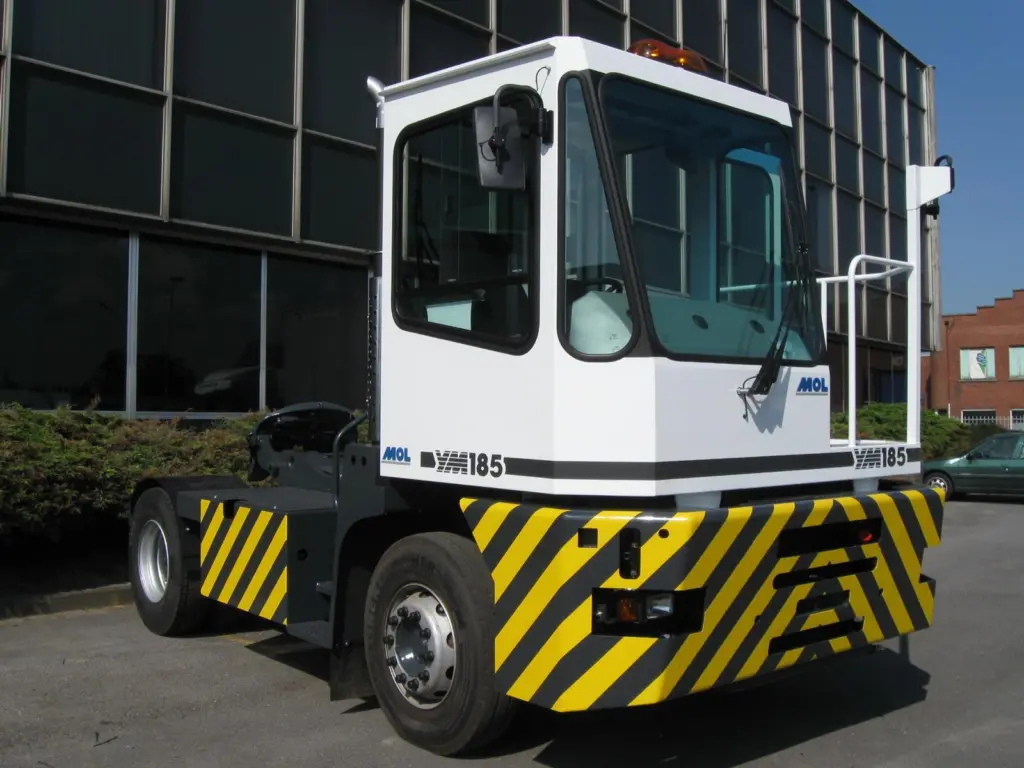
Similarly, Belgium’s MOL Group is to introduce an updated version of its YM185/4×2 and YM225/4×2 terminal tractors. The company has redesigned the chassis to accommodate the standard installation of Cummins, Volvo or Deutz engines and Allison or ZF transmissions. The cabin and chassis redesign are claimed to enhance driver comfort and visibility while reducing noise levels. A flat walking platform affords a greater degree of access to the different components for servicing and maintenance requirements.
Related Articles
 CONTAINER & CARGO HANDLING
 CONTAINER & CARGO HANDLING
 BULK HANDLING