![PortStrategy[GreenPort]](https://www.portstrategy.com/wp-content/uploads/2026/09/PortStrategyGreenPort.svg)





Tug designs match innovation with power
Ship sizes are increasing, and this means innovative tug-handling capabilities are needed at ports. Dave MacIntyre investigates current tug options and possible future trends.
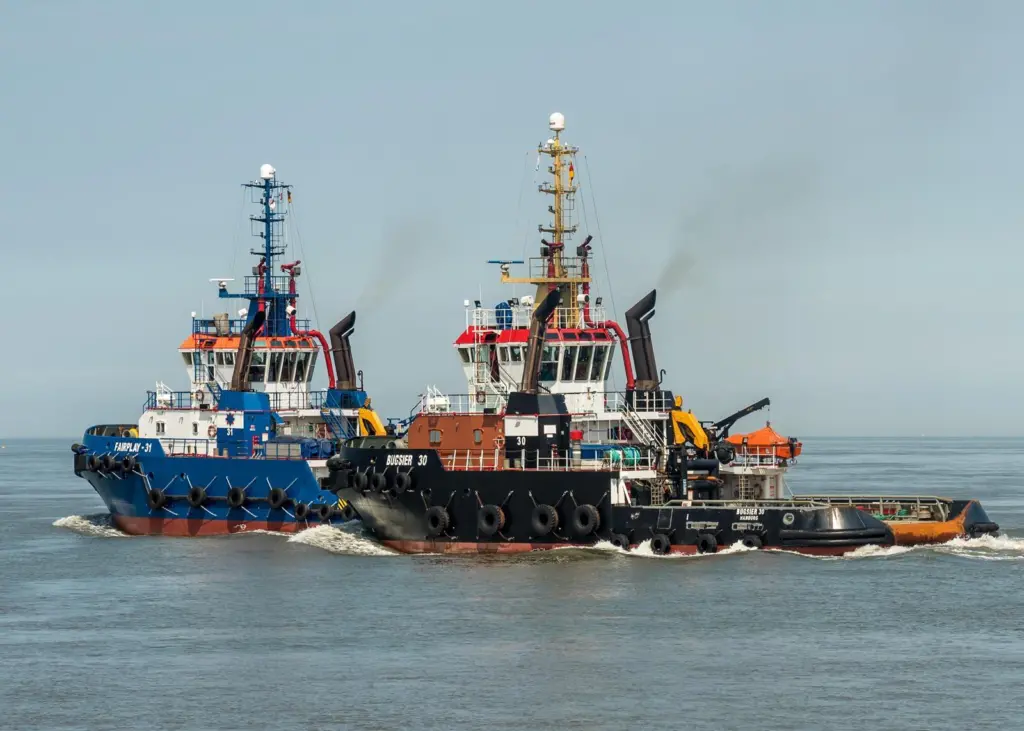
With ship sizes continuing to increase, ports and terminals need to urgently address their tug-handling capabilities to ensure the continued safe guidance of vessels.
Ports cannot easily change the size of their wharves, approach channels and turning basins. Therefore, innovations in tug design are having to respond to demands for more power and greater manoeuvrability, more safety features and the embracing of sustainable, lower-emissions propulsion.
An example is shipbuilder Keppel Offshore & Marine, which is developing its first autonomous vessel – a harbour tug to be operated by Keppel Smit Towage in Singapore. The vessel will involve modifying a 65-tonne bollard pull tug by retrofitting systems such as position manoeuvring, digital pilot vision and collision detection and avoidance. An onshore command centre will remotely control the tug.
Another company working on innovative designs is Crowley Maritime/Jensen, which has produced a hybrid diesel/dieselelectric propulsion system. Jay Edgar, Vice President Engineering Services, says there is increasing interest in hybrid, diesel electric, battery power and integration of high-efficiency “green” technologies (LNG, hydrogen fuel cells, etc.).
Crowley/Jensen’s response has been to maximise bollard pull in compact tugs with simple, robust systems, efficient fendering and precise control systems to support manoeuvring in tight quarters.
“From our perspective, demand for new tugs is driven by the need to service larger ships in existing ports, increasing awareness of emissions as no-discharge zones become more common and ongoing need for low-cost, powerful solutions that minimise impact on ship-handling fees/rates,” says Mr Edgar.
This demand has led Crowley Maritime/Jensen to focus on the use of lower-powered main engines but incorporating electric motor “boost” to match higher power needs in the hybrid tug Delta Theresa.
“Hybrid” refers to a system of direct diesel and diesel electric power. The technologies facilitating this hybrid system are multiple input thrusters and integrated control systems that allow seamless transitions between operating modes (diesel-electric “manoeuvring” mode, diesel-only and combined diesel/diesel-electric “boost” mode).
Looking at future innovations, Mr Edgar says: “We see a trend towards increasing power levels in smaller boats, which requires careful exploration of stability and operability/control.
Increasingly, we see requests for remote supervision/logging of machinery condition and operating data to support predictive maintenance programmes and trend monitoring.
“Autonomy is definitely receiving a lot of attention and although it is not currently impacting the basic design of the tug itself, it is exciting to see developments that can improve situational awareness and coordination of multiple vessels on a particular task.”
The Damen Group also sees increasing desire for renewable energy propulsion, such as LNG or hybrid, but warns that the significant CAPEX increase means the acceptance of such solutions is still limited.
“The main aspects for the next couple of years are safety, sustainability and efficiency. All concepts and technologies developed will have to bring added value in one of these aspects,” says Damen Product Manager Tugs, Dirk Degroote.
“We are actively working on technologies such as digitisation, as this will enable fuel consumption optimisation and improve maintenance towards full predictive maintenance (data analysis). We are working on further automation and integration onboard, to enable the captain and crew to see the right information at the right time though an optimised human/machine interface.
“The next step is to integrate all of this towards giving advice to the captain on things like stability and performance and limitations of the vessel, to increase safety.”
Mr Degroote says autonomous tugs are not a goal in itself for Damen but adds, “The technologies to get there could be of great value with regards to safety and efficiency and should therefore be implemented independent of the fact if the tug is autonomous or not.”
Another important factor, says Damen, will be the standardisation principle, especially digitisation. “Not standardising will mean a big hurdle for analysis and might even prove commercially not viable.”
Operator perspective
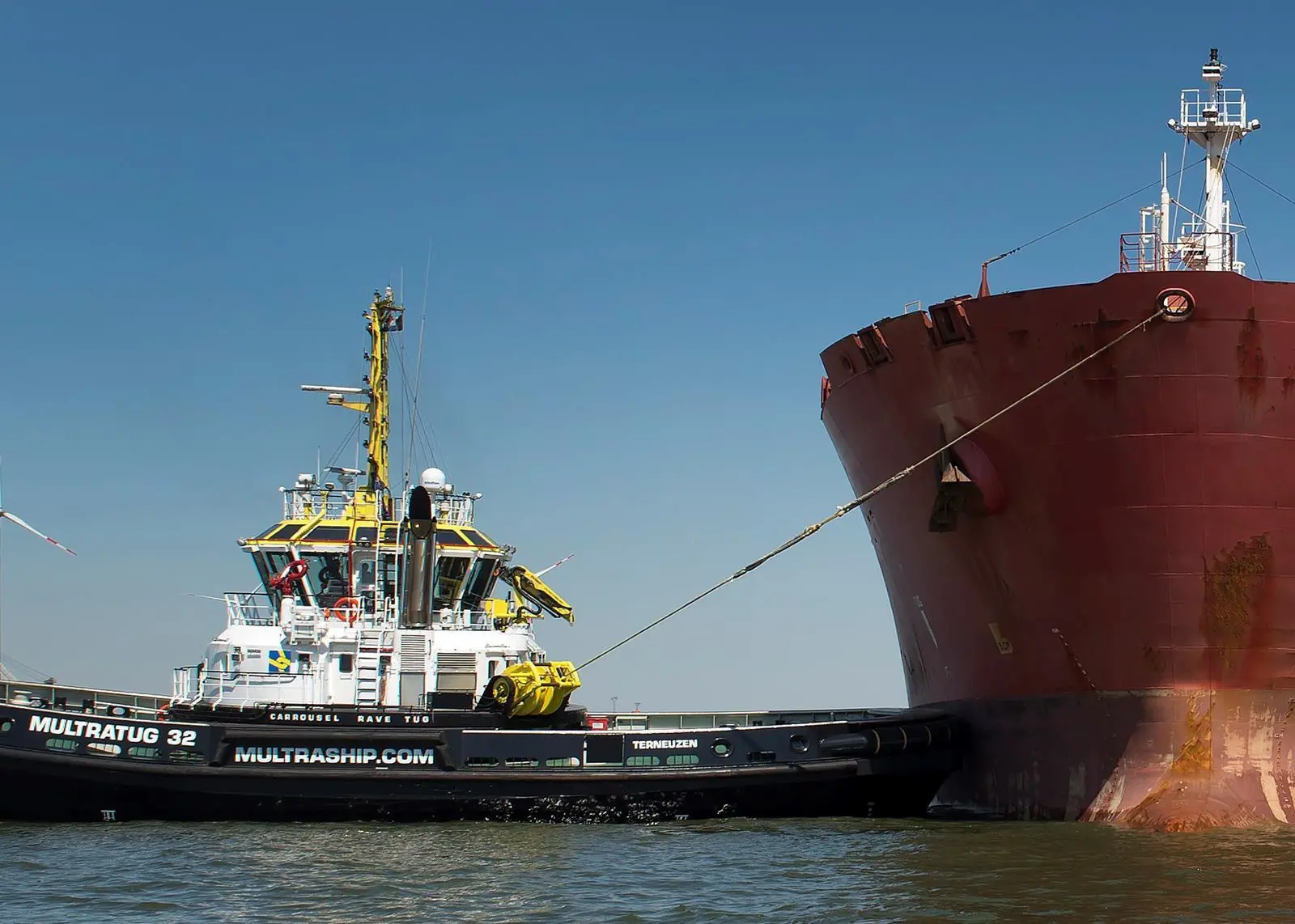
From the operator perspective, Fairplay Towage is one of Europe’s leading tugboat companies, running a fleet with various types of propulsion. Managing director Walter Collet says that with a harbour fleet up of to 100 tonnes bollard pull, it is well-placed to handle the biggest vessels calling.
The main factors that prompt Fairplay to start thinking about a new tug are expansion to other ports, organic growth or replacement.Asked how Fairplay goes about selecting a manufacturer/shipyard, Mr Collet says: “Quality is the biggest issue. Cost, of course, is an issue but quality of shipbuilding and components is for us more important.”
Of future trends, he adds: “We do not believe in full autonomous tugs in the near future. For the time being we will upgrade our tugs as much as possible but we believe in manned tugs.
“The newest trend we can see is a design from Novatug. They designed a carousel tug which can be a game changer. The abilities of these tugs and safety at high speed is groundbreaking.”
The tug to which Mr Collet refers is the Carrousel Rave Tug (CRT). Novatug has placed a towing point on a steel ring, freely rotating around the superstructure of the tug. Towline force alone cannot capsize the tug.
Combined with Voith propulsion, the tug can use its own hull to create lift for braking and steering, providing enhanced control over assisted ships while they are moving.
Julian Oggel, Managing Director of Novatug, says tug design should be about addressing the needs of ships during their port call turnaround and to satisfy trends such as scale, speed, safety and sustainability.
“Ports around the world are confronted with ships that are bigger than what the port was designed to deal with. The solution for this problem is either to make the port bigger, by investing in the construction of fixed infrastructure and dredging, or increase the control over the visiting ships so that you simply need less room. The CRT is that latter solution.”
Mr Oggel says the traditional response to install more power in tugs does not help as the standard “static bollard pull” metric is not a good proxy for what a harbour tug is supposed to do, namely control a tow in a confined environment.
“The paradox that a ship coming into a port needs to steer as well as come to a full stop is not solved by a tool optimised for static pull only. Steering with a ship after all requires not stopping. This problem is exponentially worsened with very large ships, also because their wind surface is such that slowing down makes the problem of control even worse.”
Mr Oggel says Novatug is also looking at applying IT solutions with artificial intelligence so that the services can be made more modular with smaller tugs operating in swarms and being operated remotely.
“Fully-autonomous tugs will in our view not become a reality for the foreseeable future, but all the systems can be made to cooperate with people much more intelligently.”
Nelson goes for more power
New Zealand’s Port Nelson has dug deep to keep up with the demands of bigger vessels. The port’s investment programme has included the recent purchase of a 70-tonne bollard pull Damen 2411 tug – the Huria Matenga ll – following the purchase of the 52-tonne bollard pull Toia in 2016.
Port Nelson Chief Executive Martin Byrne says bigger visiting vessels, plus inquiries for the future, means that the port needs to increase the bollard pull available for pilots.
“We also took into account our operating draft limits and the reality that these are unlikely to change greatly going forward, as the cost to increase these would make such a project unviable.
“This tug purchase certainly puts us in a much stronger position than we would be in, had we not purchased it.”
Operations General Manager Matt McDonald says the largest regular container vessels calling were in the 240-metre range. With the greater towage power Nelson will be able to increase this to 260-270-metre ships.
He says Nelson chose a standard Damen 2411 build with minor customisations, primarily a gangway mounted on the vessel to help the crews get on and off, given the large local tidal range.
“We chose just to negotiate with Damen based on our positive experience in 2016. We also wanted to achieve a level of consistency across our fleet for training, operations etc.
“There are a number of other Damen 2411 tugs on the New Zealand coast and we also see this consistency as a positive.”
Related Articles
 CONTAINER & CARGO HANDLING
 CONTAINER & CARGO HANDLING
 BULK HANDLING