![PortStrategy[GreenPort]](https://www.portstrategy.com/wp-content/uploads/2026/09/PortStrategyGreenPort.svg)






TYPE APPROVAL BRINGS SECTOR INTO LINE
Fender testing and the procedure for reporting fender performance has been a hot topic for many years, ever since the almost universal adoption by consultants and other fender specifiers of the original PIANC testing guidelines back in 1984; but a major milestone was reached recently when the first manufacturer succeeded in obtaining Type Approval status to internationally accepted standards. David Foxwell reports.
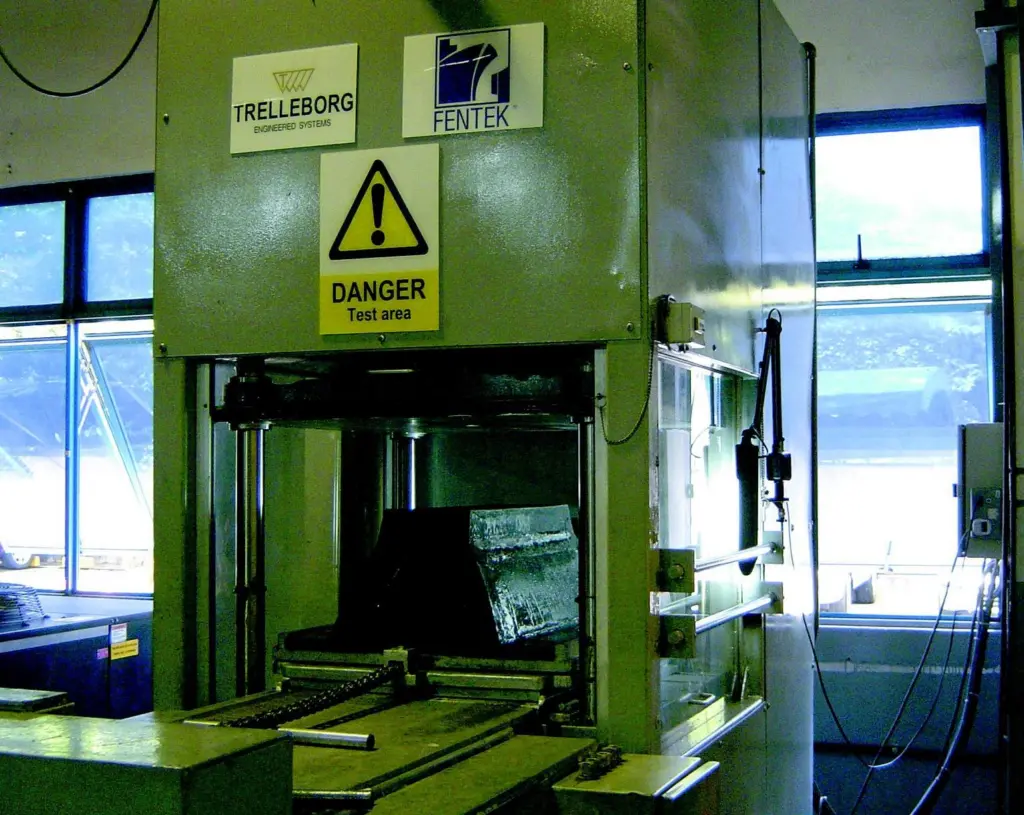
Whilst the PIANC protocol worked well in the early days, a few manufacturers sought to reinterpret these simple rules to “boost” the apparent performance of their products, and modified tests were, in some cases, used to justify a fender which used less rubber but somehow retained the same performance – gaining what many saw as an unfair price advantage.
Unfortunately, as poorly specified – and poorly designed fenders – that seemed to offer a high level of performance proliferated, so the difference in their performance on paper and actual performance ‘on the dock’ became apparent, often requiring significant repair and re-construction work at damaged facilities and replacement fender systems.
The debate continued until PIANC recognised the need to update and tighten the original test protocol – resulting in the publication of “Guidelines for the Design of Fender Systems: 2002” in April of that year.
The new guidelines not only included the very latest design practices for fenders, they also introduced a strict type approval “Procedure to Determine and Report the Performance of Marine Fenders” which would bring all manufacturers into line.
In doing so, it would also ensure that specifiers could – once again – be confident that the published performance figures of fenders from all Type Approved sources were measured using the same methods and from the same datum, rather than seeming to meet an approved ‘checklist’ of requirements, or somewhat vague specifications that define the required dynamic performance of a fender.
As manufacturers also point out, whilst ‘performance-based’ specifications might have proved sufficient in the past, fender design has evolved tremendously in the last decade and, whereas in the past a port or harbour could be sure that there was a reasonable level of ‘equivalence’ in the performance of fenders supplied by different manufacturers, that assumption no longer holds true, particularly as poor quality, low cost copies of more advanced fender designs have become widespread.
PIANC’s new protocol addresses many areas which are critical to fender performance:
A definition of the Rated Performance Data (RPD) which defines the minimum requirements for manufacturers’ published performance figures The test apparatus and performance testing procedures to be used Supporting protocols and other tests, including the effects of impact velocity on fender performance at speeds from 1mm/s up to 300mm/s; the effects of temperature on fender performance from -30infinityC up to +50infinityC; the effects of compression angle on fender performance from 0infinity (parallel) up to 20infinity; fatigue and durability testing up to 3,000 full compression cycles; temperature stabilisation, normalised at +23infinityC±5infinityC; verification and quality assurance testing; and rubber physical property testing, including tensile strength, elongation at break and hardness (both before and after ageing), as well as resistance to ozone cracking.
As the above would suggest, Type Approval testing of fenders to the new PIANC protocol calls for extensive preparation and significant investment by manufacturers, although this is justified by the end result of a safer, more reliable and better made product.
As Mike Harrison, marketing director at one of the major fender manufacturers, Fentek, explains: “Fentek’s Singapore factory – Trelleborg Hercules – started this major undertaking in late 2002, with classification society Germanischer Lloyd witnessing and verifying the tests, a process which was completed late last year with Type Approval for the company’s range of high performance moulded fenders.”
Other manufacturers, such as Bridgestone are, as spokesperson John Classey explains, also working on Type Approval, and highlight the importance of correctly specifying fenders and acquiring fenders that are ‘up to the job, ‘ a task which should be easier now that Type Approved fenders complying with the PIANC standard are beginning to be made available.
Related Articles
 CONTAINER & CARGO HANDLING
 CONTAINER & CARGO HANDLING
 BULK HANDLING