![PortStrategy[GreenPort]](https://www.portstrategy.com/wp-content/uploads/2026/09/PortStrategyGreenPort.svg)






Valencia shines
But a dwindling labour force pool is already having an impact on productivity, warns Alex Hughes
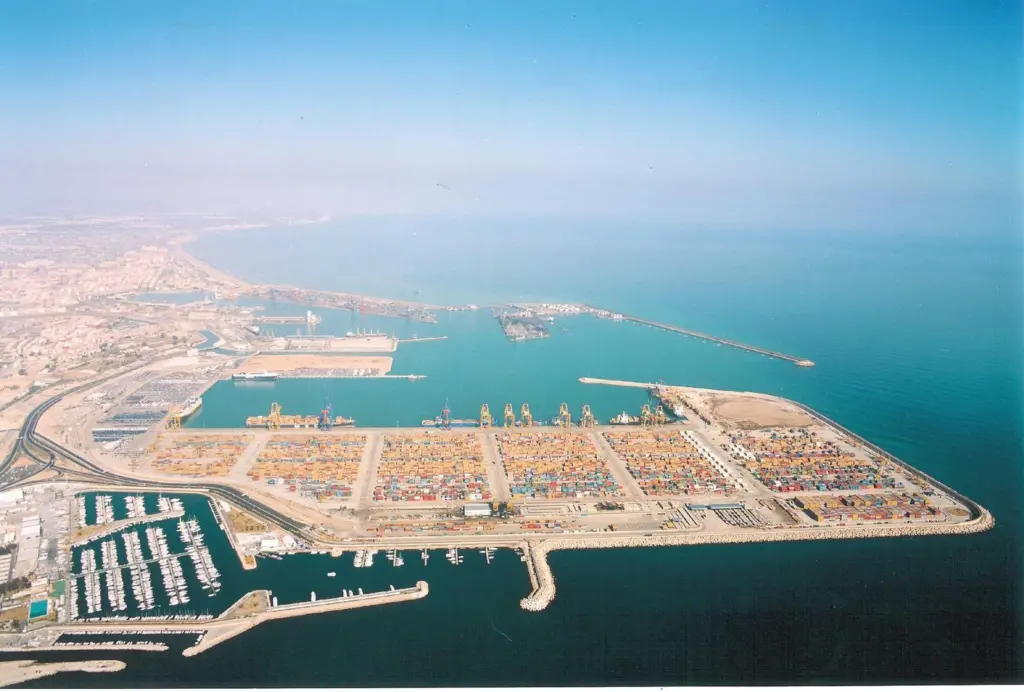
In 2001, the Spanish Mediterranean port of Valencia overtook main rival Barcelona to become Spain’s leading import-export gateway. Ever since then, Valencia has remained in pole position. It ended last year with box throughput up 8.4% to 2.6m teu, while traffic at Barcelona grew 11.97% to end the year at 2.3,m teu.
The reason for this inversion in fortunes is relatively simple to explain: Valencia is 350km from Madrid, while Barcelona is 621km distant. Although it is possible for containers to be sent to the Spanish capital overnight from Barcelona, terminal managers there still believe that the extra distance does nevertheless leave them at a trading disadvantage.
Valencia port authority has invested heavily in line with traffic growth. Major developments to the southern harbour have allowed public container terminal operator Marítima Valenciana to become the largest of its kind in Spain, boosting throughput 10% last year to 1.8m teu. At the same time, main rival TCV Stevedoring (in which Barcelona box terminal operator TCB holds a majority stake) saw its own traffic grow to 560,000 teu at the other large public container terminal on Levante quay. Here, another new major container terminal development is taking place, incorporating land reclaimed from the sea.
Despite this go-ahead investment approach, the port authority has singularly failed to adequately address the shortage of sufficiently trained stevedores. As in all Spanish ports, while private terminals do have some of their own employees, additional labour has to be hired in from a pool company in which the port authority is also a shareholder. Pool members are highly unionised. Incumbents guard their jobs jealously. Nepotism determines who does and, crucially, who does not gain employment in the port. To keep wages high, few newcomers break into this highly lucrative sector.
The Spanish government, which could and should have tackled this problem years ago, has spinelessly passed the buck back down to the port authorities, which understandably have done little to improve the situation, given a perceived lack of central government support. Understandably, with too few stevedores available, productivity at Valencia has nose-dived, hovering around the low twenties in terms of moves-per-crane-hour, which is significantly lower than rates achieved at Barcelona.
One of the by-products has been interminable queues of trucks outside the major box terminals. As these grew longer, tempers began to fray and, inevitably, industrial action broke out, resulting in blockades being set up to force the port authority to broker new working practices and force the terminals to offer longer opening hours.
While the entire port community agrees something must be done to address the labour problems, senior terminal managers stress the need for evolution rather than revolution. After all, no port wants to get a reputation for industrial disharmony. Recent agreements have nevertheless resulted in more stevedores being taken on and somewhat better working practices adopted. The situation is not ideal, but is much improved, say all involved.
MSC has nevertheless made a major commitment to the port by opening its own dedicated terminal adjacent to that operated by Marítima Valenciana. The shipping line reportedly bid for the concession to ensure guaranteed berthing on arrival for its vessels plying key east-west services. Interestingly, management has been outsourced to Marítima Valenciana’s parent company, Dragados-SPL.
In 2007, this facility is earmarked to handle around 400,000 teu of the 1.8m teu MSC believes it will rotate in and out of the port. However, only 200,000 sq m of the 350,000 sq m site are currently operational, along with just 500 metres of quay. Operationally, this means that only one feeder and one mother vessel can currently be accommodated simultaneously. Even when the full 716 metre quay wall comes into active service, it will prove extremely tight to work two liner vessels at the same time. These problems notwithstanding, once fully developed, the terminal could be handling 650,000 teu.
MSC, which handled more than 1.2m teu at Valencia in 2006, also continues to make major use of the Marítima Valenciana terminal. In a contractual agreement, the shipping line has committed 70% of its import/export traffic to the public container terminal along with 30% of transhipped boxes. Overall box numbers generated by the shipping line this year may grow by as much as 30%.
Related Articles
 CONTAINER & CARGO HANDLING
 CONTAINER & CARGO HANDLING
 BULK HANDLING