![PortStrategy[GreenPort]](https://www.portstrategy.com/wp-content/uploads/2026/09/PortStrategyGreenPort.svg)





Germany’s largest shore power system ordered
Siemens has been commissioned to build a shore power system at a port in Germany that is able to supply electricity to two ships simultaneously and potentially reduce annual CO2 emissions by more than 8,000t.
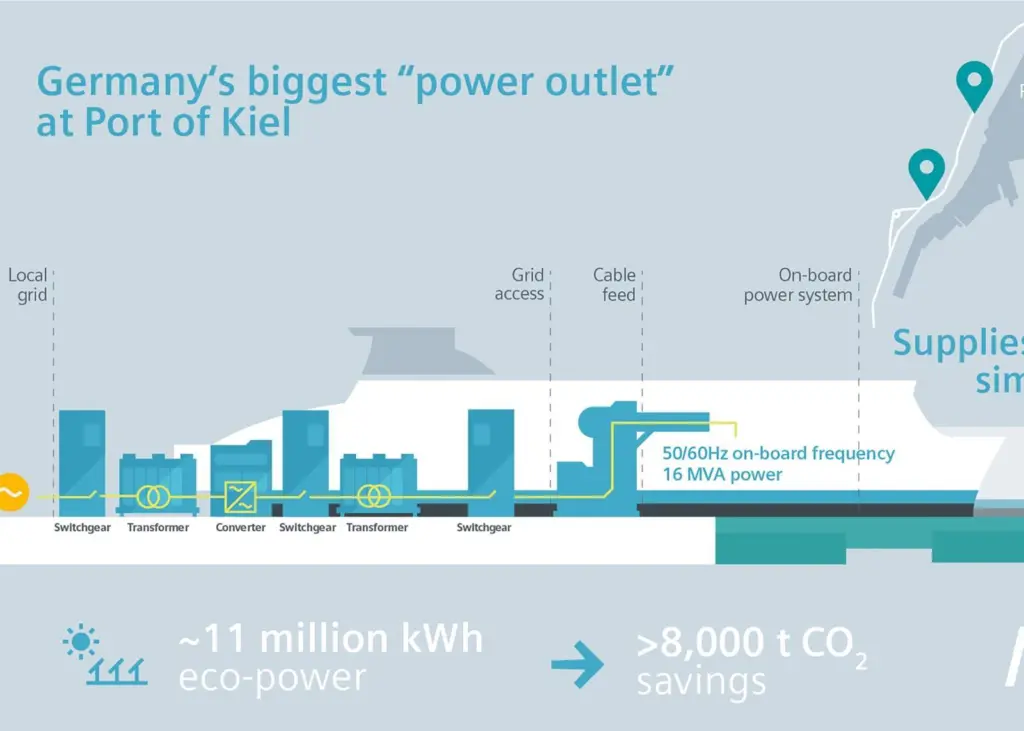
With a power of 16 megavolt amperes (MVA), the Siharbor solution at the Port of Kiel is believed to be Germany’s largest shore power system to date. In addition to enabling ships to turn off their engines and connect to the shore power system for zero-emission operations while berthed, noise from ships can also be significantly reduced.
Dr Dirk Claus, managing director at the Port of Kiel, said: “The shore connection system lets us draw electricity from renewable energy sources, both for cruise ships docked at the Ostseekai and for the ferry at the Schwedenkai.”
The Siemens installation consists of one substation with four Geafol cast resin transformers, four air-insulated medium-voltage Nxair switchgears as well as one 16-MVA frequency converter. The cast resin transformers with a rated power of six and 16 MVA are especially suited for challenging environmental conditions, such as the salty air present at the port.
For an uninterrupted and efficient power supply of the mooring ships the Siemens converter system ‘Siplink’ is used.
It features a frequency converter and a software for central controlling of the two berths. With the system, two medium-voltage networks with different frequencies can be connected. In this case the local distribution grid with 50 Hz and the ship’s onboard electrical system with 60 Hz. Siplink synchronizes both networks and takes over the power supply automatically within a few minutes. In addition, it coordinates the energy supply of the ships’ two networks so that power can be supplied to both simultaneously.
The system is expected to go into test operation within the 2020 cruise ship season. 32 different cruise ships stopped in 174 times at the port facilities in 2018.
Mr Claus stressed that the port, which has adopted a ‘Blue Port’ concept aims for shore power to provide 60% of the energy demand required by ships entering the port in the future.
Related Articles
 PORT & TERMINAL NEWS
 CRUISE GREENPORT
 CRUISE GREENPORT