![PortStrategy[GreenPort]](https://www.portstrategy.com/wp-content/uploads/2026/09/PortStrategyGreenPort.svg)

Targeting Efficiencies
Ports are looking to technology to support more efficient Vessel Traffic Services. Dean Davison highlights developments at key ports that aim to capitalise on groundbreaking new technology.
Targetting Efficiencies
The International Maritime Organization (IMO) has a simple definition of what Vessel Traffic Services (VTS) entail at a port: “VTS are shore-side systems which range from the provision of simple information messages to ships, such as position of other traffic or meteorological hazard warnings, to extensive management of traffic within a port or waterway.”
IMO continues by adding that “…ships entering a VTS area report to the authorities, usually by radio, and may be tracked by the VTS control centre.”
While this is, of course, a true description, it is also interesting to note that contact is made via a radio – a process that has not changed for many, many decades, even into the 21st century, despite the growth of digital services and artificial intelligence.
However, there is no doubt that today’s modern ports are looking towards, and investing in, much greater use of technology with respect to vessels entering or leaving their berths and terminals.
Pilot program potential
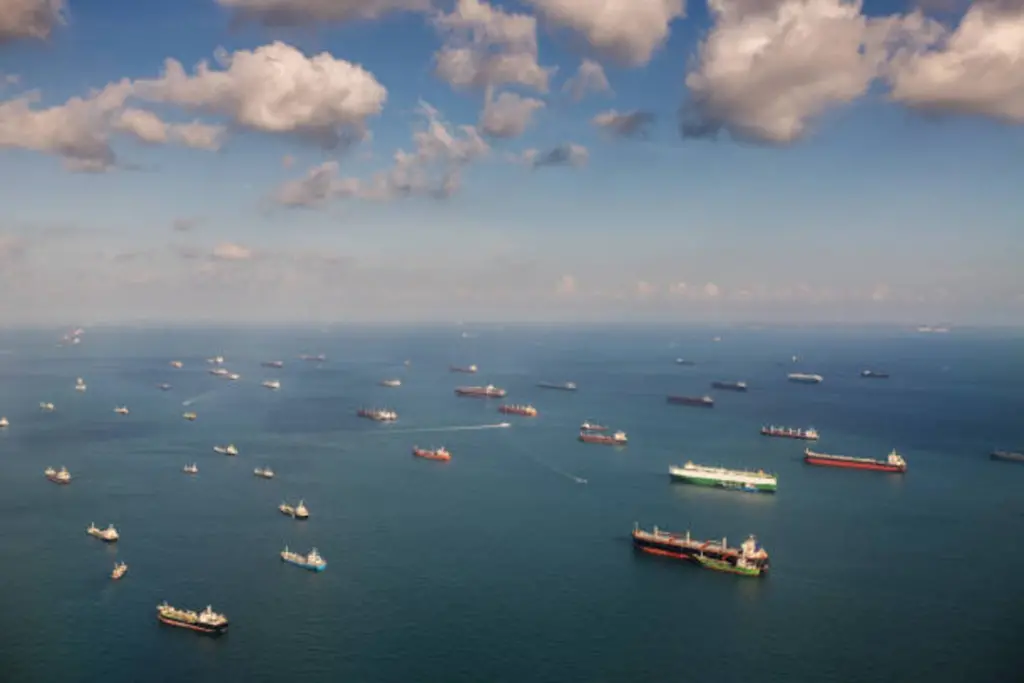
Handling 44.5 million TEU in 2025, Singapore is the world’s busiest container port and in 2025 it recorded over 11,500 vessel calls, including from the largest container ships in service. So how it handles vessel traffic needs to be safe and efficient.
In April 2026, the Maritime and Port Authority of Singapore (MPA) introduced a pilot programme for an advanced AI-driven vessel traffic management system, aiming to significantly “enhance navigational safety and optimise port efficiency.”
The new AI-powered system was introduced across selected areas of the port’s highly congested waters and utilises machine learning algorithms while processing real-time data from radar, AIS, and weather sensors to predict vessel movements, identify potential collision risks, and suggest optimal routing for incoming and outgoing ships.
MPA has confirmed that initial results indicate “potential” for up to 15% reductions in vessel waiting times and improvements in overall traffic flows, while also reducing the possibility (and impact) of human error.
In edition the new system has the capability of generating predictive analytics for berth allocation and resource management to port operators, thereby helping to streamline complex vessel movements (comprising both large deep-sea vessels and smaller feeder units) simultaneously.
MPA is expecting a full rollout by late 2027, with this initiative being a key component of Singapore’s Smart Port 2030 vision, which aims to leverage technology to maintain its position as a global maritime hub.
Increase the overall efficiency
Similarities with Singapore can also be noted in Hamburg. The port’s terminals saw over 6800 ship calls in 2025 and the use of technology is certainly at the forefront of how vessels move to/from the port’s berths.
“In vessel traffic management, the Hamburg Vessel Coordination Center (HVCC), a privately-run joint venture, supports the coordination of vessel arrivals and departures in close cooperation with the Hamburg Port Authority, shipping lines, terminals, pilots and other nautical stakeholders,” Axel Mattern, CEO, Port of Hamburg Marketing, explains, before outlining the benefits that are derived:
“By optimising arrival and departure planning, the HVCC helps reduce waiting times, improve berth utilisation, and increase the overall efficiency of port calls. Better coordination also contributes to lower emissions by supporting more efficient sailing speeds and minimising unnecessary vessel idle time.”
A crucial factor
According to the Port of Rotterdam, digitalisation and innovation play a key role in the transition to an efficient, sustainable, and future-proofed vessel traffic management system.
“If data is available early in the chain, changes and disruptions can be addressed more quickly and appropriately…. when terminals gain earlier insight into arriving and departing vessels, this provides greater scope to anticipate restrictions, such as available cranes and quay capacity,” the port states.
In April 2026, the port introduced a pilot project for an innovative artificial intelligence-powered vessel traffic management system (VTMS). The new system focuses on improving situational awareness for terminal operators by integrating data from radar, AIS, and weather forecasts. Here the AI algorithms are engineered to predict potential traffic bottlenecks and vessel traffic patterns, optimise ship scheduling to help prevent congestion, and provide proactive alerts for collision avoidance.
The Port Authority expects the AI-VTMS to deliver enhanced safety, a reduction in waiting times for incoming vessels, and an overall improvement in operational efficiency at a port that continues to see up to 29,000 ship calls annually.
Also of note, in the UK a new Kongsberg VTS system has been delivered to the Port of London Authority (PLA) covering 95 miles of the tidal River Thames in London to monitor and manage vessel movements. The system integrates radar, AIS, CCTV, and other sensor data into a single, intuitive interface, with advanced radar tracking capabilities offering greater clarity and stability in monitoring vessel positions, even in high-traffic areas and complex river bends.
Related Articles
 EQUIPMENT
 INSIGHT & OPINION
 TERMINAL OPERATIONS