![PortStrategy[GreenPort]](https://www.portstrategy.com/wp-content/uploads/2026/09/PortStrategyGreenPort.svg)



Clean fuel FLT advances
Fork-lift trucks (FLTs) are an integral part of operations in ports, terminals and throughout the logistics supply-chain where cargo needs to be handled they are recognized as a beneficial workhorse.
SECTOR ANALYSIS: STEADY ADVANCE IS THE KEYNOTE
The manufacture of these vitally-important machines is facing the same challenge as diverse other areas of cargo processing – i.e. to be greener, reflecting the latest user requirements. It is well-summarised by Hyster: “Zero-emission container handling equipment is emerging as a real option to help terminal operators reduce their carbon footprint – without sacrificing performance.” Development work proceeds apace as reflected below in the company-by-company review. Electric power can reduce fuel and maintenance costs by generating greater energy efficiencies as well as lower lifetime costs. With longer operating times and lower maintenance than traditional combustion power, alternative fuel options are becoming more appealing. Charging times are being reduced and overall the market penetration of clean fuel FLTs is steadily increasing. The latest innovations by individual manufacturers and r&d work for the future are highlighted below.
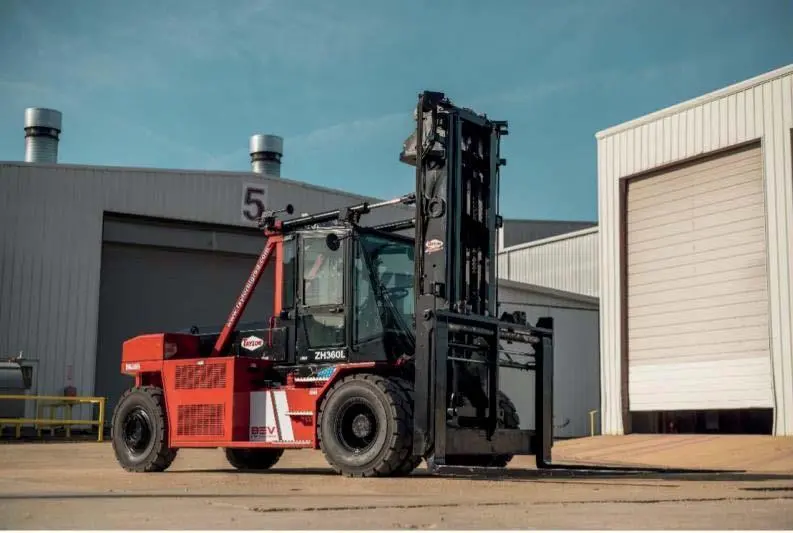
Taylor Machine Works: Taylor Machine Works, Inc has launched a new zero emissions, battery electric forklift truck. With a 36,000lb (18 tonne) lifting capacity, this new unit is expected to be used across multiple industries, including port and logistics operations. Battery electric power has been utilised by Taylor since it showcased the first two electric container handlers in October 2019 at the Port of Los Angeles. The company’s new ZH-360L machine is powered by Permanent Magnet Synchronous Electric Motors and American manufactured NMC batteries. It also features an advanced E-Axle that utilises regenerative braking to assist with battery recharge during operations. Consequently, it can operate uninterrupted through a typical eight-hour shift. Recharge time is also optimised to only 1.5 hours, meaning that by charging at lunch and during breaks, the run time can, according to Taylor, “approach the same multi-shift work cycles as any internal combustion counterpart.” The operator’s cab of the ZH-360L offers various features to support the driver’s comfort and protection. The all-steel Taylor DREAM cab can be outfitted with Poly-Armor protective glass, which can withstand up to six times more impact energy before shattering than standard tempered glass. Plus, the Clear-VU operator station with Comfort Steer is also available, which removes the traditional steering wheel and dash, to open visibility from floor to ceiling. Taylor has three additional models of zero emission forklift trucks in its portfolio. The ZLC Series of loaded container handlers is already available in a second-generation model and units are in use throughout US ports.
Hyster: According to Hyster, the move toward clean power makes “more sense than ever,” although the company does point out that before transitioning away from tried-and-trusted internal combustion engines, it is important to consider all the variables that impact the viability of equipment electrification. The Hyster® J10-18XD forklift truck is powered by 350-volt lithium-ion battery packs. Hyster chose to integrate lithium-ion power because compared to 120-volt lead acid batteries, the 350-volt lithium-ion battery is more energy efficient. This is because lithium-ion batteries produce higher performance throughout the charge cycle and have a longer life cycle, helping to reduce total cost of ownership, while zero maintenance and faster charging times ensure further savings and more operating time. Indeed, the J10-18XD model gains one hour of working for every 11 minutes of charging. Hyster further maintains that lithium-ion batteries provide an electric option capable of delivering “diesel-like” performance that modern terminal operations need, representing a major step forward from traditional lead-acid batteries. For example, the 350-volt lithium-ion batteries on the Hyster J230-360XD and J360XD36-48 units (J10-18XD in EMEA) outlive the 120-volt lead-acid batteries. Moving forward, Hyster is working on additional power sources, with two options of electric laden container handlers to further enhance meeting terminal needs. These include employing a large lithium-ion battery, with choice between conventional charging or hydrogen fuel cells in combination with lithium-ion batteries, providing full-day operations with no re-charge. As Hyster is showing, advanced electric options like lithium-ion batteries and hydrogen fuel cells can provide longer-term value, help reduce emissions and maintenance costs while maximising performance and efficiency.
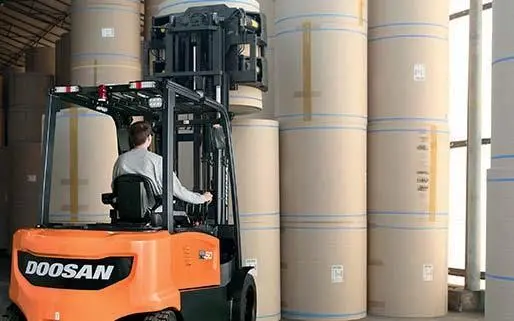
Doosan: South Korean forklift truck manufacturer, Doosan Industrial Vehicle (DIV) has signed a new agreement with German industrial automation specialist, Kollmorgen. The aim of the venture is to “innovate and build efficient, sustainable and reliable custom-made automated guided vehicles that exceed customers’ future requirements.” As part of its approach in this sector, DIV adopts a belief that “more comfortable drivers will always be more productive” and this is reflected in its equipment ergonomics. Doosan has an existing product range of over 179 vehicles, covering electric and pneumatic forklifts, reach trucks, stackers and various other warehouse vehicles, with the battery charging system on Doosan’s forklift models, including the heavy- duty four-wheeled B45X-7 units designed to be simple and swift to enable multi-shift operation and longevity. Chankyo Chung, Vice President, Doosan Industrial Vehicle, contends: “Our vehicles are a preferred choice among many of the world’s blue-chip companies. That requires us to always be at the forefront of technology and deliver reliable products to the highest of standards,” before adding in relation to the new deal: “We selected Kollmorgen for that exact reason – being a partner that invests heavily in R&D with a proven track record of solid automation solutions.”
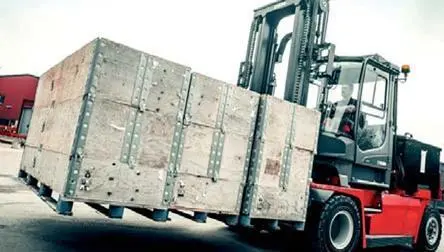
Kalmar: The latest range of Kalmar electric forklift trucks, ECG50-90, offers what the company says is the “best of both worlds” with the performance of a powerful diesel truck but without the emissions, noise and vibration. Moreover, from an investment perspective, Kalmar explains that due to high operational efficiency, low maintenance costs and long service life each unit will pay for itself in just two years. For example, the Kalmar ECG50–90 offers optimum battery usage for up to 15 per cent longer operational time than previous-generation trucks and compared to a diesel truck the energy saving alone is 75 per cent less with an electric truck. The initial 50-hour service of previous generation machines has also been replaced by a 500-hour service interval, to further increase cost efficiencies. The other notable factor with these new trucks is that in addition to traditional lead-acid batteries, the ECG50-90 utilises Li-ion batteries which can last for 2400-4000 charging cycles, do not need to be kept in ventilated spaces, require minimal maintenance and can be fully charged in 100 minutes on the basis of one per cent charge being gained per minute.
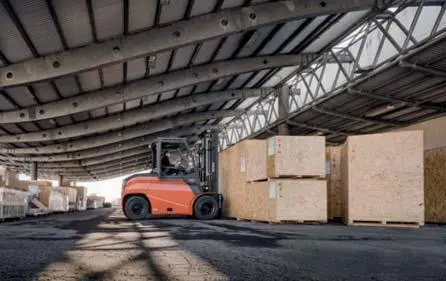
Toyota: “All-electric, all-Toyota.” That’s the message from this major manufacturer. The company offers what it describes as a “true alternative to engine powered” trucks, which includes a choice of battery technologies and a floating cabin. Toyota’s new Traigo80 range has replaced the existing Traigo HT units and provides models of up to eight-tonnes, with a 900mm load centre. The new Traigo80 electric forklift truck also offers two other benefits, namely, a System of Active Stability which controls truck stability to increase safety and productivity during load handling and, importantly, quick battery access via a side panel that fully opens without the need for tools for immediate access and charging.
Related Articles
 CONTAINER & CARGO HANDLING
 CONTAINER & CARGO HANDLING
 EQUIPMENT