



Exposing dredging to the cold
Freeze dredging, a process being pioneered by FriGeo, involves lowering large cast iron plates to the river or sea bed.
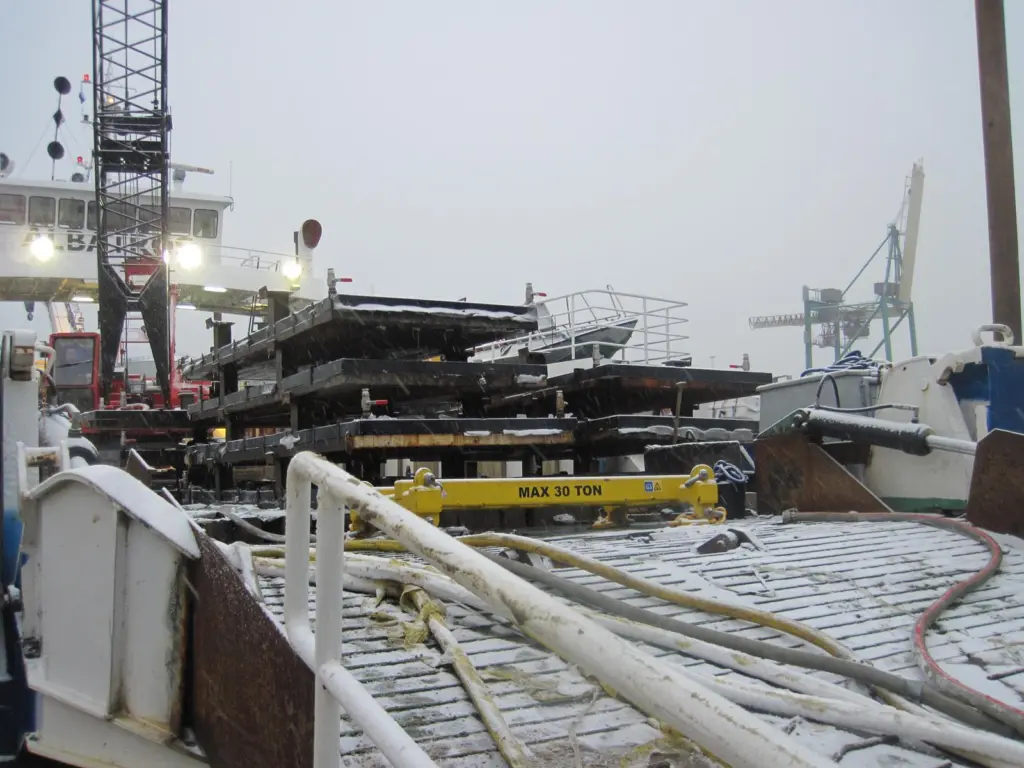
The plates contain hoses that are filled with a salt solution; this can be cooled to around minus 30° centigrade. After two days, the plates are raised again, bringing with them about 30 cms of frozen bottom material. This can then be used for landfill.
Importantly, the particles are aggregated during the freeze-thaw cycle, giving a clean effluent that can be separated.
FriGeo is a company born out of a three-year business development project launched by the Environment and Space Research Institute in Kiruna in 2000.
As well as freeze dredging, company founder and chief executive Susanne Rostmark is working with freeze drying/dewatering, and its possible applications for contaminated handling and treatment.
“In Stockholm, sediments contaminated with heavy metals and PCB were dredged, and transported to landfill in frozen form,” she says.
During the operation, turbidity was measured around the dredging site, showing that compared with open water conditions, turbidity was slightly elevated both inside and outside the silt curtains – but levels varied regardless of freeze dredging. Overall, turbidity was very low both inside and directly outside the silt curtain.
“Based on the presented data, the environmental authorities concluded that freeze dredging could be done without environmental curtains.”
Although the technology is being developed and refined for dredging purposes today, in fact man-made artificial ground freezing was first practised during mining operations in South Wales in the 19th century.
“When using freeze dredging, the main advantages are minimal exposure for workers – the system can be remotely handled and the frozen material is stable; volume reduction due to precision in uptake, dewatering and the fact that no excess water is taken up; and safe salvage of objects submerged in the material,” says Ms Rostmark. “Most of all, freeze dredging is a highly flexible system that can be adapted to most sites.”
FriGeo has also been undertaking freeze dredging in Hällevik Harbour in the south of Sweden, where the method was chosen by the municipality for its cost-effective and environmental benefits.
“Since Hällevik Harbour is a Blue Flag marina with high environmental standards, finding an effective dredging method which guarantees minimum negative impact was a top priority,” says FriGeo.
Related Articles
 EQUIPMENT
 EQUIPMENT