![PortStrategy[GreenPort]](https://www.portstrategy.com/wp-content/uploads/2026/09/PortStrategyGreenPort.svg)


Heavy Duty FLTS: The Future is Electric
Electrification, digitalization and customization are shaping the future for heavy-duty forklift trucks
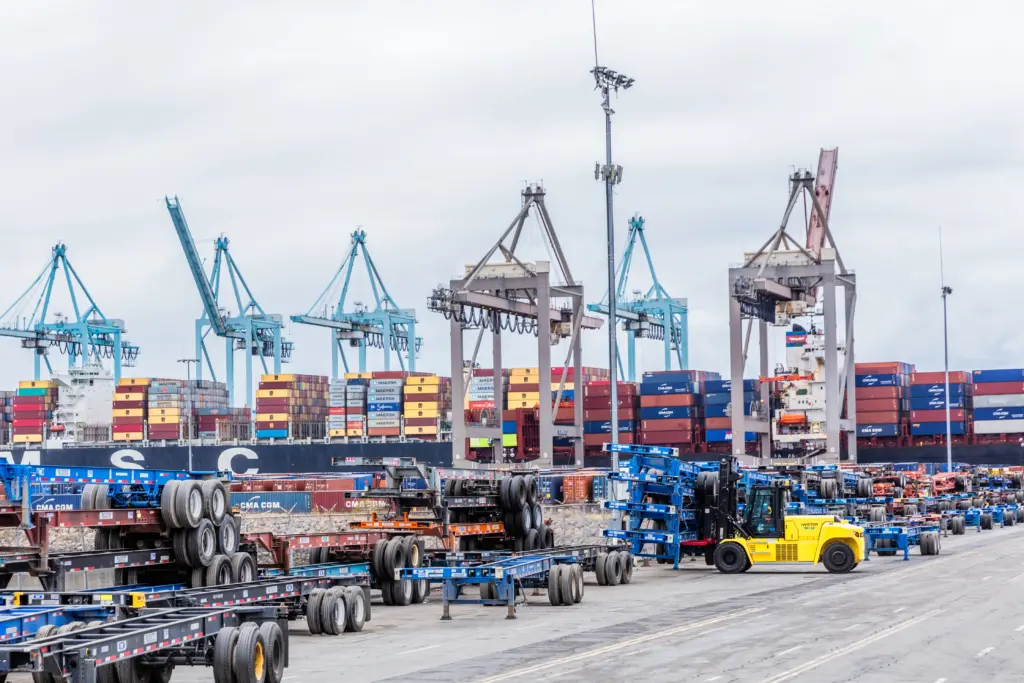
Sector analysis: development drives on
The drive towards decarbonization within the ports sector has seen electric power become ever more dominant within the heavy-duty forklift truck sector. As the company-by-company reviews below highlight, the majority of new models are electrically powered, not only offering zero emissions but additional benefits including energy efficiency and reduced maintenance. Other major themes include digitalization and AI. Ricky Hirani, Director, Product Management, Big Trucks for Hyster, tells Port Strategy: “Telemetry and the Terminal Industry Committee (TIC 4.0) standards are also driving integration of trucks into terminal operating systems, specifically solutions that feed real-time data on truck position, container height and load status.” Another trend is towards customisation and application-specific equipment. “Tailoring equipment for its application can elevate productivity, safety consciousness and equipment longevity compared to “off-the-shelf” machines,” Hirani says. One clear path forward is the “thoughtful configuration” of big trucks, for example high-capacity forklifts with quick-disconnect carriages, coil rams or magnets extend multipurpose capability. “This flexibility helps ports avoid over-investing in single-task equipment, particularly when cargo mixes and volumes fluctuate,” he comments. There are also interesting reports of ongoing development in the heavy-duty FLT diesel-powered sector.
Data analysis: Batteries, Durability and AI
Bobcat: Bobcat launched the largest forklift trucks in its line-up in March this year. The new DV180S-9 and DV250S-9 diesel forklifts, introduced to the market at European intralogistics exhibition LogiMat, are “purpose-built to exceed the toughest end-customer expectations,” the USA headquartered company underlines, adding that they “deliver exceptional durability, advanced safety and superior operator comfort, making them the ultimate choice for demanding industrial environments and heavy-duty material handling applications”. Key product features and advantages of the Bobcat DV180S/250S-9 diesel forklifts include the ability to lift a maximum of 18 and 25 tonnes at a 1200 mm load centre. They are driven by a powerful HDI DL08V diesel engine and feature a ZF 4-WG-211, 4-speed powershift transmission and a Kessler drive axle. The DV180S-9 stands out as one of the most compact machines in its class, with a width of under 2550 mm. Bobcat says that this allows for easy transport without special permits, saving on logistics costs and offering more flexibility for operators.
Hyster: Hyster’s recently-launched J10–18XD high-capacity, zero‑emission electric forklift with integrated lithium-ion battery power, has been designed for heavy-duty environments, such as ports and terminals. With lift capacities from 10,000 kg to 18,000 kg, it offers a -zero-emission alternative to internal combustion engine (ICE) power. The forklift is available with a range of battery sizes, configurable up to 280kW. The 350-volt architecture provides a right-sized solution for ICE-like performance and energy efficiency. This solution offers long run times and minimises energy loss without the additional cost and complexity of higher-voltage systems. Ricky Hirani, Global Commercial Product Leader, Big Trucks, Hyster states: “We also took steps with this series to help ease the transition for operations pursuing decarbonisation. This includes a high level of commonality with equivalent diesel Hyster models, tools to help monitor and manage batteries, and compatibility with common charging infrastructure.” All Hyster electric big trucks incorporate a Combined Charging System (CCS), which uses a single, standardised charging connector. Hyster notes that equipped with the right battery pack and charger, the truck in a typical duty cycle can add approximately one hour of work time from 11 minutes of charging at 90 kW. Each truck includes an onboard Battery Management System (BMS) that provides information on battery health and overall performance. The BMS also helps monitor overheating, control overcharging, and manages lift interrupt at low charge.
Kalmar: The Kalmar Heavy Electric Forklift truck is an important driver for net zero loads. The ECG180-330 has a lift capacity range of 18-33 tonnes for sectors including container handling. The Finland-headquartered company underlines how an electrically powered driveline enables faster and smoother acceleration and more responsive handling while still being able to lift up to 33 tonnes efficiently and safely. Fewer moving and mechanical parts is said to facilitate less maintenance and the company points out that it can run optimally within a broader range of temperatures with Kalmar’s Thermal Management System, which keeps the core battery temperature between 15-35˚C for best performance, even when the temperature outside gets down to -30˚C or up to 40˚C. By linking the Thermal Management System to the Climate Control System, the energy used to heat or cool the operator’s cabin is reduced. Orders over the last few years include a delivery to Norwegian transport company CargoNet’s intermodal terminal in Oslo.
Konecranes: Decarbonisation, electrification and smart capabilities are among the main themes driving Konecranes’ recent developments within its terminal heavy-duty truck sector. The Finland-headquartered company has revealed that all its latest Generation C Konecranes lift trucks can run on HVO100, which can reduce fossil-based CO2 emissions by up to 90%. Within the last two years, the company has also introduced a heavy-duty version of its flagship E-VER electric forklift for lifting capacities of 18-25 tonnes. Konescranes says that this new range of lift trucks is part of its aim to electrify its entire lift truck fleet by the end of 2026. The new 18-to-25-tonne Konecranes E-VER is intended for heavy-duty industrial applications including ports, with low energy consumption and zero tailpipe emissions. The lithium-ion (Li-ion) battery pack fuels the truck’s electric motors. Easily adaptable to the local power grid, it allows fast charging of under an hour, top-ups from braking energy during work shifts, and slower charging when not in use. A combination of high voltage and low current reduces energy consumption and losses, allowing the truck to use up to 90% of available energy. When no longer able to hold enough charge to run the motors, the battery can be repurposed as a power reserve at charging stations, or a backup power supply if regular sources fail. The forklift uses Konecranes TRUCONNET to collect real-time data, including battery charge monitoring and estimated truck autonomy; energy consumption per lift, distance or load; the amount of energy recovered from braking; and alarms, alerts and other diagnostics. This transmits to the customer portal to monitor and control the truck’s operational efficiency, productivity, safety and environmental impact.
Linde Material Handling: Germany-headquartered Linde Material Handling (MH) has expanded its digital customer platform to manage and control industrial forklift trucks with an AI feature. Announced in June this year, the new AI feature in myLinde makes creating analyses and reports easier. Instead of entering data into analysis tools, users of the web portal can now enter instructions or questions such as: “Create a table showing the operating hours of all forklifts over the past week,” or “What were the respective travel and lift percentages for each forklift.” Tobias Klein, Portfolio Manager, Linde MH, points out: “Compiling information from various data sources is tedious, and very few people enjoy doing it. Thanks to the ‘myLinde AI’ chat feature, this will soon become much easier and more convenient.” On the myLinde all-in-one digital platform, Linde MH consolidates software applications for fleet, safety and battery charging management. The Linde HT heavy duty forklift truck series uses hydrodynamic drive and heavy-duty diesel engines to move heavy loads with an emphasis on fuel efficiency. Linde also offers high-performance electric heavy-duty forklifts.
SANY: SANY has boosted its port electric forklift offerings over the last few years by introducing the 35-tonne SCPE350, its largest yet. The truck possesses a fully-loaded running speed of 28 km/hr, an empty-loaded lifting speed of 350 mm/s, and its response time is less than 400 ms. The China-headquartered company claims it takes only 2.5 kWh of electricity to accomplish the exact same workload as one litre of diesel. Therefore, based on 2000 annual operating hours, SANY estimates the SCPE350 can deliver annual cost savings of up to 200,000 RMB ($28,571). Featuring an upgraded 750 V double-gun charging system, SANY claims that the SCPE350 charges twice as fast as conventional models, fully charging in just 1.5 hours, enabling up to 10 hours of continuous operation. Equipped with a smart client system and a large HD screen, operators can monitor real-time equipment running track and data. The auto-diagnosis system can identify problems quickly and support historical fault queries, boosting maintenance. The SCPE350 is equipped with a dynamic anti-tipping system, automatic fire extinguishing system, and high voltage isolation system.
Related Articles
 CONTAINER & CARGO HANDLING
 CONTAINER & CARGO HANDLING
 EQUIPMENT