![PortStrategy[GreenPort]](https://www.portstrategy.com/wp-content/uploads/2026/09/PortStrategyGreenPort.svg)





Larger ships and less experience to blame for mooring incidents
Growing concern about mooring accidents, from both the shipping and stevedoring organisations, has led to calls for improvements in best practice to prevent deaths and injuries, particularly in dry bulk and containers trades.
The problems affect both sides of the equation: while port staff are being presented with ever bigger ships and the need to moor in areas which conflict with the operation of cranes and other port equipment, the crews are equally challenged by ports’ differing arrangements.
Aiming to address this, two volumes on mooring published by the Nautical Institute (NI) have just been released. Volume 1, ‘Principles and Practice’ by Ian Clarke MNI looks at the theory behind good practice and explores how shore and sea staff can avoid personal injury and breakaway incidents.
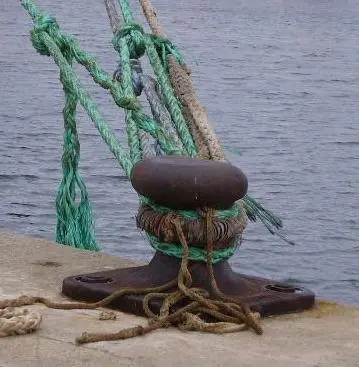
Volume 2, ‘Inspection and Maintenance’ by Walter Vervloesem looks at good – and bad – practice. On the latter, the volume has more than 530 useful colour photographs which shows many types of pitfall common to mooring operations.
As Captain Richard Coates, president of the NI, says: “There are now so many different designs of ships in use and they are getting larger. The forces acting on them are huge and need to be understood by today’s mariners and shore workers.”
A large contributory factor to mooring incidents has been the increase in scale, complicated by a lack of experience in the crew or staff to hand, according to the report’s author. One of the authors, Walter Vervloesem, adds that the situation is “a dangerous mix – and an accident waiting to happen”, adding that time pressure, lack of communication and leaner crews have also lead to poor practice.
In fact, he points out, that from over 800 ships inspected by the ICMS in the last four years, virtually none were mooring-defect free. Mr Vervloesem adds that the fact that there was so much evidence of bad practice is an indication of a real and serious problem – at every level.
Details are available from the Nautical Institute, www.nautinst.org.
Related Articles
 EQUIPMENT
 CONTAINER & CARGO HANDLING
 CONTAINER & CARGO HANDLING