![PortStrategy[GreenPort]](https://www.portstrategy.com/wp-content/uploads/2026/09/PortStrategyGreenPort.svg)




maintenance dredge main again
Lean times lie ahead for companies on the hunt for maintenancedredging work, with the real effect of the economic downturn nothitting their balance sheets until next year and beyond.
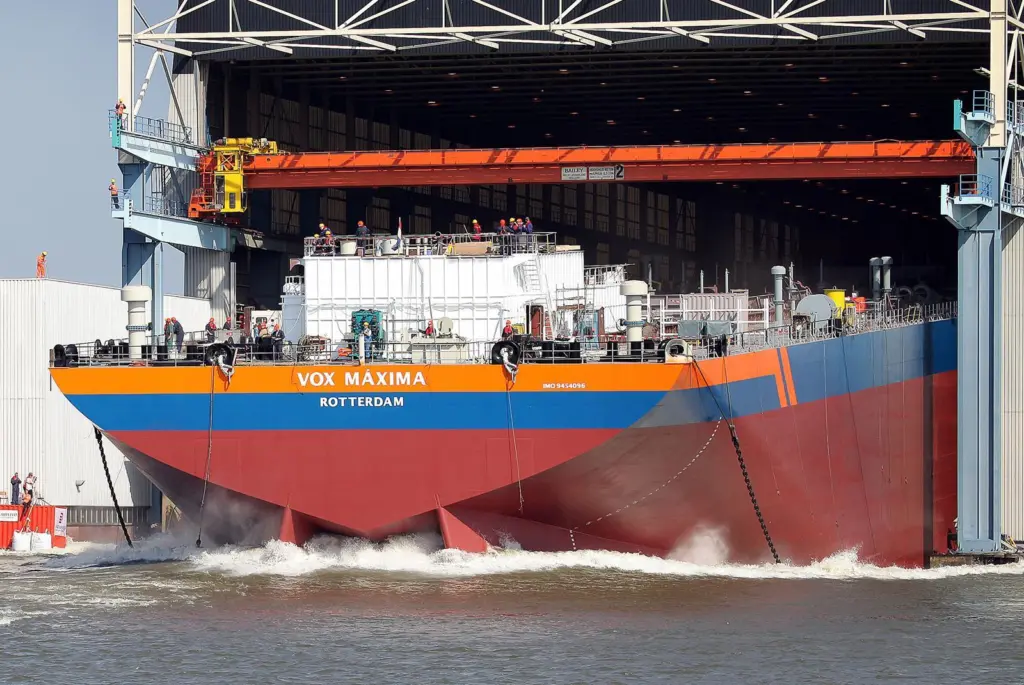
And that means there’s likely to be a fierce struggle to acquire work for vessels like Van Oord’s Vox Maxima and the hopper dredgers currently under construction for the Jan de Nul Group.
Jan de Nul made the decision to invest in two dredgers and a stone dumping vessel to increase its presence in world dredging, not only geographically, but also in terms of the work it could undertake. “This, in combination with a vessel replacement programme, is pushing us to acquire a larger stake of the market,” says a company spokesman. “Whilst the recent economical downturn has shed a somewhat different light on these decisions, we remain fully committed to it – but this implies that the struggle will be fiercer to acquire work for all these new vessels; a challenge indeed.”
Dredging clients, themselves clearly not immune from financial difficulties, are alive to the situation, and, understandably, are increasingly seeking to turn it to their advantage. “Ports know that a leaner period is coming. I heard of some large clients thinking about re-tendering large jobs hoping that lower prices will be obtained,” says the spokesman. Even so, he suggests that the best way for both parties to work towards a mutually-beneficial solution, in ‘predictable’ situations, would be a long-term contract – which could easily unlock a discount.
Although such arrangements are rare at the moment, they potentially represent the best solution for both client and contractor. “They will result in the most economical solution, but are possible only where the workload, siltation, etc are relatively predictable and calculable.”
That’s one front on which the coming decade is likely to be a tough one for dredging companies; another is identification of the solution to the expected challenge of compliance with ever-tightening environmental legislation. That’s a concern clearly not restricted to the dredging industry, which is likely to address it while resolving another area of concern – rising costs.
The solution to both, suggests Jan de Nul, is to use new and more efficient vessels. “Capital costs, crew, maintenance and repair can be minimised by using new and very efficient dredging vessels with a high level of automation. The more strict requirements concerning emissions, like NOX and CO2, will require very efficient and controlled use of power generated on board, and the way we generate this power.”
Related Articles
 EQUIPMENT
 CONTAINER & CARGO HANDLING
 CONTAINER & CARGO HANDLING