






Natures way
Stevie Knights looks at the latest innovations to keep channels and berths clear
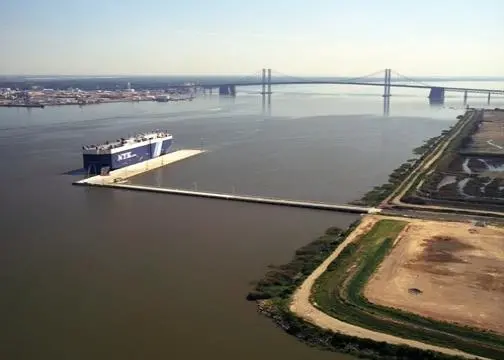
“What goes wrong with taking sediment out is that you can denude things like mud and salt flats. A lot of estuaries have a sediment regime fed by the sea so it’s better to nudge nature along a bit by picking it up from the channel you are trying to maintain and simply placing it further up the estuary.”
It’s a point shared by others. “All across the world now you have dredged material permit and licence requirements to meet, and these hoops are getting harder to jump through,” says consultant Anthony Bates. “It stands to reason that using clean sand, for example – and most maintenance dredge is fairly clean – to replenish eroded down-drift beaches instead of dumping it at sea would help everyone. After all, the very fact you are dredging in the area will probably be escalating their difficulty.”
Even so, both he and Mr Bray acknowledge that there are a number of environmental targets that the smaller organisations don’t have the resources to meet in order to do “the sensible thing” – and the fishing lobby has, according to Mr Bates, a loud voice.
However, there are lots more ways to minimise the sediment problem via water flow. Interestingly the manipulation of flows and in-situ management of sediment can be applied best to fine, cohesive particles. These were formerly thought of as being the most intractable, but now via technology and applied science, these ‘offer the greatest prospect for alternative approaches’ says engineering consultant Rob Kirby.
John Headland of Moffatt & Nichol explains that the methods fall loosely under three main headings: keep it moving, keep it out, or keep it navigable.
To keep silt moving on through usually means increasing the velocity in the deepened area which can be done through structural realignment or additions that help the water maintain its velocity. The Caribbean port of Barranquilla, which lies on the Magdalena River Delta, needed to maintain a 40-foot-deep access channel. “River-training” constructions consisted of a series of seven rock jetties aligned perpendicular to the flow of the river, which constrained the river to a single channel, increasing its flow and self scour properties.
Keeping the sediment out depends on a number of factors. While tidal exchange currents can’t be manipulated easily, things like horizontal eddy exchanges can be – and the same goes for density currents, the effects of which can be greatly underestimated as salt/freshwater currents can amount to a volume exchange unexpectedly greater than from tide or eddy exchanges.
Entrance flow systems – including current deflecting walls – have been proven in a number of places, such as Kohlfleet in the Port of Hamburg and at Deurganckdok in Antwerp as part solutions, which have drastically reduced penetration and trapping of suspended sediment in open tidal basins. The port of Bremen in Germany used an eddy deflecting structure at its entrance and found the sedimentation was reduced by 67%.
Scour arrays can also augment flow. These are located near the bed of the channel, and pump water through tubes at intermittent periods to keep the silt moving. While a scour system may be able to solve the problems of a lot of repeat dredging, it has to be affixed to a wharf, and it is particularly suited to facilities with swift currents running close to the port.
If, on the other hand, there’s more than a kilometre to swift current, its efficiency may be impaired as silt can drop out again where you don’t want it. Further, Nick Bray says some mixed results may be partially down to the cohesive nature of the sediment the systems has to keep moving.
However, while a scour system re-suspends the mud with a water jet, a water injection system is different in that it fluidises the mud which then can move some distance – especially if it’s a little downhill. Further, the water injection system is can be simply used a floating unit which can travel anywhere its needed – no wharf or current required.
Mr Headland says that Moffat & Nichol are presently looking at harbours on the Mississippi and Delaware rivers that could benefit by regularly pumping water in at the bottom to create a density current and shifting out the mud.
It’s attractive as the need for licenses has, in the past, disappeared if you don’t bring the dredge above the water – which means methods like water injection dredging have quite literally slipped under the surface. Mr Bray however says that the industry is generally moving toward a stance of ‘if you can’t say where it ends up, you can’t do it – unless of course you take the stance of do a little bit very frequently as you just keep everything moving.’
Mr Headland however is keen to see the results of tests on the sediments and water after being subject to trials. “We haven’t yet begun monitoring the sediment and water quality – that is, suspension of particles, turbidity and feedback between for example, the dissolved oxygen and the total organic carbon. However, I am fairly certain that studies and transparent testing will show no substantial effects other than in the very short term.”
Although there are discussions for and against water injection dredging, Mr Headland says “there’s an argument that says normally a river would keep water moving: since we have added a harbour that fills up with silt, a system that keeps it all going past, rather than it getting trapped inside the port, is a remedy, not a problem.”
The strategies aren’t new, but Mr Headland is hoping that in these days of environmental awareness, they may find a wider audience. “We have the ability to make ports ‘invisible’ to sediment and make them self-scouring,” adds Mr Kirby who has pioneered sediment-reduction methods. “Ships are getting bigger, handling is getting more efficient but waterside management has still some way to go – and an operation is only going to be as efficient as its depths allow.”
Related Articles
 EQUIPMENT
 EQUIPMENT