



Responding to ecological needs
Terex Port Solutions’ Klaus Peter Hoffmann discusses the need to meet a rise in environment awareness

‘Maritime trade volumes are likely to increase more than two-fold by 2030’…‘Oceans full of ships’; these are just a couple of the headlines adorning trade journals and daily newspapers highlighting the success within the port and shipping industry.
In comparison with road, rail and air freight, transport by water is a favourable option to deliver goods around the world, and as maritime trade grows, so do the ports and terminals that support this industry. As a result, there is growing concern regarding the ecological impact of the equipment used within these locations.
In many cases the ecological aspects of a port terminal solution are decisive. In a number of locations, concessions are only issued to terminal operators that can prove that the handling machinery they intend to use complies with stringent, locally applicable environmental legislation. Regulations of this kind exist all over the world as national or regional laws and regulations issued by port authorities. Self-imposed ecological restrictions set by terminal operators show how deeply embedded environmental awareness has become in this industrial sector.
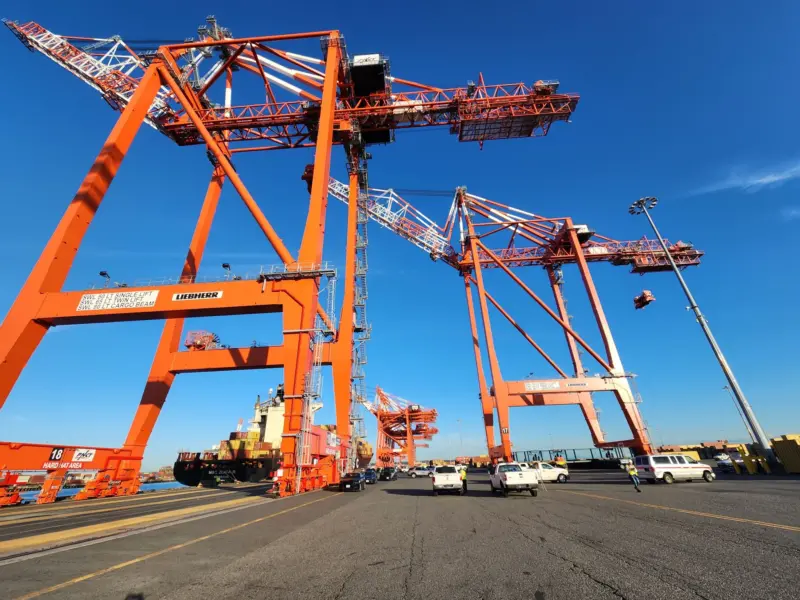
At an early stage, Terex Port Solutions (TPS) realised that environment concerns would influence our future and began focusing R&D activities to address these concerns. As a leading equipment manufacturer and technology provider to this sector of industry, TPS developed forward-thinking, environmentally compatible technologies to work in virtually every set of site conditions: from low-consumption hybrid drives to battery powered drives that generate no exhaust gases at all. This environmentally aware technology has been incorporated to certain models of our cargo handling cranes – including those for loading, unloading and storing goods – and to vehicles providing horizontal container transport.
To a large extent, customers express interest in drive technologies that blend efficiency with ecology, and many terminal operators now deliberately opt for our Terex Gottwald harbour cranes because of their electric drives. This drive method is ideally suited to hooking up equipment to external power sources, which is a favoured option with cranes already supplied by Terex Port Solutions in Turkey and Norway. New cranes ordered for these destinations are almost exclusively equipped for use with external power supplies while some older models have been retrofitted for this purpose.
Box boost
The same general trend applies to the development of container transport vehicles for ports and terminals. Over the coming months, we will be supplying a large number of battery-driven automated guided vehicles (AGVs) and Lift AGVs, which do not generate any exhaust fumes, to Rotterdam, The Netherlands and to California. Ten of our hybrid straddle carriers will soon be going into commercial operation in the Bahamas. Whether it is cranes, AGVs or straddle carriers, the cases referred to are evidence of the social awareness put into practice by our customers.
This change of thinking is accompanied by a further trend in our target markets. Since many operators are keen to implement terminals that are as green as possible – incorporating efficient, end-to-end processes – the demand for holistic solutions from a single source is steadily growing, including intelligent management, simulation and emulation software.
To help drive the development of innovative technology, Terex Port Solutions regularly participates in future-orientated pilot projects. We are currently managing a consortium project that is building and testing a prototype of a battery-powered terminal truck. In addition, together with Hamburger Hafen und Logistik AG (HHLA), we were awarded the Hanse Globe Sustainability Prize in Hamburg in 2011 for our battery-driven AGVs. At the time, they were being tested as prototypes and are now in demand in the market worldwide.
Klaus Peter Hoffmann is vice president and managing director of Terex Port Solutions, a business group within the Material Handling & Port Solutions business segment of Terex Corporation.
Related Articles
 EQUIPMENT
 EQUIPMENT