![PortStrategy[GreenPort]](https://www.portstrategy.com/wp-content/uploads/2026/09/PortStrategyGreenPort.svg)






Scans lead with new oil filtration process
Traditionally known for their green conscience, Scandinavians are constantly pioneering new ideas to make the world a greener place.
Ports such as Gothenburg, have for some time had a variety of policies in force to reduce emissions. This includes having all its new diesel powered trucks fitted with exhaust catalysts and particle filters; and using Vapour Recovery Systems (VPS) in the loading of petrol at the oil ports, whether this is to road tankers, rail tankers or sea tankers.
The VPS system has proved not only to decrease hydrocarbon emissions dramatically but has also given an overall recovery return as well. In addition, discounts are given on harbour dues if a ship burns high quality bunkers while in the port. This latter recommendation comes from the Swedish shipowners, Swedish ports and National Maritime Administration.
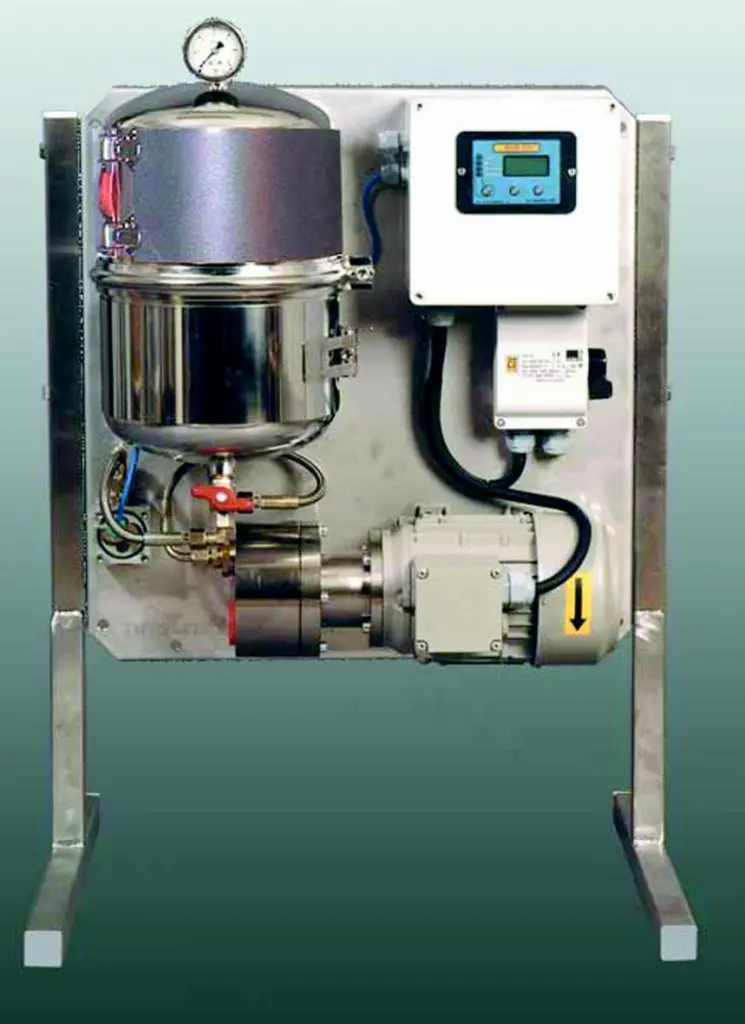
A company that is striving to reduce the problem of emission and at the same time promises operational efficiency of oil lubricated machinery such as gears, hydraulics, thrusters and diesel engines up to 6,000 bhp, is Europafilter AS.
Its patented product employs a new system of filtration. Its capillary cleaning system works on the same principle as that of a tree which pulls water from the roots and transports it up the trunk to nourish the leaves and foliage. The cleaning cartridge is made up of about 1.3bn cellulose fibres or tubes which are not round but actually square with rounded corners.
The way this paper is manufactured, these cellulose fibres are next to each other in the flow direction and not criss-crossed randomly as would be the case in on ordinary filter. The flow of oil through these tiny tubes is laminar, so that the parallel layers have different velocities of flow relative to each other.
This means that oil will be stagnant along the edges or the sides of the tube but will be flowing freely in the centre of it. Where the oil is stagnant the particles are absorbed and any water is absorbed by the fibre wall of the tube.
Since all oil has a mass of particles which increases in the particle content the more it is used, removing these particles, water and residues allows the filtered oil to have the same properties as new oil. “The technique filtrates down to 0,1 micron without harming or removing any additives from the oil or lubricant, ” explains Hans Storebo, vice president of Europafilter. “The main idea behind utilising this filter invention is to avoid costly breakdowns and minimise the impact of used oil both in nature and humans.”
In March 2004 Europafilter won the Scandinavian First Maintenance Service Award on the basis of the large savings it enabled its customer, Statoil, to make. The 5 gascompressor plants, each of 43 Megawatt capacity at Statoil Kollsnes Refinery in Norway made savings of approximately 5% or 11.2 Million NOK. Just eliminating oil changes, washing and flushing alone gave an annual savings 750000 NOK.
It is not however, only industrial plants that can utilise these filters. According to Europafilter, forklift trucks and other container lifting equipment too can benefit from its use. “It can keep valve functions stable, increasing safety. By keeping the oil completely clean, far beyond current standards it will give reduced consumption of oil, spare parts and pressure filters – in some cases up to 90%. Also, the pressure filters will have better operational conditions which means they will not be punctured or ripped apart.
And as the hydraulic system is kept dry and clean it gives the lubricant the possibility to function at optimal levels at all time, ” says Storebo.
Related Articles
 CONTAINER & CARGO HANDLING
 CONTAINER & CARGO HANDLING
 EQUIPMENT