![PortStrategy[GreenPort]](https://www.portstrategy.com/wp-content/uploads/2026/09/PortStrategyGreenPort.svg)



Simulation and scheduling tools a must for busy ports
Two maritime software tools – Amatis, used to undertake traffic simulations, and Seaberth, used for both berth scheduling and berth simulation – are being deployed as part of a major new port development in Qatar. Over the next 10-15 years, Ras Laffan Port will be transformed into the biggest liquefied natural gas (LNG) dispatch point for consignments to the US, the UK and Japan, while also implementing major new container and general cargo terminals.
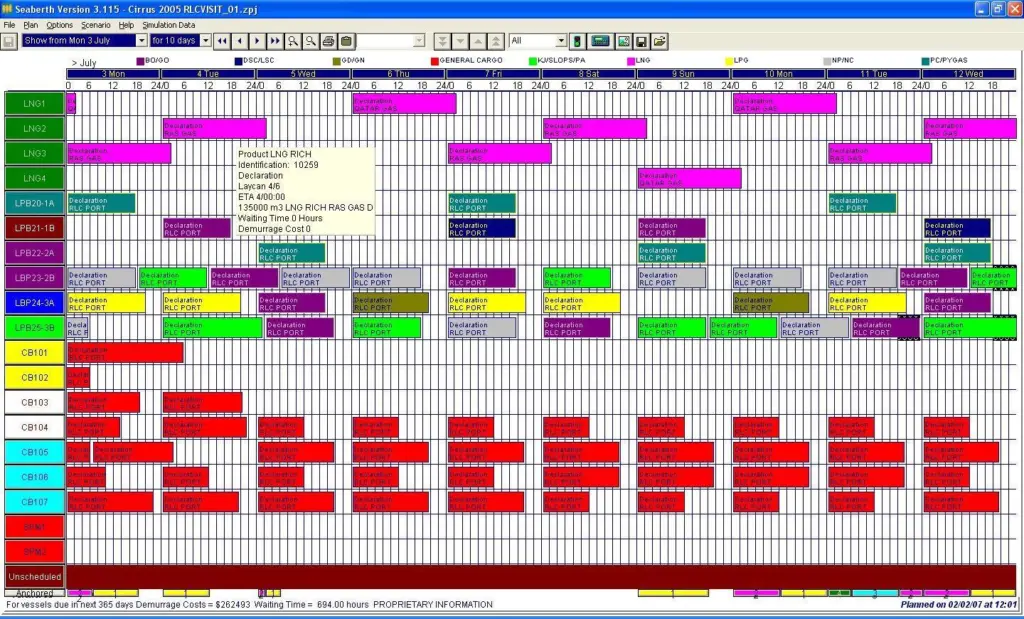
Kevin Hawes of software developer Cirrus Logistics says that initially, Amatis was used to study the prevailing rules of navigation to ensure that eventual vessel safety would not be compromised once the enhanced port became operational. Then, as part of a group led by Honeywell, an integrated software tool was developed to oversee management of the entire LNG supply chain. Cirrus Logistics was made responsible for berth scheduling and harbour management. The complete system is designed to tease out efficiencies all the way down the supply chain. As part of this, Seaberth has been used to forecast and schedule all vessel movements over time. Amatis, originally developed with marine consultant Eagle Lyon Pope, part of the Global Maritime Group, was initially deployed in Qatar on the port’s Phase I and II development. Personnel at Ras Laffan have subsequently been trained up and are now making use of the tool themselves using a run-time version of the software. This allows port managers to visit existing results and run additional scenarios where necessary.
Traditionally, many consultants have eschewed the use of such tools, preferring instead to undertake static analyses using spreadsheets. While this may well produce acceptable results in ports with manageable traffic flows, in extremely busy harbours a much more rigorous analysis is needed, implying the use of tools such as Amatis.
“A static analysis is unable to take fullest account of changes over time. With software, you can also introduce random or seldom seen events into the analysis. This gives a port a more robust, longer range projection of risk,” says Mr Hawes. “In fact, if one collision at sea can be avoided, then a port automatically recoups its initial investment on such software.”
A whole host of factors can force changes to traffic patterns in a harbour environment and Amatis can help model these. In Hong Kong, for example, it was used to analyse the impact of a land reclamation scheme on harbour traffic and to assist the port authority in planning new rules of navigation to safely deal with the new shipping scenarios generated.
However, for tools of this kind to be really practical, they must have flexible data entry mechanisms. Data must be easily transferable from existing databases and post analysis, end-user reports must be tailored to specific project requirements and not be simply generic in nature.
For its part, Seaberth combines the power of automated scheduling algorithms with an intuitive interactive planning board and an integrated simulation module for longer term “what if?” analysis. Both its modules are configured to incorporate all information and constraints pertaining to a port, its infrastructure and berthing tasks. The simulation module is used to allow the port to consider a whole range of potential future scenarios affecting berth operation, including changes to the traffic profile and/or berthing infrastructure.
“This tool aids existing controllers; it doesn’t replace them. It presents a suggested plan, which an experienced controller can then act on or adjust, thus ensuring the best possible berthing solution based on information available,” claims Hawes, adding that experienced controllers can therefore work more effectively, efficiently and safely, while taking into account all the multiple considerations that go into a berthing plan, including costs.
Crucially, the experience of outgoing schedulers can often be embedded into the tool, thereby ensuring that this is passed on to their successors. By making traffic management safer and more efficient, says Mr Hawes, ports will continue to save money.
“The standard by which ports can measure the success of such tools is to look at three indicators: the impact on throughput, reductions in demurrage costs and reductions in waiting time. Seaberth will help in all three areas.”
Related Articles
 CONTAINER & CARGO HANDLING
 CONTAINER & CARGO HANDLING
 EQUIPMENT