![PortStrategy[GreenPort]](https://www.portstrategy.com/wp-content/uploads/2026/09/PortStrategyGreenPort.svg)






THE INTELLIGENT NETWORKED SEAPORT
The seaport industry faces a multitude of pressures. These competitive forces arise from a variety of sources and for a variety of reasons.
Taken together, they create a business environment in which all aspects of seaport operations need to provide maximum efficiency alongside optimal security, as wireless network solutions provider LXE explains.
New ports are opening to challenge established operations.
Shipping companies need to move cargo as fast as possible in order to maximize the efficiency of their operations.
However, increased concerns about security and tightening customs procedures mean that the speed with which cargo can be moved is inevitably compromised.
Such delays can be costly. In order to minimise their impact, and to create efficiencies that can counteract the effects of additional security, it is vital that the information flowing around a port, between a wide range of employees and clients, both at dockside, at head office and at sea, is in real time, and available over a flexible, adaptable and secure network.
In addition to these pressures on their businesses, seaport operators need to find ways to increase their revenues by offering additional, value-added services to their customers.
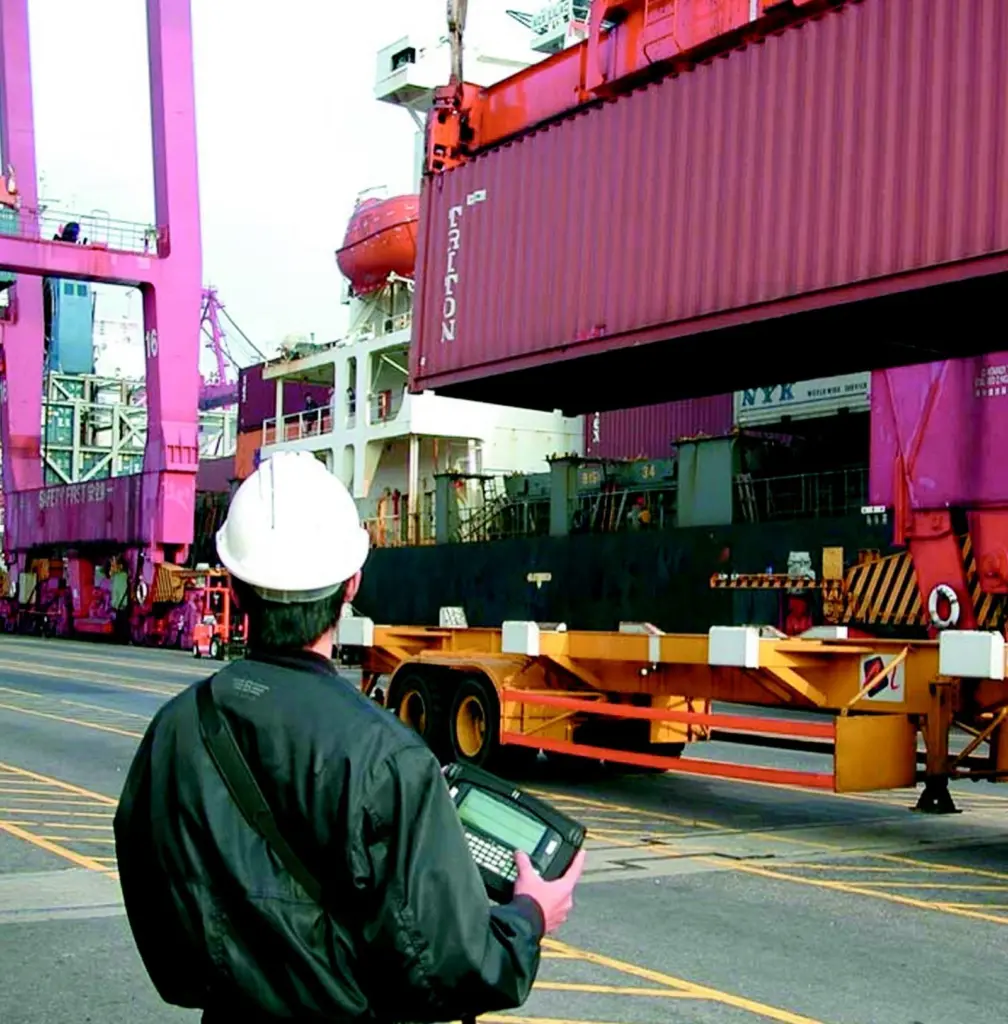
Information plays a vital role in the way all employees need to engage in seaport operations. For example, connecting the roaming yard worker with a mobile IP telephone extension allows traditional voice communication to be coupled to his wireless container scanner system and thus any anomalies can be addressed by connecting both the scanned data and voice conversation back to the head office. The Internet, and specifically IP, has long been recognized as a medium that can improve the flow of information, whether this is via data, voice or video.
BUSINESS CHALLENGES Because seaports face growing competitive pressures and increased security requirements, seaport managers must explore ways to meet a number of key challenges. These include:
Optimizing the movement of cargo – ensuring that containers, personnel, ships, trucks, and rail traffic move in and out of port as efficiently as possible.
Maximizing the mobility and productivity of personnel by enabling them to access data and communicate with each other from any point in the facility.
Monitoring security throughout the port, screening the port and its perimeter, as well as containers, ships, trucks, rail cars, and personnel entering or leaving the facility Complying with EU regulations and communicating efficiently with the Coast Guard, Customs, and the Immigration and Naturalization Service Promoting tenants’ satisfaction by providing an efficient operating environment and value-added services Unifying and upgrading the facility’s communication systems for greater operational efficiency IP SOLUTIONS TO DELIVER OPERATORS’ GOALS The challenges outlined above require seaport operators to develop more collaborative working methods and systems. At the same time, competitive pressures mean that they must achieve this without adding to their operating costs that would erode their profitability.
Maximizing revenues is also a key business objective for seaport operators. By using a secure and adaptable IP network, operators can allow third parties to have access to services and information. An open standards-based communications infrastructure enables seaports to operate more efficiently and support new security initiatives.
THE BASICS OF RF One of the key technological enablers for seaports is Radio Frequency Data Communications. RF is the abbreviation for Radio Frequency Data Communications (= wireless communication). This refers to the wireless transmission of data by means of digital radio signals at a particular frequency. RF maintains a bilateral two-way, on-line radio connection between a mobile computer at the workstation and the host computer. The mobile computer is used for collecting and displaying the data. Such a mobile computer can be portable but can also be mounted on a forklift truck. The host computer can be a separate warehouse host computer (eg a PC), a mini-computer or a much larger mainframe.
The only way to meet today’s supply chain demands is to have 100% goods flow control and traceability. RF should therefore be understood as the concept encompassing all the elements of wireless communication for real-time intermodal, logistics and manufacturing management. RF is indeed critical for the management of the large quantity of information associated with the flow of goods.
THE RIGHT TECHNOLOGY TO CREATE REAL TIME WORKING Wireless LANs being installed today in ports and container terminals form a transparent extension of their wired counterparts. They are based on the 2.4GHz IEEE 802.11 standard. The greatest advantage of this bandwidth is that graphics-based applications are possible.
This opens the door to a range of other rich media applications. These include voice input (Wireless Voice over IP); paging and Web-based information displays; the incorporation of cost effective devices such as laptops, desktops and printers, Global Positioning Data Systems, Internet Protocol Wireless Video Surveillance (CCTV), all on a single converged network. It also allows building-to-building links without having to dig up the dockside.
Many of the operations and administration carried out in seaports are either paper-based and manual or reliant on proprietary systems that are unable to communicate effectively with other systems. This creates silos of information and a lack of connectivity that can hamper efficiency and create problems. Those problems cost time and therefore, ultimately, money. With real time data access and management, real efficiency gains are available from the start.
In the seaport, security refers to both the security of the network and the physical environments. Security of the network is vital and in a wireless environment the protection against unauthorized intruders is as essential as the precautions that need to be taken to ensure that the physical area of the seaport remains unbreached.
SECURITY OF THE WIRELESS NETWORK & THE BUSINESS BENEFITS As a port is an open, outdoor environment, to which many people have access, great care should be taken when installing a wireless LAN.
Standard security measurements as provided with the 802.11b/g/a wireless LAN systems cannot be considered secure enough to allow essential confidential data to be transmitted. LXE’s wireless networks can be constructed using the latest security mechanisms:
IEEE.802.1X based authentication, with mutual authentication. So, the client (the radio data terminal) authenticates the access point and the access point authenticates the client, in combination with dynamic, per user, per terminal, per session encryption schemes to offer an appropriate security level.
There are many business benefits of increased security. Not only are customers assured that their cargo is more likely to arrive intact, but there are gains to be made in efficiency and administrative simplicity:
Increased operator and management efficiency Simplified methods of operation Corporate governance and accountability Risk avoidance Insurance cost reduction Lowering of operational and procurement costs Consistent structured response to incidents High level policing and control.
VIDEO-ENABLED NETWORK SYSTEMS Many seaport operators use fixed analogue video systems with copper cables for transmission of images to a central monitoring point. Though they are of proven benefit in ensuring that more areas of the yard can be covered than with patrols or other means of surveillance, they remain limited in their use, as they operate along a fixed system. As more cameras are required to provide greater coverage, each one has to be installed to the present system, which is both expensive and ultimately limited by the capacity of the analogue system. Digital cameras attached to an IP network create an infinitely more flexible and scaleable surveillance solution. Both fixed and portable cameras can be added to an IP network with ease and with minimal additional cost.
One solution is Cisco Intelligent Networked Seaport (CINS), a strategy to turn seaport operators’ information and network systems into a strategic asset that provides them with a competitive edge. CINS is designed to protect, optimise and grow existing infrastructures.
Advanced technologies like wireless, IP telephones, storage, and video can be added as required to gain improved collaboration and so raise efficiencies and effectiveness across the entire seaport operation. CINS ensures that investments in any IT network and solutions environment become a strategic asset and a self-protected, sustainable competitive advantage for the seaport value chain.
This paper was contributed by LXE International. www. lxe. com/us
Related Articles
 CONTAINER & CARGO HANDLING
 CONTAINER & CARGO HANDLING
 EQUIPMENT