![PortStrategy[GreenPort]](https://www.portstrategy.com/wp-content/uploads/2026/09/PortStrategyGreenPort.svg)


Tractor automation push
Autonomous terminal tractor solutions are proliferating with various trials of new models underway and benefitting from hi-tech partnerships
SECTOR ANALYSIS: AUTOMATION A PRIMARY DRIVER FOR BUOUYANT TERMINAL TRACTOR SECTOR
The terminal tractor market is experiencing rapid growth and playing an important part in fostering this is the growing need for automation.
According to ResearchAndMarkets.com’s Terminal Tractor Market Analysis and Forecast 2024-2034 report, the terminal tractor market is valued at US$1.48 billion in 2024 and is projected to expand at a CAGR of 6.31%, reaching US$2.73 billion by 2034.
Terminal tractors are essential for efficient container transfer operations between quay and stack, additional transfer operations and in the context of modern design generally promoting terminal efficiency. As trade volume builds in an increasingly digital world, the requirement for advanced terminal tractor designs becomes increasingly critical. As the report underlines: “Technological advancements, such as automation and telematics, are further enhancing the efficiency and safety of terminal tractors, making them more attractive to operators.”
Furthermore, the development of smart ports and digital infrastructure is also boosting the demand for advanced designs. Their ability to integrate with port management systems is a path to optimising performance, reducing downtime and proactive risk mitigation for safer operation. In the latter respect, the terminal tractor market analysis highlights how this is, “leading to the adoption of high-tech safety systems in terminal tractors. Features like collision avoidance, 360-degree cameras, and automated emergency braking ensure safer handling of goods in busy terminal environments”.
The discussion below of the recent activities and plans of leading terminal tractor suppliers places a major focus on the rapid advancements and innovations with the automation of terminal tractors.
DATA ANALYSIS, PILOTS, R&D, COLLABORATION AND RECENT UPTAKE
FERNRIDE – Safety Plus: The Germany-headquartered company is boosting the reliability and security of its autonomous terminal tractor by deploying QNX® OS for Safety. FERNRIDE has originated an autonomous terminal tractor solution, developing a path towards compliance with the European Machinery Directive and EU Declaration of Conformity in the field of autonomous logistics. With foundational embedded software from QNX – a division of Blackberry Limited- FERNRIDE is accelerating its development efforts to move closer to these milestones. “Safety is a non-negotiable priority at FERNRIDE,” says John Hughes, Senior Engineering Manager, FERNRIDE. “As a next milestone, we will remove the safety driver from the cabin of our autonomous terminal tractors to unlock the path to scaling with our customers. To do this, we need to authoritatively prove that the entire system is safe. Choosing a certified operating system means we are able to shorten the timeline for getting the entire technology stack for our solution certified.” Using QNX OS for Safety meant FERNRIDE could meet the high standards of functional safety and focus their efforts on innovation, instead of certifying their operating system.
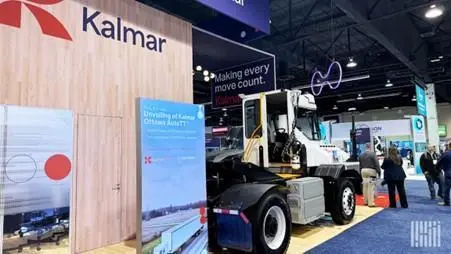
Kalmar – Forterra Partnership: Kalmar and Forterra have announced a partnership to develop an autonomous terminal tractor solution for container terminals. The companies have signed a joint development agreement for autonomous terminal tractor solutions. US headquartered Kalmar will be responsible for developing the automation-ready terminal tractor – including the drive-by-wire solution integration – as well as the Kalmar One fleet management system to manage the operation of automated terminal tractor fleets. Forterra will be responsible for the integration of its AutoDrive® platform for autonomous operations. The AutoDrive® system is a driverless system aimed at complex conditions including ports and logistics centres. “Our goal in this partnership is to develop a true integrated system that provides the customer with a single point of contact for systems, safety and performance optimisation, as well as scalability to full-size logistics operations,” says Mike McGhan, Head of Commercial Logistics, Forterra. The autonomous solution will be available for the Ottawa T2 and Kalmar T2i terminal tractor models, as well as the respective battery-powered models once they are on the market. The Kalmar Ottawa T2 AutoTT will be available in 2026 followed by the Ottawa T2EV AutoTT and Kalmar T2EV AutoTT.
MAFI – Pilot Projects: An Autonomous Terminal Tractor (ATT) proof-of-concept has been launched at Wilhelmshaven Container Terminal, Germany by system supplier MAFI. The company teamed up with container terminal operator EUROGATE, provider of autonomous driving solutions Embotech and industrial technology solutions provider ICT Group for the six-month project to showcase the next phase of autonomous operations in port environments. The project deploys MAFI’s T series as a base vehicle, powered by Embotech’s Level 4 AV-Kit, while ICT Group’s SmartECS will integrate the equipment with the Eurogate systems. Key benefits include the ability to navigate complex mixed-traffic environments, execute precise reverse driving with 5cm accuracy, and detect obstacles in any weather, ensuring smoother and safer operations. The system was tested successfully in landside operations in Rotterdam and has now expanded to waterside operations, providing integration with quay cranes. All relevant vehicle functions of the MAFI terminal tractor can be controlled externally via a specially developed drive by-wire interface. Another key aspect of the project is the testing of an IT integration between Embotech’s Fleet Management System PROFLEET and ICT Group’s Equipment Control System (SmartECS). This integration will allow co-ordination between the autonomous tractor and existing terminal operations, providing real-time data exchange for efficient container handling.
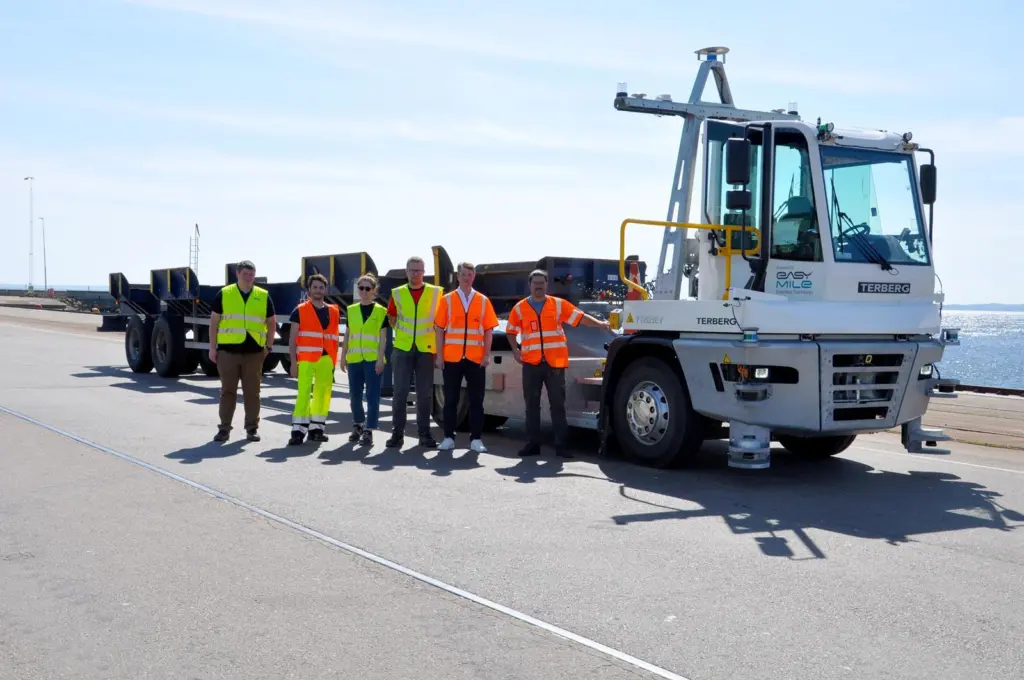
Terberg – Testing Time: The Port of Helsingborg is testing an automated tractor in the port’s container terminal. The goal is to investigate the autonomous system’s maturity level and identify the technical challenges. The project’s results will serve as a basis for equipment selection for a new container facility that the Port of Helsingborg aims to implement around 2030. Driverless technology provider EasyMile is conducting the deployment in collaboration with terminal tractor supplier Terberg. This long-standing partnership has seen Netherlands-headquartered Terberg develop a ‘Drive By Wire’ terminal tractor designed for autonomous and teleoperated driving. EasyMile and Terberg are using a vehicle that resembles the port’s existing tractors. The EZTug tractor is operated on a 2-kilometre route connecting Ship-to-Shore (STS) cranes with areas designated for stacking import and export containers. EZTug is equipped with a range of redundant sensors that provide monitoring of its surroundings. This allows it to safely navigate the port environment, calculate the speed and direction of moving objects, and act accordingly. It can stop under STS spreaders with less than 10cm longitudinal precision and 0.5cm lateral precision, ensuring that container transfers are executed efficiently and without the need for corrections from the STS cranes. This precision maximises operational efficiency and reduces downtime. Recent uptake: Terberg together with Emboteach AG has signed a cooperation contract with APM Terminals Maasvlakte II (MVII), for the supply and entire implementation of 30 automated electric terminal tractors. The new fleet of automated terminal tractors is expected to enter service in the first quarter of 2027. This project follows a pilot at APM Terminals MVII, after which the all-new autonomous technology was deemed ready for safe and solid large-scale deployment. The ATTs are equipped with Embotech’s Level 4 AV Kit, which allows them to operate autonomously in complex and mixed traffic situations.
Westwell – Q Truck Roll-Out: Hutchinson Ports has introduced a fleet of electric autonomous terminal tractor units into mixed traffic container terminal operations – understood to be the first port in Europe to do so. The first batch of 34 battery-powered units were delivered last year, supplied by Hong Kong’s Westwell. Port of Felixstowe and Westwell have signed an agreement for a total of 100 battery-powered autonomous Q-Trucks with battery swapping facilities. Hutchison Ports first introduced Westwell’s Q-Trucks in Thailand’s Laem Chabang Port in 2020. Fifteen Q-Trucks run in mixed mode operation with no separation from other traffic and have handled over 334,000 TEU moves since their introduction. The tractors use a digital map loaded to a fleet management system, which controls the navigation around the terminal. The tractor then combines that map with its onboard GPS navigation to track its real-time position. They use LiDAR, a light sensing technology that creates a 3D map of a tractor’s surroundings using a laser and receiver, which, when combined with its onboard 360-degree cameras, provide real-time, all-round ‘vision’. With the support of an extreme precise position (EPP) system, the tractor can achieve positioning accuracy of 2cm and a steering angle accuracy of 0.5 degrees.
ZF Mobility Solutions – Retrofit Solution: ZF and Aidrivers have agreed on a strategic cooperation to retrofit terminal tractors for autonomous operations. AI enabled autonomous mobility company Aidrivers will focus on the supply of an autonomous driving (AD) software ecosystem. Germany’s ZF Mobility Solutions will be the engineering partner for the integration, validation and deployment. The converted vehicles can be used in mixed traffic operations without special lanes for on-yard logistic solutions. This means that port operators can benefit from enhanced terminal safety and efficiency using modern advanced autonomous technologies. “Based on our long-term expertise in autonomous driving systems, we are delighted to now also operate successfully on the market as a mobility solutions provider,” says Alexander Makowski, Head of ZF Mobility Solutions. “In addition, we will leverage the ZF Group’s entire expertise in vehicle technology, for example in the electrification of the drivetrain and vehicle motion control. And together with our global aftermarket organisation, we will provide state-of-the-art customer service directly on site.”
Related Articles
 CONTAINER & CARGO HANDLING
 CONTAINER & CARGO HANDLING
 EQUIPMENT