![PortStrategy[GreenPort]](https://www.portstrategy.com/wp-content/uploads/2026/09/PortStrategyGreenPort.svg)





Era of the eRTG
As terminals come under greater pressure to cut their carbon footprint, their efforts to reduce the environmental impact of handling equipment are growing commensurately.
SECTOR ANALYSIS: eRTG SYSTEM OPTIONS AND APPEAL WIDEN
Rubber-tyred gantry cranes (RTG) are a key focus as they are one of the major sources of CO2 emissions in container terminals. Indeed, Corvus Energy notes that approximately 20 per cent of diesel fuel emissions from cargo handling operations at terminals are emitted by RTGs and container handling equipment such as automated guided vehicles. New RTG orders are thus increasing for either hybrid or fully electric options, while, as is featured in the company information below, the market is also ripe for diesel- powered RTGs to be converted to electric operations. As well as a quest to make RTGs more environmentally friendly, a key driver is that in deploying eRTGs, terminal operators also benefit from greater operational efficiencies, reduced overall energy consumption and a decrease in maintenance costs. New battery- powered solutions for RTGs promise to further boost take-up. While RTGs using the electric grid can be a challenge for some terminals due to the need for additional infrastructure such as motorised cable reels or conductor rails, new battery-powered solutions for RTGs being launched, which do not require this, provide another alternative.
DESIGN ADVANCES, POWER COST REDUCTION, CONVERSIONS
Cavotec: Cavotec is focused on designing electrification solutions to enable the decarbonisation of ports.
As part of this, it provides RTG electrification solutions that range from manual connection to front-end automated technologies. The Cavotec Automatic Plug-in System (APS) automates the connection and disconnection of the cable reel powering the eRTG and is available for low and medium voltage applications with fibre optics. Apart from the environmental benefits, other advantages cited include higher average and peak productivity, flexibility in handling varying volumes and reduced maintenance expenditure. Cavotec says that its manual connection is ideal for terminals with a low number of daily eRTG movements between different blocks. Here, it says that its power units and Double Anchor Openable System ensure rapid and safe manual connection and anchoring operations.
Recentup-take: Cavotec was involved in a milestone eRTG conversion that was completed last year after nine ZPMC diesel-electric RTGs were converted to be fully grid-tied electric at SSA Marine’s Port of Long Beach Pier J terminal. SSA Marine notes that “This is the largest deployment of eRTGs in North America and represents 100 per cent of the RTG fleet at the Port of Long Beach Pier J terminal.” Cavotec supplied the conversion equipment.
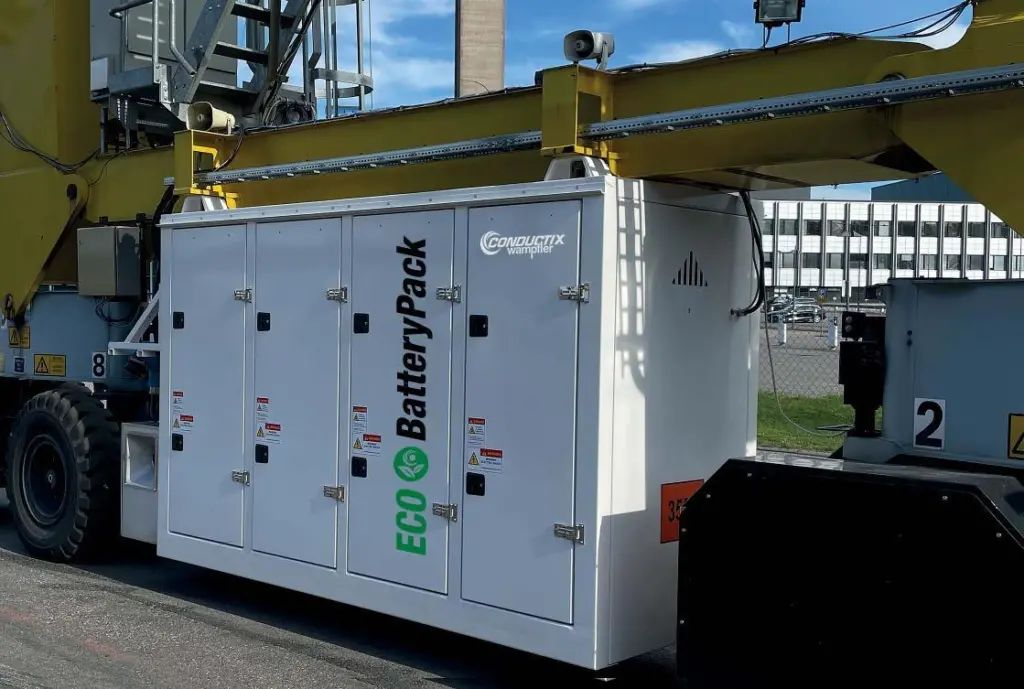
Conductix-Wampfler: Conductix-Wampfler has launched an ECOBatteryPack for RTGs – which it calls a “game- changer” for the port industry. The company, which provides sustainable energy solutions for mobile port equipment, says that its new battery-hybrid solution consists of a medium-sized Li-Ion battery system that drives all crane operations and a small size diesel genset that charges the battery when necessary. The system ensures that the regenerative energy produced during container lowering is fully utilised to also charge the battery. With approximately 30 moves without the need for a genset when fully charged, container terminal operators can, it is claimed, achieve up to 60 per cent fuel savings compared to conventional genset usage. Conductix-Wampfler highlights that unlike electrified systems using grid power, the battery-hybrid solution does not require extra yard infrastructure like motorised cable reels or conductor rails. ECOBatteryPack’s small diesel genset automatically starts when the battery state of charge reaches the lower limit. This ensures that the RTG’s normal operation is not interrupted when the battery is charging.
Philipp Wasmer, Global Market Manager, Container Handling, at Conductix-Wampfler underlines: “The ECOBatteryPack Battery-Hybrid Solution is a game-changer for the port industry. It provides an unparalleled combination of efficiency, flexibility, and sustainability, all while maintaining full operational flexibility.”
Corvus Energy: Corvus Energy has seen an increase in the use of its Energy Storage Systems (ESS) to power hybrid RTGs. The energy storage solutions supplier notes that hybrid RTGs powered by its Orca ESS run primarily on battery power, leading to a reduction of fuel consumption of approximately 65 per cent, along with a reduction in noise. The system stores regenerative braking energy captured as the RTG crane lowers a container—a high- current charge that most battery systems cannot sustain, Corvus says. The stored energy is used to power the RTG crane during operations such as trolley and gantry movement, allowing the diesel engine to be shut off when it would traditionally be idling or operating inefficiently at low loads. This means that the size of the generator can be smaller, used less often and its operation optimised for fuel efficiency.
Liebherr: Recent orders for Liebherr highlight the growing trend to install both new hybrid RTGs and convert existing machinery. In March this year, the Baltic Hub, formerly DCT Gdansk, commissioned Liebherr to retrofit a hybrid green energy storage solution on one of its Liebherr RTGs. This initial purchase will allow the Baltic Hub to assess the technology with a view to further retrofitting its fleet of 18 Liebherr RTGs with the system. At the heart of the solution is the Liduro LES 200, a capacitor system developed by Liebherr-Electronics and Drives GmbH. The system is designed to capture and store energy generated during hoist lowering and braking that would otherwise be wasted. The stored energy is then deployed during the hoisting cycle to reduce the overall demand on the genset, allowing for a reduction in fuel consumed and in emissions. Liebherr notes that this technology means that the “RTG crane will have access to reliable, high-power energy during peak demand periods”, with the retrofit leading to over 30 per cent reductions in emissions and fuel consumption. Other benefits include cost savings by reducing running and maintenance expenses. The Liduro LES 200 is also part of a new order for a new hybrid RTG from Doyle Shipping Group, at Dublin Port. As well as hybrid solutions, a full electric RTG is available from Liebherr. This can be fitted with a full diesel genset, auxiliary generator or a connection for a portable generator to allow movement between the stacks.
Kalmar: Cargo handling solutions provider Kalmar launched a new generation of its RTGs in 2021 that covers five models, including the Kalmar Zero Emission RTG and Kalmar Hybrid RTG. These models have a “stronger, lighter and simpler modular design with intelligent features, creating an even more highly productive and eco-efficient container-handling solution,” notes Kalmar. The Kalmar Zero Emission RTG features a fully electric power system that produces no emissions or engine noise at source and eliminates the need for hydraulic oil. A benefit is that its simplified design means it requires “significantly less” maintenance than a diesel-powered RTG. Available with either a busbar system that is situated along the stack or a cable reel system mounted on to the RTG frame, both systems allow a “seamless flow of power and data to be transferred form the RTG to other systems”. It has the ability to support variable input voltage levels and has an optional onboard battery system for stack changing. Regenerative power is used to keep these optional auxiliary Li-on batteries charged for use when needed.
Konecranes: Konecranes’ ‘Ecolifting’ vision is aimed at reducing CO2 emissions of its container handling equipment, and its eRTG solutions form a major part of this concept. Having started with offering fully electric RTGs with a choice of cable reels or busbar systems, and hybrid systems, Konecranes has launched a battery-driven RTG (B-RTG). Explaining the drivers behind this development, Konecranes said: “Seeing the global “battery megatrend” gathering strength in a worldwide effort to reduce CO2 emissions, Konecranes is now the first to offer a battery driven RTG as part of Ecolifting. While eRTGs powered via busbar or cable reel systems require yard infrastructure adjustments that are not feasible for all container terminal operators, the B-RTG “can be adopted easily by brownfield container terminals without major yard adjustments,” the company says. The technology can also be retrofitted to other brands of RTG. The B-RTG uses Li-on technology that works either with a charging station or with manual plug-in to the mains for charging.
Recent up-take: Konecranes has supplied the Port of Koper in Slovenia with three eRTG cranes as part of its Ecolifting concept. Featuring an auto plug-in system and cable reel systems, they will feed regenerative power back to the local grid. The company has additionally signed an agreement with PSA Halifax for eight new eRTGs.
This purchase will replace the existing fleet of diesel front end loaders and reach stackers in order to transform the Atlantic Hub terminal into an all-electric RTG operating environment.
Related Articles
 CONTAINER & CARGO HANDLING
 CONTAINER & CARGO HANDLING
 BULK HANDLING