![PortStrategy[GreenPort]](https://www.portstrategy.com/wp-content/uploads/2026/09/PortStrategyGreenPort.svg)





MOBILES: GROWING IN THE WIND
John Bensalhia investigates the development and operation of mobile harbour cranes for the growing task of wind turbine component handling
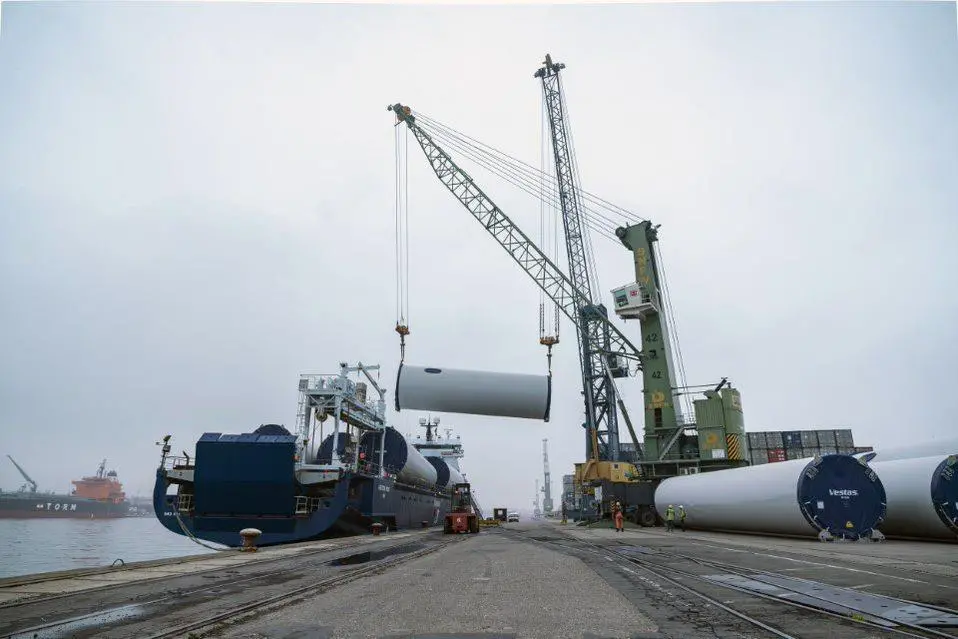
Ports and terminals are setting their sights on the off shore wind industry, a sector that continues to grow. Given the increasing scale of the wind power industry, port interests are looking to use the best quality mobile harbour cranes that can efficiently handle bulky, heavy wind turbine components.
A recent report from WindEurope says that with massive expansion throughout Europe of offshore wind farms, investment in this field is a necessity. Power output levels are predicted to grow from 25 GW to over 400 GW by 2050. With that in mind, the report estimates that €6.5bn worth of investment will be required into port infrastructure by 2030. New infrastructures will be needed for new berths, heavyduty quay and general work-space as well as supporting supply-chain facilities.
Giles Dickson CEO, WindEurope, points out that ports are essential for offshore wind as they are a crucial element of the supply and logistics chain needed for “the installation, assembly, operation and maintenance of offshore wind farms.
“Ports are perfect hubs for green energy. The offshore wind supply chain is often located in or around ports. Ports are then integrated into wider industrial ecosystems, and they will play a key role in the decarbonisation of, for example, chemical plant and refineries in coastal industrial clusters – through the renewable energy for which they serve in a hub capacity”
Typical of the response of ports to meet wind generated energy requirements are the following prohects:
- The Port of Tyne, UK: is to become the base for large-scale offshore wind farm, the Dogger Bank project. Over the course of a six-year plan extending from 2020 to 2026, the project is due to be implemented in three 12 GW phases, with the ultimate aim of generating around five per cent of the country’s electricity requirements.
- Forth Ports, UK: plans are underway for the UK’s Forth Ports’ Port of Leith to establish itself as a renewable energy hub. Central to these are a riverside marine berth for accommodating offshore wind installation vessels, and an upgrade of a 140-acre cargo handling site.
- Port of Amsterdam, The Netherlands: This year will see the completion of the new energy port, Energiehaven, being developed by the Port of Amsterdam, With work having commenced on the 15-hectare area in 2020, Energiehaven is due to be completed by May 2022. It is intended to play a major role in the construction of offshore wind farms in the North Sea. The facility is strategically located in front of the sea locks in Ijmuiden.
ADAPTING TO DEMAND
While the concept of wind power is by no means new, port interests are progressively responding to the sector’s growing demands. The Port of Antwerp notes:
“For more than a decade, we have been handling cargo for the production of renewable energy such as wind power. During that time, the global wind power market nearly quadrupled. As the market has grown, so has our expertise. There is no one-size-fits-all for this type of cargo: each load consists of motors, hubs, blades, tower sections, and nacelles.”
At a cargo handling systems supply level mobile cranes are a primary machine for over the quay handling.
Sebastian Simon, Product Manager, Liebherr Mobile Harbour Cranes, notes that typically the weight of the nacelle to be loaded can be several hundred tonnes. “For this purpose,“ he says, “our LHM 800 is the perfect solution. It is possible to lift up to 616 tonnes (on rope) with two LHM 800 units in tandem operation.”
He gives the examples of the LHM 800 in service in the port of Esbjerg or the Lindø facility in the port of Odense, a facility located between the North Sea and the Baltic Sea, providing handling facilities to the burgeoning offshore wind industry.
Carsten Aa, CEO, Lindø, explains that the company’s purchase of the LHM 800 is designed to cement its, “key role as one of the world’s largest port players in the green transition with unique production facilities for future offshore wind turbines.” With the increasing size of this plant, the port can now “continue to contribute to facilitating green workplaces within sustainable energy production,” he says
LARGEST AND MOST POWERFUL
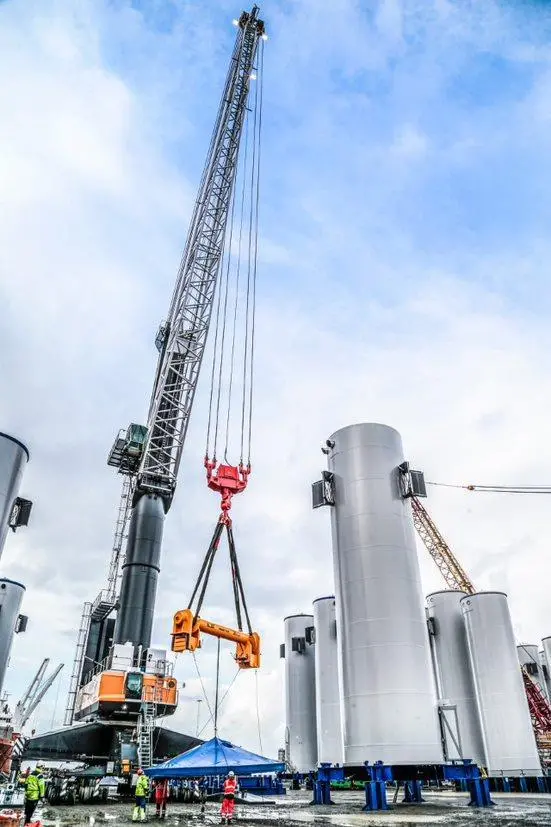
Liebherr suggests that the development and launch of the LHM 800 represents a clear signal to the market: “The LHM 800 is the largest and most powerful mobile harbour crane in our portfolio. The machine meets the ever-increasing demand for mobile heavy-duty cranes in the maritime sector. A key driver of the development of this unit is clearly the wind industry.”
“In a special heavy-duty version, the LHM 800 is capable of transporting weights of up to 308 tonnes on the ropes,” elaborates Simon.
Konecranes Gottwald mobile harbour cranes have a maximum lifting capacity of 200 tonnes, and with two cranes in tandem, this can double the load capability to 400 tonnes.
The company’s Generation 6 range of mobile harbour cranes includes an electric drive which is designed to provide affordable, efficient and environmentally sound operations. As well as a high lifting capacity, the Generation 6 mobile harbour cranes include a 360-degree working range, a useful feature when handling bulky wind turbine components.
Another key factor in wind turbine handling is support.
The Mammoet Wind Turbine Maintenance (WTM) 100 and Wind Turbine Assembly (WTA 250) cranes are examples of using the turbine tower as a point of support, so that the cranes can both manage the turbine components and raise and lower these at greater heights. For the WTM 100, this is connected to two pre-fitted hoisting eyes, allowing for the ability to pull itself up and load up along the turbine using the tower for support. As a means of keeping steady during operations, this machine includes claws that can wrap around the tower. Meanwhile, the WTA 250 (developed in conjunction with engineering firm, MECAL) is installed on a guide rail running along the lower section of the turbine, which can then lift the next section using the tower as support. The process is repeated as the crane pushes itself up along the guide rail for the remaining turbine sections.
An advantage of these cranes is their compact size, which means that they can be easily transported and relocated to the site of operations.
In terms of a step-by-step handling process using a mobile crane to discharge wind turbine cargo from a vessel, the Port of Antwerp says that the handling process is a “two-way street” between the crane operator and the dockers working on both the ship and on the quay. Both parties work closely together, with the crane operator keeping a careful eye on the operations below via the computer monitor screen.
This ‘double co-operation’ is mirrored in the horizontal twin lift of two cranes, a precise synchronicity of movement for unloading the blades and tower sections of the turbine. The Port of Antwerp underlines that this is very precise damage sensitive work:
“When lifting a component, the crane operator has to do all he can to avoid collisions, as the cargo is very sensitive to damage. Twin lifting requires a lot of co-ordination: it’s not a job every crane operator can do. You need a dedicated and experienced team that’s familiar with handling sensitive cargo.”
THE SYCRATONIC OPTION
Liebherr mobile harbour cranes are able to operate safely in tandem with this promoted by an ‘intelligent’ Liebherr system called Sycratronic. This is a computerised assistance system for operating two cranes with one crane operator.
“This makes the system not only ideally suited for tandem lifts of turbines over 500 tons, but is also ideal for handling rotor blades, which ‘in the offshore sector can be over 80 metres long,” says Liebherr. “Sycratronic speeds up operation and enhances safety as the computer monitors operations to avoid overloads and compensates for the displacement of components being loaded.
“Sycratronic is an essential asset in the wind industry – on – and offshore.”
New Liebherr mobile harbour cranes as installed at France’s Nantes Saint-Nazaire Port, for example, are currently utilising Sycratronic for handling wind turbines and other windmill components for the offshore wind farm ‘Parc du Banc de Guérande’, France.”
Nantes Saint-Nazaire Port has recently acquired two new Liebherr LHM 550 and LHM 600 mobile harbour cranes. The machines were specifically selected for deployment in conjunction with handling turbine and related cargo for Parc du Banc de Guérande, which is being built off the LoireAtlantique coast, and which is due to open this year.
With the Sycratronic system boosting safety and efficiency, Ludovic Bocquier, Energy Sector Business Unit, Nantes Saint-Nazaire Port, explains that the new cranes meet the requirements in relation to developing the marine renewable energy sector. “The combination of the LHM 600 and LHM 550 cranes provides reliability and safety in the handling of XXL components such as masts or blades of offshore wind turbines,” he says.
The growing number of wind power port projects means that there is ongoing demand for mobile harbour cranes to consolidate their position in the front line of handling turbine components.
Related Articles
 PORT & TERMINAL NEWS
 EXPANSION & DEVELOPMENT
 PORT & TERMINAL NEWS