![PortStrategy[GreenPort]](https://www.portstrategy.com/wp-content/uploads/2026/09/PortStrategyGreenPort.svg)






Odessa snaps at Illichivsks heels
Just 30 km separates the rival Ukrainian ports of Odessa and Illichivsk, but the management systems employed by the two are worlds apart, reports Alex Hughes
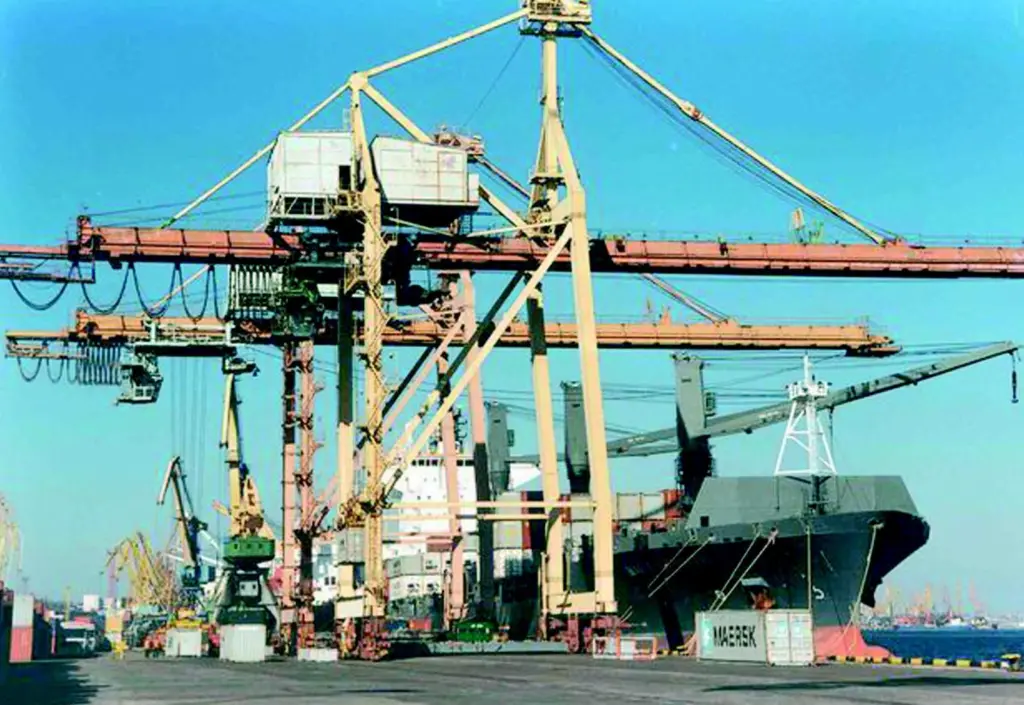
The battle for supremacy between the Ukrainian ports of Odessa and Illichivsk is hotting up. Illichivsk, the government’s preferred facility for container traffic, handled 291,127 teu last year, closely tailed by the 288,348 teu registered in Odessa, where a current lack of space continues to hamper smooth operations.
Despite this, in January-May 2006, throughput in Odessa rose by 42%, reaching 142,670 teu, while vessel calls increased by 21% to 253. Main growth has been in imports, which went up by 53% to 80,068 teu, representing 56% of all traffic handled by the terminal.
Furthermore, to enable future increases to be accommodated, the Odessa port authority is to go ahead with a project to build a brand new 1m teu terminal on 360,000 sq m of reclaimed land as an extension of the Quarantine Mole. A two-berth facility is projected, consisting of a 600m long quay with alongside draught of 14m.
Odessa Commercial Seaport estimates the total cost of the project as being $430m, although preliminary investment will amount to around $252.2m.
Once operational, this new terminal could tip the balance of trade in favour of Odessa, whose hourly berth productivity on feeder vessels of 28 moves is already seven moves better than that achieved at Illichivsk, where handling conditions are more favourable. In part, this is due to the introduction on July 1, 2001 of a private sector operating company, HPC Ukraina (a subsidiary of Hamburg Port Consulting), to take over management of the existing Odessa Container Terminal.
Shipping agents in the region note that HPC Ukraina’s new IT system has effectively made Odessa a much more attractive option in terms of reduced paperwork.
Meanwhile, at Illichivsk, the system remains much as it was during the Soviet era, with shipping lines having to supply multiple copies of documents and have everything rubber stamped in order to do business.
This insistence on large amount of documentation effectively prevents shipping companies from undertaking even modest amounts of transhipment traffic in Illichivsk, because it is impossible to guarantee quick turnarounds, which are sometimes required if boxes need to be switched between services because of delays.
However, Illichivsk has no intention of surrendering the initiative to Odessa, having announced ambitious plans of its own to expand existing facilities. Berths 1 and 2 are to be rebuilt to handle 350,000 teu containers annually, with draught being deepened from 13m to 15m.
Berths 3 and 4 are to undergo similar treatment, with additional stacking areas to be created which will link up with those already serving berths 5 and 6. This new area, which could handle 650,000 teu annually, is aimed directly at attracting transhipment traffic, with a new IT system planned to overcome current paperwork difficulties.
Bizarrely, while just 30km separates the two ports, most shipping lines have to call at both. Interestingly, Maersk, which at one point decided to concentrate all traffic at Illichivsk, was forced to resume calls at Odessa in 2005. Shipping agents explain that certain commodities are associated with one port and not the other, hence the strange call pattern.
Finally, despite the Ukrainian government’s insistence that it is doing everything to tempt Russia to push as much transit container traffic through Odessa and Illichivsk as possible, sufficiently attractive freight rates are not yet available on the rail network, while bureaucracy remains as impenetrable as ever. As a result, both ports continue to see a year-on-year reduction in traffic from surrounding countries, with Russia using alternative outlets such as St Petersburg or Novorossiysk.
Related Articles
 PORT & TERMINAL NEWS
 EXPANSION & DEVELOPMENT
 PORT & TERMINAL NEWS