![PortStrategy[GreenPort]](https://www.portstrategy.com/wp-content/uploads/2026/09/PortStrategyGreenPort.svg)



Getting more remote
As container ships have become larger, so the number of remotely operated ship to shore (STS) cranes has increased.
Sector analysis: STS remote operation advances
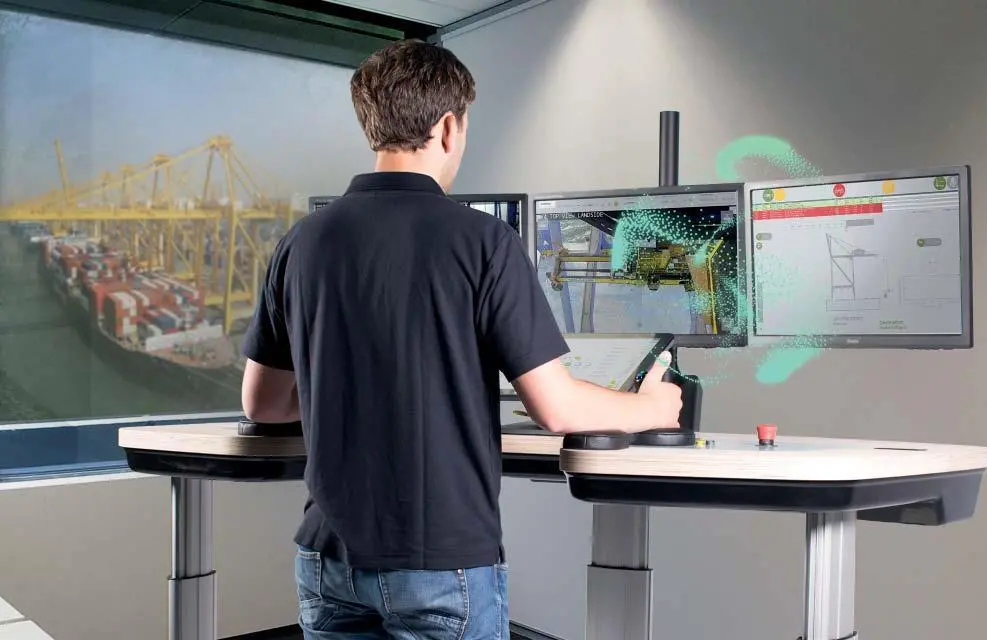
Alongside increased pressure on terminals to handle cargo more efficiently, bigger ships have led to visibility challenges for crane operators, as on larger cranes the ability of the human eye is limited by the distance between the cabin and target. Remote operations combat this issue as operators are moved to a central control room and have extended visibility with multiple camera views. In 2015, APM Terminals’ Maasvlakte II Rotterdam became the first container terminal to use STS cranes with no driver’s cabins installed. Since then, there has been a steady adoption of remotely operated STS cranes, as part of a wider action to automate complete terminals.
Fredrik Johanson, Head of Marketing and Sales, ABB Ports, points out: “Today, we see an increasing interest in remote operation and more and more terminals are implementing remote STS cranes, in smaller terminals as well as in mega hubs. Remote operation puts people in focus, offering an improved work environment that also opens up inclusion and diversification of the workforce. At the same time, it has a positive impact on reliability and productivity of terminal operations.” The below company by company review of organisations active in the supply of remote-control systems for STS cranes highlights the growing interest and activity in the sector.
Design innovation, projects, state-of-the-art thinking
ABB: ABB has been developing crane automation solutions for decades and considers itself a “pioneer” in remote operations for container handling. Its STS crane automation solution enables a fully automatic cycle between the quay and the ship, and its remote-control solution sees operators located in a control room whereby they supervise the crane motion via onboard cameras and a remote-control station. ABB highlights how remotely controlled STS operations can be developed even further. Its QuayPro application means that a remote operator can see all work queues and orders and can, for instance, bypass a certain cell if the container cannot be discharged to ensure uninterrupted operation. The company notes:
“Through QuayPro, information showing changes made by the crane operator is also instantly visible to the rest of the team. The remote checker can start solving the issue and the operator continues discharging.”
Recent take-up: ABB supplied its automation and remote operations technology to two of the “world’s biggest” quay cranes at Hutchison Ports’ Stockholm Norvik Port. Andy Lewis, Head of Operations, Engineering and Automation at Hutchison Ports Stockholm, notes: “With the assistance crane operators get from automation, we are able to achieve both operational stability and consistency, which makes operations more predictable.”
Cavotec: Cavotec supplies a range of radio remote control (RRC) technologies and human operator interface (HOI) systems for applications including STS cranes. Its RRC technology has boosted the remote operations of ZPMC cranes in the automated terminals in Tangier, Morocco, and Qingdao and Yangshen in China. Cavotec explains that while these STS cranes are operated remotely from a control room, during commissioning and maintenance operators are required to control cranes on-site, exposing them to potentially hazardous situations. As a consequence, operators needed a remote-control device. Therefore, Cavotec engineered and supplied 29 RRC units that are installed on the cranes at the three terminals. The transmitter and receiver units enable operators to control cranes from a safe distance during ommissioning and maintenance operations.
Kaleris: The Navis N4 terminal operating system from Kaleris, a solution specifically designed for large, high-volume container terminals, serves as a core technology for managing automated STS crane work. Floris Vernooj, Director of Product Management, TOS at Kaleris, says: “In addition to the physical execution of STS crane movements, which may be fully automated or handled by a remote driver in an office or on the crane, N4 also provides the required data input for STS automation, which is key to this type of operations.” Some of Navis’ latest developments in STS automation include STS berth planning. This function determines which STS crane works on what vessel and bay, or part of the vessel. N4 helps the terminal optimise its operations by taking into account a number of factors to determine which STS cranes should work on each vessel. Before a vessel arrives, N4 has already determined the best work split per bay for each crane. Another development is worklist planning: N4 determines the full list of each container to be loaded and unloaded from a vessel, the order in which this happens, and which STS does the work. N4 integrates with Optical Character Recognition systems and automatic STS crane systems to make sure the right containers are loaded/unloaded.
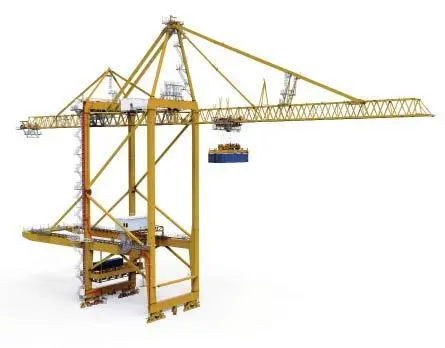
Liebherr: Liebherr Container Cranes has developed its own automated and remote-control systems for STS cranes. It launched its Remote Operator Station (ROS) in 2019, which it says has been ergonomically designed and fitted with multiple displays, allowing the operator to perform all normal driving functions from a remote office environment. Liebherr points out the benefits: “The move to automation with remote control brings operational benefits, with a single ROS operator being able to operate several cranes simultaneously. Additional benefits include faster and easier shift changes, and a more attractive work environment for employees.”
Recent take-up: Eurogate Container Terminal Wilhelmshaven (CTW) placed an order for two dual trolley STS cranes in January 2023 – the first order of its type for Liebherr. The automated cranes increase productivity by decoupling the land and sea side cycles of vessel handling. The cabinless cranes, which deploy Liebherr’s remote operating stations, have a primary outreach of 73m, a lift height of 54.5m, a span of 30.48m and operational back reach with secondary trolley of 26m. Designed for tandem operation, the primary trolley delivers containers automatically to the pinning platform. The containers rest on frames whilst the twistlocks are removed. Once the pinning personnel leave the platform, the secondary trolley is activated, which automatically delivers the container to the landside AGVs. The cranes – the first double trolley container cranes at CTW – will play a key role in the expansion and modernisation of the facility as Eurogate turns it into an automated terminal “geared for the future”.
Siemens: The growth in vessel size and the need to provide a solution which maintains cargo handling efficiency was the driver behind Siemens’ development of its Simocrane Remote Control Operation System (RCOS). The Remote Control Station can be situated anywhere on the terminal when associated with a reliable and low latency network connection. The system is supported by strategically positioned cameras and smart screens that automatically change the view to follow the process as the operator performs a movement. Siemens released an updated version – Remote Control Solution Version 6.1 – at the end of May. New features include a universal camera interface based on the Onvif protocol. A second feature is the integration of video-wall functionality.
Both functionalities are based on the WinCC OA video. Siemens says: “The Onvif feature plays a very important role within the unique agnostic remote-control concept which can connect to different crane types of different crane builders and control them remotely.” In combination with the new release, Siemens has launched a training desk (based on a digital twin) to train remote operators.
ZPMC: As one of the world’s leading manufacturers of STS cranes, Shanghai Zhenhua Heavy Industries Company (ZPMC) has been increasingly focused on automated and ‘smart’ container handling operations. It established ZPMC Smart Solutions for this purpose, which has developed a terminal operating system (TOS) that includes smart STS cranes. It has inked an MoU with APM Terminals to jointly develop automated solutions. The MoU includes an order for 18 STS cranes for six terminals, along with the reservation of production slots for an extra 25 STS cranes in the coming years. The cranes will be operated remotely from a control room.
Recent take-up: ZPMC delivered five semi-automatic STS cranes in 2022 to Ashdod Port in Israel as part of an aim to reduce congestion and boost competitiveness. The contract is valued at NIS 208 million (€58.2 million). The cranes can work with ultra large container ships of up to 24,000TEU capacity and their camera and laser systems allow for remote control, while a TOS system facilitates semi-automatic operations.
Related Articles
 CONTAINER & CARGO HANDLING
 CONTAINER & CARGO HANDLING
 EQUIPMENT