![PortStrategy[GreenPort]](https://www.portstrategy.com/wp-content/uploads/2026/09/PortStrategyGreenPort.svg)

A call to action
With its reputation as a forerunner in environmental stewardship, what better host for the 2021 GreenPort Cruise and Congress than the Greek Port of Piraeus.
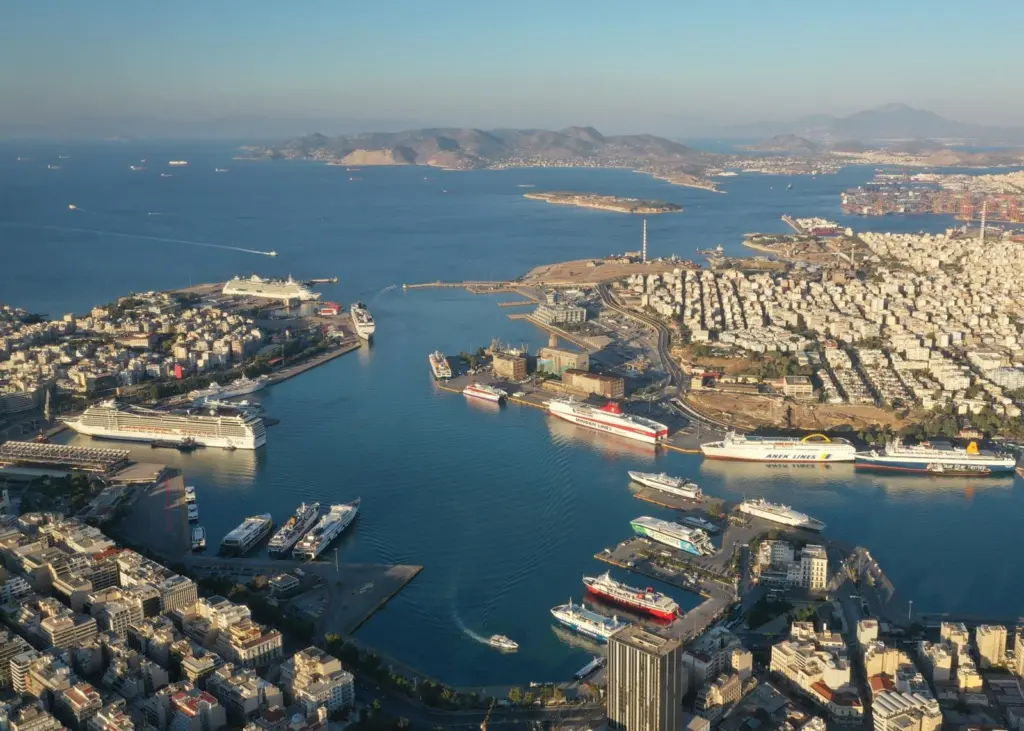
In this article, GreenPort sits down for a Q&A with Mr, Yu Zeng Gang, Chairman of the Piraeus Port Authority (PPA) BoD.
Q Why do you think Piraeus was the right choice to hold the conference this year?
Greece has traditionally played a leading role in the global shipping industry with the Port of Piraeus, the biggest port in the country, being at its very core. Over the course of recent years, the port has experienced remarkable growth, uplifting the country’s role in the global sea transportation, tourism and trade.
The Port of Piraeus large scale expansion plan continues at a fast pace. By hosting this year’s GreenPort Cruise & Congress we want to showcase the importance of linking growth with environmental sustainability and green development. That is why, alongside our expansion projects, we have set our sustainability goals around six key areas, water, air, energy, noise, waste management and digitisation/innovation.
Protection and preservation are concepts inherent to our development and sustainability strategy and we thus take all necessary preventive and remedial measures required by legislation. We in fact go beyond these requirements acting as a role model in green innovation and environmental performance for the whole Mediterranean port industry.
Q In terms of your own environmental objectives what are you striving for in the short and longer term?
On a long-term basis, we want to ensure a balance between environmental, social, and economic development, enabling an efficient dialogue between the port and the city and the communities it serves.
Facilitating the greening of Piraeus Port is central to these interrelated objectives and a pre-requisite for a sustainable future. We are embracing Europe’s ambition to be the world’s first net zero emission area by 2050 and take a strategic role in making the European Green Deal happen.
Today, we have an integrated energy management system in place involving the use of a photovoltaic power plant leading to major reductions and savings of greenhouse gas emissions and delivering significant benefits to society, the energy market and the natural environment.
Alongside a large scale planted roof enabling a microclimatic upgrade, several programs are already in place aiming to make us a first reference for go to environmental initiatives and best practices in the port industry.
More specifically, we have developed and applied an integrated pollution prevention and control plan monitoring the atmospheric environment and the quality of the seawater, the marine sediment and the acoustic environment on a 24-hour basis. In addition, we have installed atmospheric and fixed noise measurement stations, as well as created an integrated waste management system involving both land facilities and ship-generated waste.
Several certifications, memberships and international alliances, such as our EcoPort PERS (Port Environmental Review System) certified status, ensure that we keep track of our environmental goals, while increasing the impact of our actions.
Q Can you give us an overview of your involvement in the Poseidon Med II project?
Since the start of the Poseidon Med II project, which aims to introduce LNG as the main fuel for the shipping industry, we have organised 31 events, attracting more than 2080 stakeholders and presented the project at 114 conferences.
Both the site planning and the master plans for all respective ports have been updated and the necessary approvals have been obtained, including the approval of the addendum to the Master Plan of the Port of Piraeus by the Greek Ministry of Maritime Affairs and Insular Policy in February 2020.
In addition, Geophysical and Bathymetric studies for the Port of Piraeus were completed in December 2018, alongside the Preliminary Engineering Design of the pipelines installation in all ports completed in 2020.
We’ve also conducted a Cost Benefit Analysis which we update constantly in compliance with the detailed engineering designs and any new market data.
It is noteworthy that PMII has strongly contributed to the working team assigned by the Greek Ministry of Shipping and Islands Policy for the drafting of the Presidential Decree (PD) on safe LNG Bunkering operations (PD 64/2019), a major milestone for the national regulatory framework.
The PD is the umbrella legislation considering all national and international rules and practices, while containing a set of provisions and minimum criteria, such as safety & emergency procedures, simultaneous operations, fire-fighting measurements, manuals overview for LNG bunkering preparation & execution, training and other pillars, all enabling Greek ports to accommodate LNG bunkering operations.
Q What projects are next for Piraeus?
The effort towards a Green Port is an ongoing process and despite the immense work already done towards this direction, new projects are in the pipeline.
For example, CIPORTS which focuses on the preparation of the required studies for the electrification of the ships in the Port of Piraeus for cruise.
These studies include technical studies of cold ironing installations for the berthed ships, environmental studies, a traffic study, Economic Structure and Pricing and an overall cost-benefit analysis of the project.
We are also working on the ARSINOE project which develops the methodological framework for the combination of System Innovation Approach (SIA) with the Climate Innovation Window (CIW) in order to create, based on a three-tier approach, an ecosystem for climate change adaptation solutions.
Q What advice could you give to other ports in terms of their environmental strategy?
A port’s environmental strategy needs a holistic approach based on a future proof strategy framework. It is an ongoing process requiring investments and embracing change as the new constant. Moreover, it needs dedication and a clear alignment of environmental sustainability goals with business objectives, culture and principles. It needs to be embedded across the organisation as a shared value at all levels, cultivating a common ground for all company stakeholders.
Q What messages are you looking to deliver to the industry at the GreenPort Congress?
Our main message will be that environmental protection, social and economic growth go hand in hand. Prioritising the environment ensures long-term success versus short-term economic gains and it can create competitive advantage and deliver greater shareholder value. To make this happen, it needs structural reforms, investments, redefining of business models, strategy alignment, a clear roadmap and constant monitoring of performance based on specific key performance indicators, alongside close collaboration with all stakeholders, the port, policy makers, authorities, industry representatives and local communities.
Q Why is it so important in your opinion to attend the event?
The GreenPort Cruise & Congress is a must-attend event for everyone in the maritime ecosystem. With a strong speaker line-up, covering a wide range of topics the Congress is sure to facilitate connections and valuable knowledge transfer. The attendants will not only learn the latest developments and innovations in the Eco Port space, but moreover, they will have the chance to meet in person with thought leaders and industry executives and learn best practices and how they can tackle relevant challenges. The role of seaports is central in ensuring resilience to climate change. The GreenPort Cruise & Congress is the perfect platform for creating alignment and inspiration. Now more than ever action is required.
Green projects underway at Piraeus (BOX OUT AT BOTTOM PLEASE)
POSEIDON MED is the first Cross European Border project which aims to develop a sufficient LNG infrastructure network and bunkering value chain. It focuses on the eastern Mediterranean region with five Member States (Cyprus, Greece, Italy, Croatia and Slovenia) involved.
PIXEL aims to enable a two-way collaboration of ports, multimodal transport agents and cities for optimal use of internal and external resources, sustainable economic growth and environmental impact mitigation, creating ‘Ports of the Future’.
GREEN C PORT aims at improving the environmental sustainability of ports and the performance of port operations in the TEN-T Core Network. The project addresses six business cases consisting of prototypes and pilot tests that are implemented in different European ports (Valencia, Venice, Piraeus, Wilhelmshaven and Bremerhaven) and that will serve as a basis to test innovative technologies such as IoT, big data or predictive analysis using artificial intelligence models.
In the context of the European Green Deal, the EALING Motorways of the Sea Action contributes to the Global Project aiming to accelerate the transition to electrification and deployment of Onshore Power Supply (OPS) solutions by 2025 in at least 16 EU maritime ports belonging to three different sea basins: The Mediterranean, Atlantic and Black Sea.SUPER-LNG
SUPER LNG is aimed at providing a uniform framework to support the implementation of technical systems for the distribution and supply of LNG in port areas, meeting the requirements of the Seveso Directive (Directive 2012/18/EU).
Related Articles
 GREENPORT CONGRESS
 GREENPORT CONGRESS GREENPORT
 GREENPORT CONGRESS GREENPORT