



ICTSI RIO RENAISSANCE
Pursuing new cargo streams and investing in inland cargo logistics is breathing new life into ICTSI Rio despite a challenging marketplace. Rob Ward reports
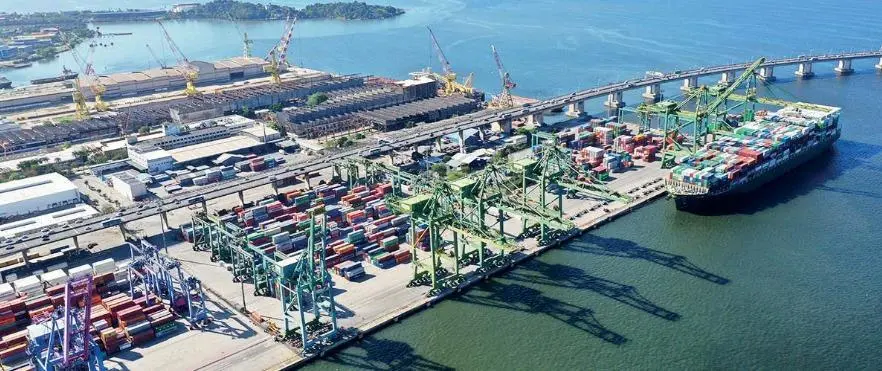
From close to zero five years ago, ICTSI Rio now handles around 35 to 40 per cent of the break bulk volumes passing through the port of Rio de Janeiro, with rival MultiRio still handling the majority share. And thanks to that re-alignment in its cargo mix and improved fi nancial management, ICTSI Rio posted a revenue improvement of 25 per cent in 2021 when compared to 2020.
The decent financial result was despite container volumes falling in recent years, from a peak of 240,000TEU back in 2013, to just 160,000TEU in 2021, when the UCLA service of Maersk and MSC (to the US Gulf) transferred over to neighbouring MultiRio, where MSC participates in the shareholding structure.
This trend of box terminals diversifying to alternative cargoes – such as break-bulk, cellulose and ro-ro – has been a common thread in Brazil in recent years as facilities, such as Ecoporto and DP World in Santos, as well as ICTSI Rio endeavour to counter the “Verticalisation” manoeuvres of the major carriers. Notably in the latter respect, Maersk and MSC with their BTP joint venture in Santos, Maersk (APMTerminals) in Itajai and Pecem, and MSC in Portonave/Itajai and Rio.
“Despite the Covid situation and losing one of our main Services [the UCLA service of Maersk and MSC] 2021 was not bad year from our perspective,” says Roberto Lopes, CEO, ICTSI Rio 1: “We lost container volume in 2021 – down to 160,000TEU for the year from 181,000TEU in 2020 – but we made significant progress in terms of break-bulk cargoes.
“On top of that we brought down costs, improved our pricing structure and began attracting more breakbulk operations. We have improved our mix of cargoes and widened our portfolio, to include even more project cargoes.
“Since 2017 when I came back here [when it was Libra Rio, prior to the ICTSI buyout] we have been chasing the breakbulk market and our first call came in 2018.”

CALL PATTERN
“In 2021,” elaborates Lopes, “we handled 12 calls for breakbulk, all lift-on lift-off and no ro-ro, and it’s improving again so far this year and our forecast for 2022 is now for at least 15 vessels, so that would be another 25 per cent increase. Today MultiRio has between 60 and 65 per cent of breakbulk but they used to be close to 100 per cent.”
Among the regular calls at ICTSI Rio 1 are breakbulk perennials BBC Chartering and Intermarine and “we sometimes have tramp vessels calling, often bringing in fertilisers from Russia”, adds Lopes, who has also worked for Libra in Santos for long periods and had a spell with LogZ (who set up Porto Itapoa in Santa Catarina, the 500,000TEU per annum facility in which Maersk has a sizeable share) from 2013 to 17, during a long career in the Brazilian port sector.
In terms of breakbulk cargoes, equipment for Rio de Janeiro’s once again flourishing oil and gas industry (especially since the Russian war in Ukraine broke out) tops the list. Additionally, however, ICTSI Rio also handles large structures for industrial installations, including car manufacturers, such as Nissan and Fiat.
When it comes to containerised cargo, as indicated above, ICTSI Rio has been particularly challenged by its rival, MultiRio, owing to the latter’s very close relationship and “Special Agreement” with TIL that is the terminal arm of global carrier MSC and its “Verticalization” strategies in Brazil. White Flag (neutral) operators in Brazil feel they are losing out to the so-called “Verticalists” who direct cargo to their own facilities.
Regular calls at ICTSI Rio are: Tango (to USEC) with Hamburg Sud/Maersk and Hapag Lloyd; ESA 1 (to Asia) with CMA CGM, Evergreen, Yang Ming and Cosco; Abac/Conosur (ECSA to WCSA) with Hamburg Sud/Maersk and Hapag Lloyd; Brazex (to US Gulf and Caribbean) of CMA CGM and Cosco as well as several Brazilian coastal and shuttle services.
ICTSI, with its HQ in the Philippines, took over in Rio from Libra Terminais (which had long-standing financial problems mostly caused by its operations in Santos at Terminals 35 and 37), in July 2019 for US$195.4m. Libra had already renewed its 25 plus 25-year concession in 2011, so it now runs until 2048. Part of that extended concession commitment involves building a Reais130m 85m extension to the current pier which “should be ready by December 2023,” notes Lopes.
“Today, with four SSGs and 16 RTGs (of which 12 are electric), we have a capacity of between 580,000 to 600,000TEU per annum,” he explains, “but as we are currently operating at less than 30 per cent capacity it could take a few years to get near that. If we do attract a Far East service, which we are working on, and possibly others, then we will reconsider ordering more equipment.”
IMPROVED CONNECTIVITY
Just before Lopes came back for his second stint at the Rio Libra/ICTSI terminal, Rio de Janeiro hosted the Rio Olympic Games (2016) and several games of the Brazilian World Cup (2014). One “major legacy for the City of Rio from the Olympic games” is the new access road into the port of Rio de Janeiro, and also a “much improved” road connection from the port to the major highway, the Dutra, linking the city to Sao Paulo, which finally fully opened last year.
“By truck from ICTSI Rio it used to take two hours to the Dutra freeway but now it is only 30 minutes,” enthuses Lopes, “and that is a massive improvement for all our logistics companies.”
The Dutra is around 20km away and 4km in that direction is a rapidly growing logistics area, just northwest of the ICTSI Caju site. Here ICTSI Rio is setting up a base for its new logistics company IRB Logistica (ICTSI Rio Brasil).
“We are working now to improve our logistics options outside the port and so we are developing a facility in the logistics park, along with a number of other companies,” Lopes advises. He adds that ICTSI Rio “will buy at least 40 trucks this year” for IRB, from VW, which has a manufacturing base in Resende (Rio state). A truck now takes only two hours to Resende (instead of three and a half) and five to Belo Horizonte (it was six and a half).
There is also expansion on the railroad side, with the long-term lease of Floriano Intermodal Terminal, in Barra Mansa, an industrial cluster around 150km from the port of Rio. IRB Logistica will operate the facility which is offering “cargo handling, transport and storage services to the economic, industrial and production centres in Rio, Minas Gerais [including Belo Horizonte] and Sao Paulo”, asserts Lopes.
Related Articles
 OPERATIONS
 OPERATIONS
 OPERATIONS