![PortStrategy[GreenPort]](https://www.portstrategy.com/wp-content/uploads/2026/09/PortStrategyGreenPort.svg)



Laying the groundwork for post-pandemic port business
Anne-Marie Causer talks to Patrick Verhoeven, managing director, International Association of Ports and Harbors (IAPH) to find out where business is headed post-pandemic
What are the current situations/challenges being faced by your members since the onset of the Covid-19 pandemic?
When Covid-19 started to spread beyond Asia, it soon became apparent that contagion would impact cargo supply chains as well as passenger movements by air, sea and land. Shortly after the lockdowns in Europe were declared, we put together a closely-knit group of fifteen port specialists from nine different members as well as inviting experts in trade facilitation and port economists in order to ask that same question.
The answer really fell into three broad categories, with a fourth added as the contagion gradually spread across the world. The most urgent focus on immediate measures to address port operations, governance and communication, where we called upon experience of some of our Asian colleagues who were ahead of the curve. Secondly, we simultaneously looked at measures to protect the business and financial returns as well as measures to support customers, stakeholders and community. When the first members began returning back to relatively normal operations as Covid-19 cases diminished, we put together guidance on back to work planning, which was based on experience already acquired both inside and outside the port industry.
The summary of this work led to the publication by our WPSP Covid-19 Task Force of the WPSP COVID-19 Guidance Document for Ports, which is readily available on our dedicated World Ports Covid-1919 Information Portal.
Are there any positives coming out of the requirements to find new ways of working?
I think that as a start, the online work and collaboration between our WPSP Covid-19 Task Force members was phenomenal. Via weekly and then bi-weekly video conference meetings, we were able to build up a pretty accurate picture of what was happening on the ground at ports around the world and what they needed in terms of support. We could rapidly consult ports in several regions for their input and could call in experts from organizations such as the World Bank to deal with specific issues.
Similarly the three coronavirus webinars we co-organised on “Business Unusual”, the Ship-to-Shore Interface and Digitalisation were highly successful, not just in terms of content and attendees, but also in terms of audience engagement with questions, remarks and feedback.
Since the pandemic, have ports been reporting dramatic decreases in emissions?
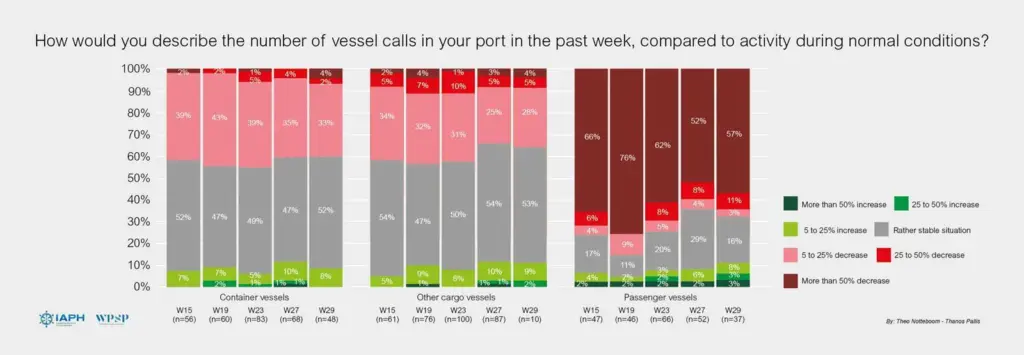
This question has not been one we have included in our eleven global port surveys for the WPSP Covid-19 Port Economic Impact Barometer. We did however ask ports eleven times on how they were faring with the number of vessel calls over the past week, compared to activity during normal conditions. So far, reports suggest that the levels of reduced vessel calls remain relatively high, so we can conclude that emissions have by and large decreased, with variations according to port size, vessel call type and location. In addition, ports with industrial facilities reported a downturn in activities accompanied by a significant increase in demand for storage, especially of liquid bulk and chemicals. This was confirmed by answers by ports to the survey question about the week’s situation in terms of capacity utilisation, including warehousing and distribution activities in the port. We should also not forget the impact of reduced truck activity in and around ports, especially during lockdown periods.
Have decarbonisation efforts largely been set aside during the coronavirus crisis or have they been embraced?
I certainly would not say they have been set aside. In fact our work alongside organisations such as the International Chamber of Shipping and other vital port industry players to accelerate decarbonisation have gathered pace. The recent IAPH-led initiative to call to action to accelerate pace of digitalisation to cope with a post Covid-19 “new normal” is one such example. One of the major positive consequences of digitalisation is potential for open data sharing of “single truths” about anything from current port drafts to barge availability to estimated cargo loading time at berth. The practical use of common shared data using the same data sets and standards has, for example, the potential to simplify the highly complex choreography between the different players involved in the port call process. Improving that reduces waste, optimises vessel speed and energy use with the potential to reduce emissions. Reducing paper-based transactions, especially at the ship-to-shore interface will be vital in reducing the nervousness of port workers and crews at berth. Digitalisation is not just about efficiency and emissions reductions anymore; it’s becoming a critical safety issue.
How are ports laying the groundwork for post-pandemic business?
As mentioned, we have worked very closely to put together guidance on back to work planning. Also of vital importance is assessing present and future financial risks, with mitigation actions worked out on the basis of the differing business model scenarios.
In addition, quite a bit of work has been done on interaction between ship and shore-based personnel. IAPH has been cooperating with an initiative led by the International Chamber of Shipping (ICS) on Covid-19 related guidelines for ensuring a safe shipboard interface between ship and shore-based personnel.
Then there is the issue of crew changes, a subject we have also reporting on in our past two WPSP-IAPH COVID19 Economic Impact Barometer reports. IAPH has participated in the formulation of a 12-step framework of protocols on crew changes compiled by ICS in coordination with the maritime industry and supported and published by the IMO. The IMO are formally distributing the circular to member states as a recommendation.
In addition, several of our ports are actively addressing the impact of Covid-19 on their local communities and society at large, in line with their corporate social responsibility programmes. This includes engaging on sourcing, distributing and donating medical supplies and products for fighting Covid-19 to health agencies and local authorities. Other initiatives include supporting local producers in finding alternative ways to sell their products, or partnering up with NGO’s to provide social support and infrastructure for health care and education programs to mitigate the spread of the virus. Some of our members have even been engaged in mass testing of the port communities.
What are the main opportunities ports are being presented with to reinvent the way they do business?
I think the clue lies in the latter part of the answer on how ports are laying groundwork for the post-pandemic business. Port community needs are changing. This is not just about digitalisation and collaboration, but also about long-term risk mitigation and business resilience. In that respect I believe that port authorities need to consider a wider role in the business and communities they serve, well beyond the traditional landlord model and involving a much closer integration between nautical and physical supply chains for cargo and passengers alike.
How can technology (especially green technology) be accelerated to adapt to this new world?
In our World Ports Sustainability Program, we have collated over 120 examples of innovation, some of which deploy green, state-of-the-art technology, and others which address head-on issues of port governance, resilient infrastructure, safety and security, some without technology. It is this integrated approach that will yield positive results rather than just focusing on issues in isolation such as alternative fuel provision, on shore power and electrification of materials handling equipment. We need to join the dots together to get technology to work for ports to achieve a sustainable future and not focus on technology per se.
How can small ports play a role in digital transformation and in the greening of the supply chains?
Whilst that is easier said than done, I have already seen encouraging examples from our member ports, both large and small, who are leading the way forward in terms of connecting innovative start-ups with port communities. Recent efforts by organisations such as PortXL, the Maritime Port Authority of Singapore’s Smart Port Challenge and the Port of San Diego’s Blue Economy Incubator Program are fine examples of this. Small ports have already been used for trialing PortXL pilots, such as the wave energy pilot at the Port of Gibraltar. The Port of Helsinki is pushing ahead with its plans for onshore power supply and automated mooring. The Port of Barcelona is also promoting innovation and Smart Ports via its digital knowledge hub. This are just a few of many examples we have come across.
Will the path ahead be greener in a post pandemic world?
I think this greener path is inevitable. It will have to be in order to meet the IMO target of reducing the total annual GHG emissions by at least 50% by 2050 compared to 2008, while, at the same time, pursuing efforts towards phasing them out entirely. For this reason IAPH intends to play its part in the adoption of climate and energy-related initiatives at industry level, starting with its joint submission of an IMO Resolution initiated with the Canadian government and co-sponsored by several other Member States and NGOs. This resolution MEPC.323(74) invites Member States to encourage voluntary cooperation between the port and shipping sectors to contribute to reducing GHG emissions from ships. The Resolution promotes regulatory, technical, operational and economic actions in the port sector, such as the provision of onshore power supply (preferably from renewable sources); safe and efficient bunkering of alternative low-carbon and zero-carbon fuels; incentives promoting sustainable low-carbon and zero-carbon shipping and support for the optimisation of port calls including facilitation of just-in-time arrival of ships.
What will the main challenges be to adopting green tech on a wider scale, have these remained the same as prior to the pandemic or have they changed?
The main challenges remain, whether they boil down to investments in climate and energy solutions as well as resilient infrastructure, building business resilience, improving safety, removing waste and encouraging the facilitation of trade and passenger services at ports. One critical factor IAPH has identified in this conundrum is cyber security and adequate awareness and training for port communities in the secure use of green tech and technology as a whole to innovate, improve efficiency and safety at the world’s ports. For this reason we put together a team of experts from inside and outside the port industry to offer port authorities and operators a white paper on port community cyber security. This document takes a practical, pragmatic approach on a high level in order for ports to have a starting point from which to work on their own cyber security strategy and awareness programs. There are highly sophisticated approaches by some of the world’s largest ports. However becoming a “smart port” need not imply multi-million dollar investments. A lot of the advice in the paper points towards a step-by-step approach, taking port colleagues every one of those steps of the way.
The other is the wider adoption of port community systems (PCS). Only a fraction of IMO member states have operational PCS’s. Working on this priority requires collaboration between maritime supply chain industry stakeholders and government. Above all, it calls for inter-governmental collaboration as the acceleration of digitalisation will require change management at local, regional, and national levels. As mentioned, IAPH is heavily involved in kick-starting the process alongside ICS, IPCSA and other players to accelerate digitalisation and green technology.
Related Articles
 INSIGHT & OPINION GREENPORT
 INSIGHT & OPINION GREENPORT