![PortStrategy[GreenPort]](https://www.portstrategy.com/wp-content/uploads/2026/09/PortStrategyGreenPort.svg)


Box loss at sea: new rules
The problem of containers lost overboard at sea is one that according to statistics provided by the World Shipping Council (WSC) fluctuates from year to year.
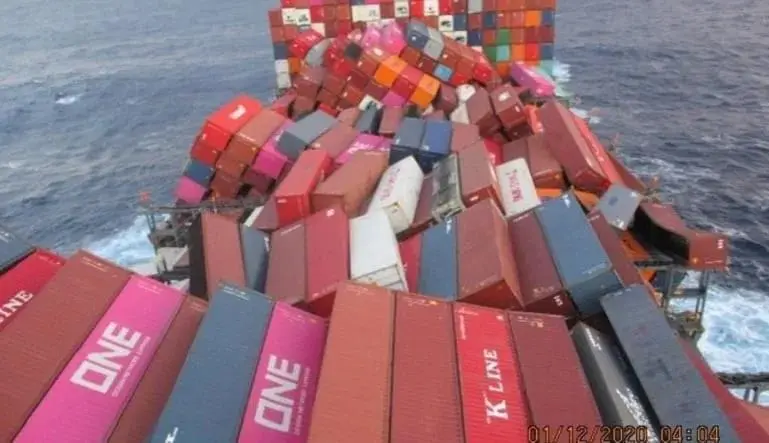
The WSC’s Containers Lost at Sea Report 2025 identifies 576 containers lost at sea in 2024 – a very low figure which, as the WSC points out, represents 0.0002% of the over 250 million containers transported. The WSC notes that the figure is higher than 2023 but well below the 10-year average of 1,274 containers per year. It also points out the 2024 total was arrived at against a background of trade route changes driving losses – notably a 191% increase in transits around the Cape of Good Hope in relation to which the South African Maritime Authority reported nearly 200 containers lost in this region, equivalent to 35% of the 2024 loss total.
Containers lost overboard tend to do one of two things: sink or float along just beneath the water’s surface.
The latter situation represents a danger to smaller vessels and particularly yachts or fishing vessels. In the case of a yacht, for example, they can be responsible for the loss of keel or other damage leading to a sinking. Similarly, incidents have been reported where overboard containers are cited as the cause or potential cause of damage to fishing vessels or the complete loss of the vessel.
In the case of both containers that sink and those that bob along just beneath the surface there is also the risk of environmental damage, the leaking of harmful substances and contributing to the already prolific problem of plastic pollution. Moreover, when containers sink they can crush coral reefs or locate on the ocean floor damaging fragile ecosystems.
Traditional methods of reducing the scale of the problem have largely focused on improving stowage arrangements – the strict application of the Cargo Securing Manual (CSM), ensuring accurate verified gross mass (VGM) and applying enhanced weather routing.
Marine insurer Gard additionally brings into focus as a cause of container loss overboard the often inherent complexity of lashing arrangements. It points out for example, “… a common cause of stack collapse is the failure to comply with limits for stack or tier weights or stack heights stipulated in the ship’s CSM. In some cases,” the company elaborates, “we have seen, the CSM itself has not catered for different stability conditions or the use of non-standard containers, such as high cubes.” And adds: “When a container ship is on charter, we have also seen communication breakdowns between the charterer’s container planners and the crew, even when using the same computer stowage planning programme. Charterers will naturally look to optimise stowage, but the crew may be reluctant to intervene and upset tight schedules.”
WHAT CAN BE DONE?
Reducing the scale of the problem remains highly dependent on following best practice for cargo stowage by all the parties involved in this right through from vessel design to day-to-day lashing arrangements. Doubtless going forward AI can play a positive role in this.
It is also notable that in terms of attempting to mitigate the damage of containers lost overboard January this year saw IMO amendments to SOLAS Chapter V (Safety of Navigation) making it mandatory for ship Masters to immediately report lost or observed drifting containers to nearby ships, coastal States, and the flag State. These new rules, updating regulations V/31 and V/32, apply to all ships carrying containers to enhance safety and tracking.
Further in this regard, there is already evidence of AI seeking to offer a helping hand. Late last year Eyesea and EVI Safety Technologies reported commencing the roll out of an artificial intelligence system“ designed to detect and report containers lost overboard using standard onboard cameras. Development and simulation had been carried out and the system is now proceeding to trials onboard operational vessels,
The system uses computer vision and machine learning, using onboard deck and bridge cameras to automatically identify and count containers either falling from a ship or observed adrift. Once detected, incident data can be immediately transmitted to registered vessel owners, flag states and – where appropriate – coastal authorities.
Related Articles
 CONTAINER & CARGO HANDLING
 INSIGHT & OPINION
 INSIGHT & OPINION