![PortStrategy[GreenPort]](https://www.portstrategy.com/wp-content/uploads/2026/09/PortStrategyGreenPort.svg)






WEAKENED CONFIDENCE
The influence of the Ukraine war on global economic conditions is seen as a signifi cant factor influencing the outlook for the multi-purpose vessel fleet. Felicity Landon reports
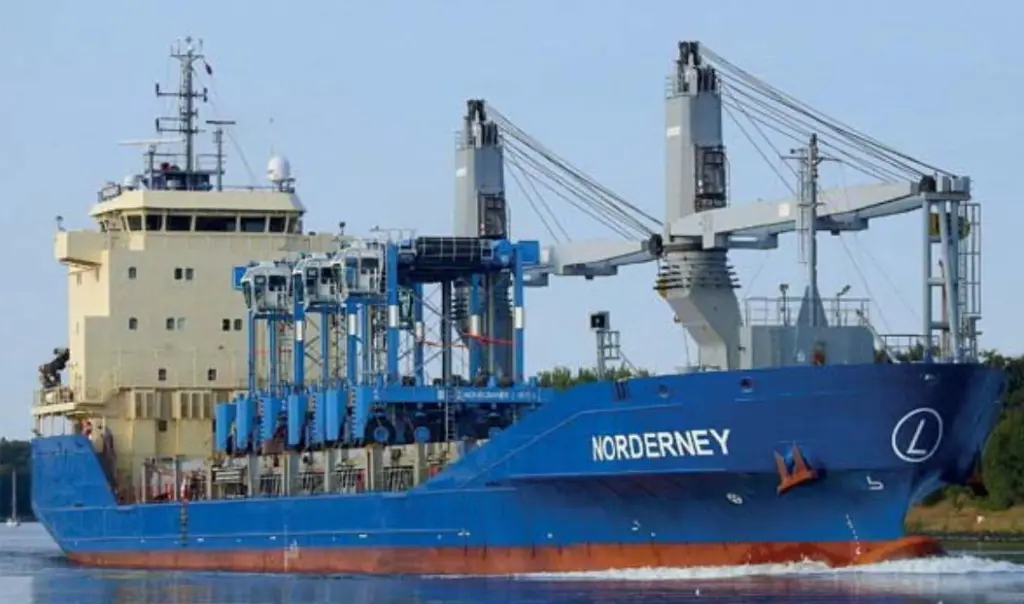
Russia’s invasion of Ukraine might not have an immediate, clear impact on multipurpose vessel (MPV) and heavy lift operations but there will be a fallout from reduced global economic confi dence, according to Drewry Shipping Consultants.
At a webinar to present Drewry’s MPV fleet and shipping outlook report, Susan Oatway, Senior Analyst, Multipurpose and Breakbulk Shipping, said a protracted conflict in Ukraine, along with harsher sanctions against Russia, will reduce economic confidence further and lead to an additional percentage point off global growth.
“We can see little, if any potential upside [in the MPV sector] at the moment,” she said. “In the shorter term, we expect rates to plateau in 2022. The market is waiting to see what will happen.”
Most MPVs are already booked for the next couple of months “and there is a bit of a hiatus about how global confidence will be, going forward”, said Oatway. “Yet the war in Ukraine has definitely weakened confidence and dented our demand forecast. That said, we do expect [MPV] rates to stay above pre-pandemic rates when they start to settle around 2023.
”Ukraine has “definitely usurped COVID-19” at the top of the list and market uncertainty is one of the biggest drivers of the sector’s outlook in the short to medium term, she said. However, COVID-19-related supply disruption and lockdowns are also underpinning short-term MPV demand.
Drewry’s multipurpose time charter index indicated that MPV rates fell 0.2 per cent from February to March, to US$11,170 per day. Over the year to March 2022, rates had leapt by 43 per cent and compared with March 2020 daily rates were up by 78 per cent.
“We expect this weakening trend to continue into April with the index dropping perhaps a further half a percent to $11,100 per day,” said Oatway.
At the end of 2021, she noted, Drewry had been ‘cautiously optimistic’ for the sector, until the events of the past three months.
“It is all to do with uncertainty in the global market – the conflict in Ukraine, new COVID-19 lockdowns in China … they have a multitude of ripple effects coming from them, with the biggest being the change in expectations for the global economy. We see little, if any, upside in our base case scenario.”
TRADE DEMAND AND…
Translating economic assumptions into trade demand, Oatway noted that global dry cargo (containers, bulk, general cargo including breakbulk and project) demand bounced back over 2021 with a growth of 4.5 per cent, and although that growth is expected to slow over the next two years, an average 3.5 per cent growth per year is likely for 2022 and 2023.
The MPV market share rebounded strongly last year with seven per cent growth – this is expected to slow to nearer four per cent growth in 2022 and 2.5 per cent in 2023 “as the supply chain issues start to unwind”.
“The MPV sector has benefited from that desperate search for space which has resulted in cargoes that were previously containerised moving back into MPVs; that effect is expected to weaken over the second half of 2022 and into 2023.
”Drewry used its market share analysis – including how much cargo could be carried by other sectors – to work out the effective demand for the MPV fleet.
…SUPPLY PICTURE
Turning her attention to supply, Oatway voiced her concern over the age of tonnage in the MPV fleet.
“Almost 60 per cent of the total MPV fleet is over 15 years old. For the simple MPV with lift capability up to only 100 tonnes, the average age is already 20 years. For project carriers/heavy lift capable vessels, it is nearer 16 years.”
In all MPV types there were bulges of newbuilding deliveries between 2007 and 2013, whereas there have been a “lack of any real delivery volumes over the last three to four years”, she said. This was particularly notable in the project carrier/heavy lift vessel category with 100-250 tonnes lift capability.
“This means that the current orderbook is comparable to less than four per cent of the operating fleet. Less than half a million DWT in total was added in 2021. This sector remains underfunded in terms of newbuilding, development and investment.”
Newbuilding slots are still at a premium as the yards are full of container ship tonnage, said Oatway. “Although the short-term outlook remains weak, we expect newbuildings to pick up marginally post-2023, when the space is available and the need for more eco-conscious vessels will probably become more pressing.”
Scrapping remained at rock bottom in 2021 – confined to smaller vessels, with no heavy lift capable vessels scrapped last year, she noted. “However, we do expect the numbers to rise after this year as the current charter market boom starts to weaken and as regulations around decarbonisation start to take effect.”
BROAD PERSPECTIVE
Considering the future outlook, Oatway said a ceasefire and Russian withdrawal from Ukraine could be an upside to improve the picture but was highly unlikely in the short term. “The downside is that a protracted conflict in Ukraine leads to harsher sanctions against Russia and reduced economic confidence.”
Increasing commodity prices means less investment for new projects, she said, while weaker demand would mean more competition for cargo and associated oversupply of tonnage in competing shipping sectors.
The competition for general cargo is expected to be back to pre-pandemic levels during 2023. Period charter rates are expected to peak in the first half of this year, before weakening in the second half 2022 and in 2023.
Related Articles
 INSIGHT & OPINION
 INSIGHT & OPINION
 PORT & TERMINAL NEWS